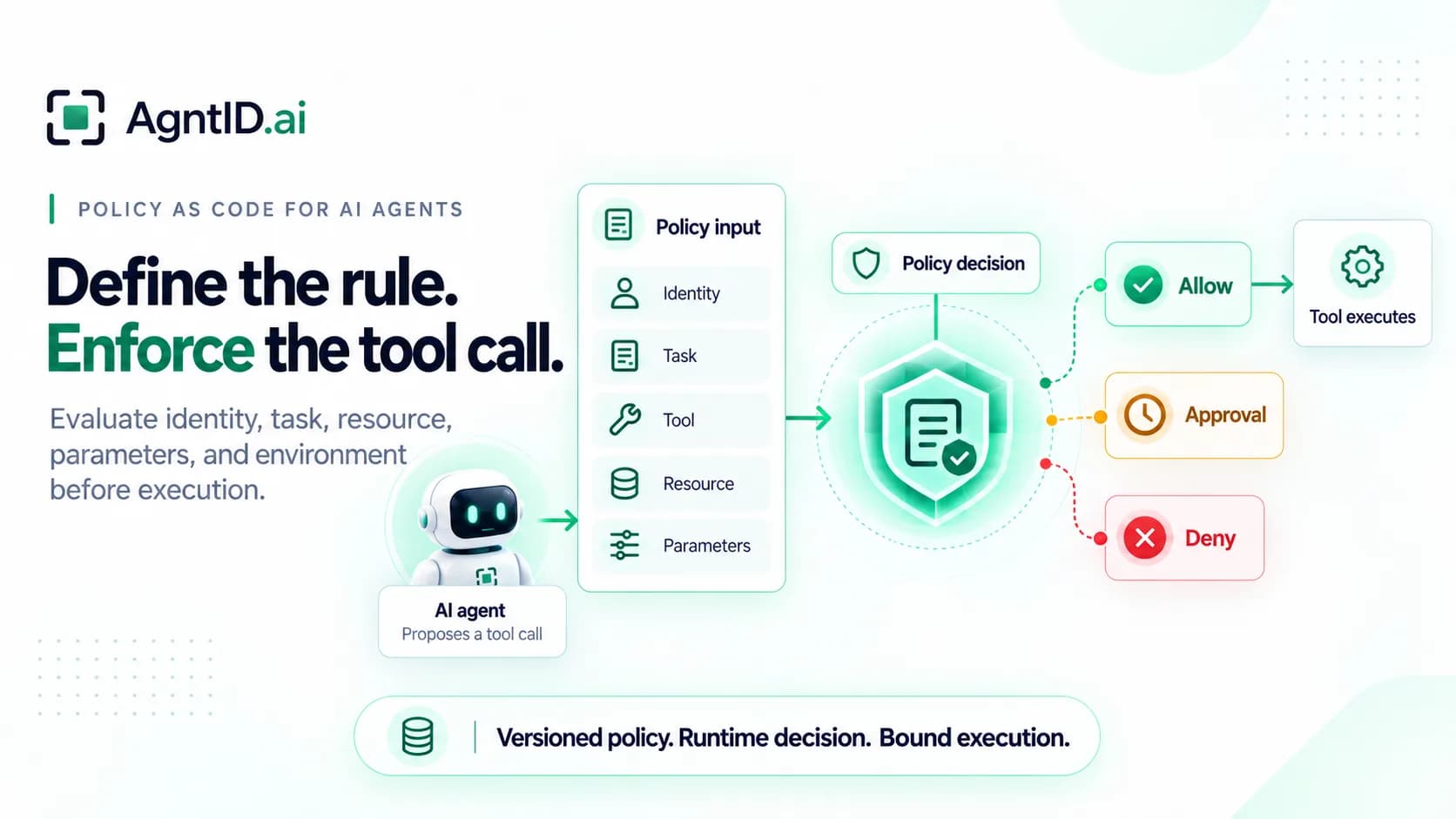
Policy as Code for AI Agents: How to Define and Enforce Agent Authorization Policies
A policy file does not stop an AI agent from taking an action. The policy becomes an enforceable control only when a system evaluates it against a proposed tool call and applies the decision before execution.
This distinction matters because agents select tools, resources, and parameters at runtime. A broad permission to access a system does not answer whether a specific action is allowed now. Policy as code defines the rule. Runtime authorization evaluates the request. A policy enforcement point applies the decision.
What is policy as code for AI agents?
Policy as code expresses authorization rules in a machine-readable language that teams can version, test, review, and deploy. A policy engine evaluates those rules against structured facts and returns a decision.
For an AI agent, the central authorization question is:
Can this agent, acting for this principal, perform this action on this resource with these parameters for this task under the current conditions?
That question is narrower than "Can the agent access the tool?" It includes the requested operation and its context. An agent may be allowed to read a production deployment but not change it. It may be allowed to roll back one service during an active incident but not deploy arbitrary code.
The model proposes an action. It does not grant itself authority. A trusted runtime must convert the proposal into a structured authorization request, evaluate policy, and apply the decision to the exact call that will run.
Why do AI agent policies need runtime context?
Roles and OAuth scopes remain useful boundaries. They can establish which systems an agent may reach and which broad operations a token can request. They usually do not describe the full conditions of an individual agent action.
A useful authorization request can include the following inputs:
| Input | What the policy evaluates | Example |
|---|---|---|
| Agent identity | Which workload is acting | ops-agent-prod |
| Requesting principal | The user or service represented by the agent | user:samira |
| Delegation | Audience, scope, and expiry of delegated authority | deployments:rollback |
| Task | The approved job and its lifetime | Roll back for INC-4821 |
| Tool | The selected server, function, and schema | deployments.rollback v3 |
| Action | The normalized operation | rollback |
| Resource | The exact target and environment | prod-eu/payments-api |
| Parameters | Arguments that change risk | Target revision and replica impact |
| Environment | Current operational facts | Active SEV-1 incident |
| Approval | Whether a reviewer approved this exact request | Approval ID and request hash |
These attributes must come from trusted sources. The runtime can verify the agent identity. An identity provider can supply user claims. A task service can attest to task scope. A resource catalog can classify the target. An incident system can report current status.
Do not let the model create trusted claims such as on_call: true or environment: production. The model can state intent, but policy should compare that intent with verified context. Use typed, bounded fields. Raw prompt text should never expand authority.
Task intent matters because the same identity and tool can require different decisions. Investigating an authentication failure may justify reading logs. It does not justify rotating a production secret. A separate task may justify that action when the named secret, approval, environment, and time limit also match.
Policy sets the maximum boundary. Task intent narrows what the current task justifies inside it. Intent cannot override a deny rule, create delegation, or prove its own claims.
What are the PDP and PEP in an agent authorization architecture?
The policy decision point, or PDP, evaluates the request and returns a decision. The policy enforcement point, or PEP, intercepts the proposed action and applies that decision.
User or upstream service
        ↓
AI agent proposes a tool call
        ↓
Policy enforcement point (PEP)
Intercept + validate + normalize
        ↓
Policy decision point (PDP)
Evaluate identity + task + tool + action
+ resource + parameters + environment
        ↓
        ├── Deny
        │     ↓
        │   Stop and record
        │
        ├── Approval required
        │     ↓
        │   Hold the exact request for review
        │
        └── Allow + obligations
              ↓
        Apply scope and constraints
              ↓
        Tool / API / MCP server executes
              ↓
        Record the decision and result
The PEP must sit on every path to the protected capability. A policy check inside an agent framework is insufficient if the agent can call the underlying API directly. Common enforcement locations include a tool gateway, an API proxy, an MCP server, or a wrapper around a sensitive SDK.
The PDP can run as a local library, sidecar, or remote service. The placement changes latency and availability behavior. It does not change the core contract: the PEP sends a normalized request, receives a structured decision, and enforces it before execution.
How should the authorization request be structured?
Treat the policy input as a versioned API. Define required fields, types, allowed values, maximum sizes, and trust sources. Reject malformed or unsupported input before evaluation.
{
  "schema_version": "agent-authz.v1",
  "request_id": "req_01K4Z7M8",
  "request_hash": "sha256:7b16c2a9",
  "agent": {
    "id": "ops-agent-prod",
    "owner": "platform-engineering",
    "roles": ["incident-responder"]
  },
  "user": {
    "id": "user:samira",
    "groups": ["payments-oncall"],
    "on_call": true
  },
  "delegation": {
    "subject": "user:samira",
    "audience": "kubernetes-prod",
    "scopes": ["deployments:rollback"],
    "expires_at": "2026-09-22T04:20:00Z"
  },
  "task": {
    "id": "task_7f31",
    "type": "rollback_deployment",
    "incident_id": "INC-4821",
    "expires_at": "2026-09-22T04:15:00Z"
  },
  "tool": {
    "protocol": "mcp",
    "server": "kubernetes-prod",
    "name": "deployments.rollback",
    "schema_version": "3"
  },
  "action": "rollback",
  "resource": {
    "type": "kubernetes.deployment",
    "id": "prod-eu/payments-api",
    "environment": "production",
    "approved_revisions": [184, 185]
  },
  "parameters": {
    "target_revision": 184,
    "replica_impact": 12
  },
  "environment": {
    "timestamp": "2026-09-22T04:05:00Z",
    "network_zone": "prod-control",
    "incident": {
      "id": "INC-4821",
      "severity": "SEV-1",
      "status": "active"
    }
  },
  "approval": {
    "status": "not_required",
    "request_hash": null
  }
}
Normalize vendor-specific tool calls into this contract. For example, map an MCP tool name and an HTTP endpoint to the same action when they produce the same effect. Keep the original request for audit and debugging, but evaluate policy against stable fields.
What should an agent authorization decision contain?
A boolean answer is easy to consume but too limited for most agent systems. Return the effect, policy version, matched rules, reason codes, and any obligations the PEP must apply.
{
  "decision_id": "dec_8c219",
  "effect": "allow",
  "policy_version": "agent-prod-2026.09.22.3",
  "matched_rules": ["prod_rollback_during_active_incident"],
  "reason_codes": ["ON_CALL", "ACTIVE_SEV1", "REVISION_APPROVED"],
  "obligations": {
    "credential_scope": [
      "k8s:namespace/payments",
      "k8s:deployment/payments-api:rollback"
    ],
    "credential_ttl_seconds": 60,
    "bind_to_request_hash": true
  }
}
The authorization service can add the decision ID and deployed policy version around the policy engine result. Keep that wrapper deterministic and auditable.
Use explicit effects:
allowpermits only the request that was evaluated.denyblocks the request.approval_requiredholds the exact request for review.indeterminatereports that the system could not make a valid decision.
Obligations are part of the decision, not optional advice. If the PEP cannot apply a required scope, time limit, redaction, or request binding, it must not execute the action.
How can a policy evaluate an agent tool call?
The following Rego example combines identity, delegation, task, resource, parameter, and environment checks. It returns an approval requirement when the proposed impact crosses a threshold.
package agent.authorization

import rego.v1

default decision := {
  "effect": "deny",
  "reason_codes": ["NO_MATCHING_ALLOW_RULE"]
}

prod_rollback_during_active_incident if {
  input.agent.id == "ops-agent-prod"
  input.agent.roles[_] == "incident-responder"
  input.user.on_call == true
  input.user.groups[_] == "payments-oncall"
  input.delegation.audience == input.tool.server
  "deployments:rollback" in input.delegation.scopes
  input.task.type == "rollback_deployment"
  input.task.incident_id == input.environment.incident.id
  input.environment.incident.status == "active"
  input.environment.incident.severity in {"SEV-1", "SEV-2"}
  input.tool.name == "deployments.rollback"
  input.action == "rollback"
  input.resource.environment == "production"
  input.resource.id == "prod-eu/payments-api"
  input.parameters.target_revision in input.resource.approved_revisions
}

decision := {
  "effect": "allow",
  "matched_rules": ["prod_rollback_during_active_incident"],
  "reason_codes": ["ACTIVE_INCIDENT", "REVISION_APPROVED"],
  "obligations": {
    "credential_scope": [
      "k8s:namespace/payments",
      "k8s:deployment/payments-api:rollback"
    ],
    "credential_ttl_seconds": 60,
    "bind_to_request_hash": true
  }
} if {
  prod_rollback_during_active_incident
  input.parameters.replica_impact <= 20
}

decision := {
  "effect": "approval_required",
  "matched_rules": ["prod_rollback_during_active_incident"],
  "reason_codes": ["HIGH_REPLICA_IMPACT"]
} if {
  prod_rollback_during_active_incident
  input.parameters.replica_impact > 20
  input.approval.status != "approved"
}

decision := {
  "effect": "allow",
  "matched_rules": ["approved_high_impact_rollback"],
  "reason_codes": ["BOUND_APPROVAL"],
  "obligations": {
    "credential_scope": ["k8s:deployment/payments-api:rollback"],
    "credential_ttl_seconds": 60,
    "bind_to_request_hash": true
  }
} if {
  prod_rollback_during_active_incident
  input.parameters.replica_impact > 20
  input.approval.status == "approved"
  input.approval.request_hash == input.request_hash
}
After approval, the PEP resubmits the unchanged request with approval bound to its hash. Policy verifies the binding before returning allow. Production rules must also check schema versions, expiry, missing attributes, and ownership. Keep validity checks separate from business rules.
Where do RBAC, ABAC, and ReBAC fit?
RBAC, ABAC, and ReBAC are models the policy engine can use. They are not complete answers to agent authorization on their own.
| Model | Useful policy input | What it does not answer alone |
|---|---|---|
| RBAC | Agent or user roles and baseline permissions | Whether this task and parameter set are allowed now |
| ABAC | Attributes of the actor, resource, action, and environment | Whether each attribute is trusted and current |
| ReBAC | Relationships such as owner, delegate, approver, or team member | Whether the proposed parameters are safe |
NIST RBAC offers a stable role model. NIST ABAC supports contextual decisions. ReBAC lets policy evaluate relationships such as ownership, membership, and delegation.
An agent policy often combines all three. A role grants a baseline capability. Attributes narrow it to a task and environment. Relationships establish whether the user or agent is connected to the target. The PDP evaluates these facts in one decision. See RBAC vs. ABAC for AI agents for a deeper model comparison.
How should the PEP enforce the decision?
The PEP should perform six actions for each protected call:
- Intercept the complete request before the tool receives it.
- Validate the tool schema and normalize the action, resource, and parameters.
- Add trusted identity, delegation, task, approval, and environment context.
- Send the versioned request to the PDP.
- Apply the effect and every obligation before forwarding the call.
- Record the request hash, decision, policy version, execution result, and relevant identities.
The executed request must match the evaluated request. If the model changes a target revision, recipient, amount, query, or resource after authorization, the PEP must request a new decision. Bind approvals and derived credentials to a canonical request hash where the underlying system supports it.
MCP can expose tools and their schemas. OAuth can protect access to a remote MCP server. Authorization policy still needs to decide whether a specific tool call is allowed. The PEP can live in an MCP proxy or server as long as no alternate path bypasses it.
How does the rollback request run end to end?
Consider the authorization input shown earlier. The agent wants to roll back payments-api to revision 184 during incident INC-4821.
- The agent selects
deployments.rollbackand proposes revision184. - The PEP intercepts the call and validates tool schema version
3. - The PEP resolves trusted agent, user, delegation, task, resource, and incident facts.
- The PDP evaluates the normalized request against the active policy version.
- The rule matches because the user is on call, the incident is active, the delegation has the correct audience and scope, and revision
184is approved. - The PDP returns
allowwith a 60-second credential limit, narrow resource scope, and request binding. - A credential broker issues or resolves a credential restricted to the required Kubernetes operation.
- The PEP confirms that every obligation is satisfied, then forwards the unchanged call.
- The runtime records the decision and the tool result under the same request and task IDs.
If the agent changes the target to revision 183, the previous decision no longer applies. The new request is denied because the revision is not in the approved set. If the PDP is unavailable, the production write is blocked under a fail-closed policy.
This is runtime authorization in practice. The system decides on the action that will execute, not on a plan described several steps earlier.
How should teams test and operate agent policies?
Treat policy like production software and the input schema like a public interface.
- Test allow, deny, approval, and indeterminate outcomes.
- Test missing, expired, malformed, and conflicting attributes.
- Test tool schema changes and unknown parameter values.
- Test replay attempts and request changes after approval.
- Run new rules in shadow mode against recorded requests.
- Roll out by agent, tool, environment, or policy bundle.
- Record the exact policy version used for every decision.
- Mask secrets and sensitive business data in decision logs.
- Monitor denial rate, approval rate, evaluation latency, and PDP errors.
Use signed policy bundles where the engine supports them. Separate policy review from deployment approval for sensitive environments. Keep a tested rollback path for policy releases. A rule that is correct in isolation can still cause an outage if its data dependency is stale or unavailable.
What commonly breaks in policy-as-code implementations?
Most failures occur in the connection between policy and execution, not in the rule syntax.
- The system evaluates a plan, then executes a different call.
- The agent can bypass the PEP and reach the tool directly.
- Policy checks the tool name but ignores the resource or arguments.
- The PDP trusts labels supplied by the model.
- An approval covers a broad task instead of one canonical request.
- The PEP treats obligations as optional metadata.
- A rule has no explicit default deny behavior.
- Logs omit the decision ID, policy version, or execution result.
Policy as code makes authorization rules reviewable. Enforcement makes those rules effective.
How AgntID applies policy as code for AI agents
The hard part is preserving one authorization context across identity, policy, tools, approvals, credentials, and audit. The executed call must match the evaluated request.
AgntID provides runtime access control for agent actions. Its customer-hosted runtime intercepts calls through an embedded MCP proxy, builds the authorization request, evaluates customer-defined policy, applies access constraints, and records the outcome.
AgntID evaluates the task, agent identity, user, tool, action, resource, parameters, and environment together. Task intent informs the decision. It does not override policy or create authority.
Existing identity, policy data, tool, and credential systems can remain. On every protected route, AgntID binds the decision to the exact request, limits credentials according to the decision, and records execution. The baseline integration does not require an agent SDK.
For related implementation detail, see AI agent authorization, runtime access control for AI agents, and AI agent authentication vs. authorization.
Bottom line
Policy as code defines when an identity may perform a specific action. It controls an agent only when a trusted runtime evaluates the final tool call and applies the decision before execution.
A sound implementation has four parts: a versioned request contract, a deterministic decision, a non-bypassable enforcement point, and an audit record that connects policy to outcome. RBAC, ABAC, ReBAC, OAuth, MCP, and existing identity systems can all contribute. None removes the need to authorize the specific action an agent is about to take.
Frequently asked questions
What is policy as code for AI agents?
Policy as code for AI agents defines authorization rules outside the agent and evaluates them before a tool call runs.
Is policy as code the same as runtime authorization?
No. Policy as code defines the rule. Runtime authorization evaluates the live request and applies the decision before the tool call runs.
Does every AI agent tool call need authorization?
Every consequential AI agent tool call should be authorized against its exact action, resource, parameters, and context.
What should an agent authorization request include?
Include agent identity, user, task, tool, action, resource, parameters, and environment state.
Should policy evaluate the model's reasoning trace?
No. Policy should evaluate structured intent and the proposed action, not private model reasoning.
Can an existing policy engine authorize agent actions?
Yes. A policy engine can act as the PDP when it receives trusted runtime context and a PEP applies each decision before execution.
How do RBAC, ABAC, and ReBAC apply to agent policy?
RBAC sets roles. ABAC checks context. ReBAC checks relationships such as ownership, membership, or delegation.
What should happen when policy evaluation fails?
Sensitive actions should fail closed. Any fallback should be narrow, time-bounded, observable, and tested.
Further reading
- AI Agent Authorization — How identity, policy, delegation, tools, resources, and parameters shape agent authorization.
- Runtime Access Control for AI Agents — How authorization decisions are enforced at the agent tool-call boundary before execution.
- RBAC vs. ABAC for AI Agents — How role-based and attribute-based access control models apply to agent authorization.