Continuous Access Evaluation vs Runtime Authorization for AI Agents
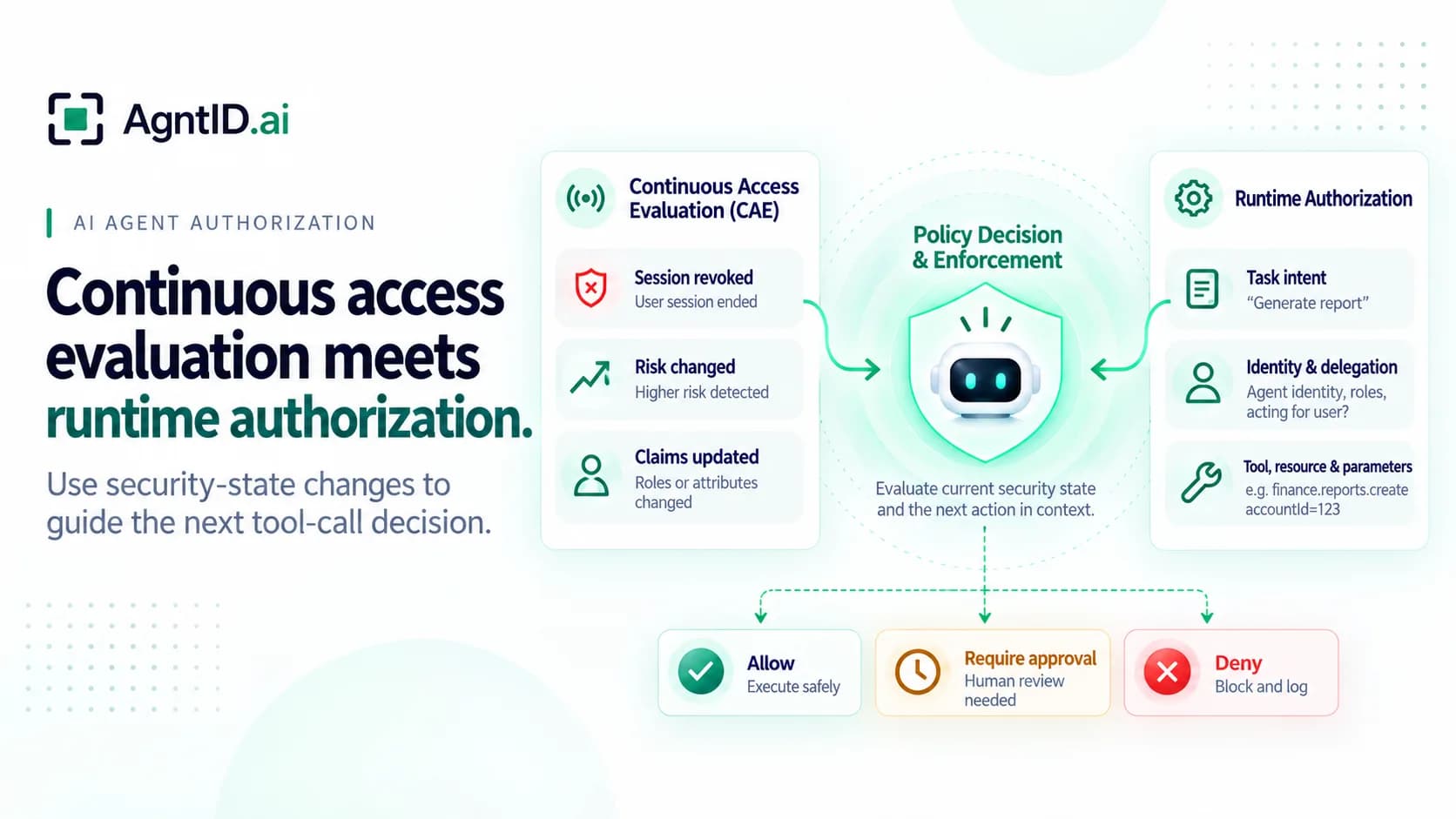
Continuous access evaluation and runtime authorization address two different access-control requirements. Continuous access evaluation (CAE) responds to changing security conditions, such as session revocation or increased identity risk. Runtime authorization determines whether an individual action is permitted when an AI agent attempts to execute it. Together, they help organizations make authorization decisions using current security information and the context of the requested action.
Consider an AI agent investigating a duplicate customer payment. The agent retrieves transaction records, confirms the duplicate charge, and prepares to issue a refund. Before the refund executes, the employee who requested the task has their session revoked. The agent has completed its investigation, and its existing credentials might still be technically valid. Should the refund proceed?
The example illustrates why AI agent authorization requires more than an initial access decision. Continuous access evaluation helps participating systems recognize changes that affect existing authority. Runtime authorization provides an opportunity to apply those changes when evaluating the agent's next protected action.
Autonomous agents introduce another consideration. An agent may have valid credentials and permission to use a particular tool, but that access does not establish whether every available operation is appropriate for its current task. Runtime authorization can evaluate applicable policy, available task intent, and the proposed action before execution, provided the necessary context is available.
Continuous Access Evaluation vs Runtime Authorization: Key Differences
| Dimension | Continuous access evaluation | Runtime authorization |
|---|---|---|
| Primary question | Have the security conditions affecting access changed? | Is this specific agent action permitted now? |
| Primary function | Keeps access decisions responsive to changing security conditions | Evaluates authorization for individual actions and enables enforcement |
| Typical inputs | Session status, identity risk, credential changes, and updated claims | Identity, delegated authority, task, tool, action, resource, parameters, policy, and available security state |
| Typical trigger | A relevant security event or reassessment of access conditions | An agent attempts a protected action |
| Scope | Affected users, sessions, devices, applications, or credentials | Individual actions and their authorization context |
| Authorization | Can trigger reassessment of existing access | Determines whether the requested action is authorized |
| Enforcement | Depends on the receiving system and connected controls | A policy enforcement point applies the authorization decision |
| AI agent example | An identity provider reports that a user's session was revoked | A refund request is evaluated against the current delegation and task-specific policy |
These mechanisms perform complementary functions. Continuous access evaluation helps systems recognize when security conditions change. Runtime authorization determines whether individual actions should proceed using the applicable policy and available context.
An agent's authority can change because its user's session is revoked. An action can also be inappropriate for the assigned task even when the session and broader technical permissions remain valid. Runtime authorization provides an opportunity to evaluate both conditions when the relevant security state and task context are available.
An identity or authorization platform may implement both functions. For AI agents, the architectural requirement is to establish whether the deployed controls can evaluate and enforce the authorization decisions required throughout the agent's execution workflow.
Can Continuous Access Evaluation Replace Runtime Authorization?
Continuous access evaluation cannot independently determine whether every action an AI agent proposes is appropriate for its current task. CAE helps participating systems respond when security conditions change. Runtime authorization evaluates individual requests against applicable policy and the context available at execution time.
For example, an agent may have an active delegated session and permission to access a payment API. Continuous access evaluation may have no new security event to report. However, the agent could still propose a refund that falls outside its assigned task. A runtime authorization system with the necessary policy and task context can deny that request before execution.
The two capabilities can coexist within the same identity or authorization platform. Organizations should assess whether their deployed controls receive updated security information, evaluate the relevant attributes of individual agent actions, and enforce authorization decisions throughout the protected execution path.
What Is Continuous Access Evaluation?
Continuous access evaluation keeps access decisions responsive to changes in security conditions after initial authentication. Traditional token-based access often relies on permissions and claims established when a token is issued. Unless an application performs additional validation, it may continue accepting the token until expiration, even after relevant security conditions change.
CAE addresses this problem by enabling cooperating systems to reassess access when new security information becomes available. For example, an identity provider might revoke a user's session, detect increased identity risk, or update access-related claims. These changes can affect whether applications should continue accepting existing access.
How CAEP Supports Continuous Access Evaluation
The Continuous Access Evaluation Profile (CAEP), developed by the OpenID Foundation, standardizes security events that cooperating systems can exchange. CAEP is part of the Shared Signals Framework and defines events that communicate relevant changes in security state. Rather than defining how every downstream system should enforce access, CAEP provides a standardized way to communicate information that may affect subsequent access decisions.
Its event types include:
| CAEP event | What it communicates |
|---|---|
session-revoked | An identified session has been revoked |
token-claims-change | Relevant token claims have changed |
credential-change | A relevant credential change has occurred |
risk-level-change | The assessed security risk has changed |
assurance-level-change | The authentication assurance level has changed |
CAE describes the broader approach to reassessing access when security conditions change. CAEP is one standardized mechanism for communicating those changes. Organizations can also use direct validation or other supported integrations, depending on their identity infrastructure and application requirements.
Receiving a CAEP event does not automatically invalidate downstream credentials or determine whether an agent's next action is authorized. The receiving system must validate the event, identify the affected subject, and incorporate the updated information into subsequent authorization decisions. The resulting enforcement depends on the receiving system and its connected controls.
This distinction becomes important when an agent performs multiple actions under delegated authority. A revoked employee session may invalidate that delegation, but the authorization system must identify the affected agent and enforce the resulting restriction before subsequent actions execute.
What Is Runtime Authorization for AI Agents?
Runtime authorization determines whether an action is permitted when an agent attempts to execute it. Existing identity and access management systems establish identities, manage permissions, and enforce access policies. Some identity platforms also provide agent-specific controls, contextual authorization, and tool-call enforcement.
Autonomous agents introduce additional authorization requirements because they dynamically select tools, generate parameters, and perform different operations as a task progresses. The relevant question is whether the deployed authorization system receives enough context to evaluate those actions individually and enforce the resulting decisions before execution.
For a deeper explanation of these principles, see AI Agent Authorization.
Why Policy and Task Intent Matter
Consider an engineering agent with access to GitHub, CI, application logs, a staging environment, and a secrets manager. Its assigned task is to investigate an authentication regression and prepare a fix for review. During the investigation, the agent might attempt to modify authentication code, run tests, deploy to staging, open a pull request, or rotate a production secret.
Some of those operations may satisfy the organization's configured access policy. The agent may be permitted to modify the repository, while secret rotation might require additional approval. However, technical permission does not establish whether every available operation is justified by the investigation. Rotating a production secret could fall outside the assigned task even when the agent has broader access to the secrets manager.
Now consider the same agent performing a different task: rotating a compromised production authentication secret and validating the application afterward. The identity, available tools, and broader policy boundaries can remain unchanged. What changes is the purpose for which the authority is requested. The same operation may therefore require a different authorization outcome depending on the current task and applicable restrictions.
A runtime policy engine can evaluate task-specific conditions when the relevant context is available. Task-aware authorization builds on that principle by using current task intent as an explicit input into authorization. Policy establishes the security boundaries, while task intent provides context about the work being performed. Neither an agent's proposed action nor its stated objective can independently create authority outside those boundaries. This supports the principles of least privilege for AI agents.
How PDP and PEP Work Together
Runtime authorization typically separates policy decisions from enforcement. The policy decision point (PDP) evaluates authorization requests against applicable policies and available context. The policy enforcement point (PEP) intercepts protected requests and enforces the resulting decisions. This separation allows authorization logic to be evaluated independently of the component responsible for intercepting protected operations.
When an agent attempts a protected MCP tool call, the PEP submits the relevant identity, tool, resource, parameters, and proposed action to the PDP. The authorization system also needs the applicable policy, available security state, and relevant task intent when task-aware evaluation is configured. The PDP evaluates these inputs and returns an authorization decision with any applicable constraints.
The PEP enforces that decision before execution. Permitted actions proceed through the configured credential model, subject to applicable authorization constraints. Denied actions are blocked, while actions requiring approval remain on hold until the relevant approval conditions are satisfied. Organizations should determine whether their existing enforcement infrastructure can apply these controls to the agent's actual execution path. For related implementation considerations, see MCP Security Best Practices.
How CAEP and Runtime Authorization Work Together
CAEP can communicate security-state changes to an authorization system. Runtime authorization can incorporate those changes when evaluating subsequent agent actions. The relationship is straightforward: a security event changes the information available to the authorization system, and the updated information can influence subsequent access decisions.
An organization implementing both mechanisms needs a way to validate incoming events, correlate the affected identity or session with any relevant agent delegations, and make the resulting security state available to its authorization system. The authorization system must then enforce applicable restrictions at the protected execution boundary.
The following diagram illustrates a generic runtime authorization architecture. It does not represent a verified native CAEP integration in AgntID. CAEP is one possible source of security-state information, provided an appropriate external integration exists.
flowchart TD
    A["AI Agent"]
    B["Policy Enforcement Point"]
    C["Policy Decision Point"]
    D["Applicable Policy"]
    E["Available Task Intent"]
    F["Available Security State"]
    G{"Enforcement Outcome"}
    H["Configured Credential Model"]
    I["MCP Server / Target API"]
    J["Deny / Block"]
    K["Approval Workflow"]

    A -->|"Proposed tool call and parameters"| B
    B -->|"Identity, delegation, proposed action, and parameters"| C

    D --> C
    E -->|"Where configured"| C
    F --> C

    C -->|"Decision and applicable constraints"| B
    B --> G

    G -->|"Allow with constraints"| H
    G -->|"Deny"| J
    G -->|"Require approval"| K

    K -->|"Approved: obtain fresh authorization"| B
    K -->|"Rejected"| J

    H -->|"Permitted execution"| I
Conceptual runtime authorization architecture. The authorization request includes identity, delegation, the proposed action, and its parameters. Applicable policy, available security state, and task intent, where configured, provide additional decision inputs. The diagram does not specify a CAEP receiver, native identity-provider integration, or a particular credential-issuance mechanism.
From Security Event to Authorization Decision
When a security event is received, an integrated system must identify the affected user, session, or security subject. It must then determine whether any agent delegations depend on that subject and update the information available to the authorization system. Affected cached decisions may also need to be invalidated or refreshed so subsequent requests are evaluated against the relevant security state.
When the agent attempts its next protected action, the PDP evaluates the request using the applicable policy and available context. That evaluation may include security state, delegated authority, available task intent, and the parameters of the proposed action. The PEP then enforces the resulting decision before execution.
The system may use existing permitted credentials or, where supported and configured, obtain appropriately scoped credentials through a credential broker. Authorization and credential issuance remain separate functions. Evaluating every protected tool call does not necessarily require generating a new credential for every call.
Runtime authorization can consider only the security-state changes available when the decision is made. If a revocation event arrives late, sensitive operations may require fresh validation, bounded decision caching, short-lived credentials, or a restrictive failure policy. These safeguards address the period during which previously valid authority may remain usable before updated security information reaches the enforcement system.
Practical Example: Session Revocation During AI Agent Execution
Consider an AI agent investigating a duplicate customer payment. An employee asks the agent to review the transaction history and issue a refund if the duplicate payment is confirmed. The agent can retrieve transaction records and request access to the payment tools needed to complete that assignment.
The organization's policy establishes two requirements. First, the investigation must be completed before the agent issues a refund. Second, payment-related actions require an active delegated user session. The policy also restricts refunds to approved accounts and transaction amounts.
These requirements demonstrate how task-specific restrictions, action parameters, and changing security conditions can independently affect agent authorization. The following scenarios illustrate a reference implementation. The CAEP event-processing workflow in Scenario B is illustrative, not a claim that AgntID currently provides native CAEP ingestion.
Scenario A: Valid Session, Unauthorized Action
The agent begins with valid delegated authority. It retrieves customer information using crm.get_customer and reviews payment history using payments.list_transactions. Before completing the investigation, the agent attempts payments.create_refund. At this point, its access remains valid, but it has not satisfied the conditions required to execute the refund.
The employee's session remains active, but the proposed refund does not satisfy the organization's task-specific policy. The PDP denies the request because the investigation is incomplete. The PEP blocks the action before the payment API executes.
Scenario A demonstrates a predefined workflow restriction: the agent cannot issue a refund until its investigation is complete. Task intent introduces another consideration. If the employee had instructed the agent only to investigate the dispute and prepare a recommendation, issuing a refund could remain unauthorized even after the investigation was complete.
The same agent might have permission to access the same refund tool in both situations. However, the tasks justify different actions under the applicable policy. Runtime authorization must account for that distinction when task-specific restrictions form part of the policy. An existing authorization platform can also enforce these restrictions when it receives and evaluates sufficiently trustworthy task context.
Scenario B: Valid Task, Revoked Session
The agent completes its investigation and confirms that the customer qualifies for a refund. Before the refund executes, the identity provider detects suspicious activity and revokes the employee's session. The agent's assigned task is still valid, but the delegated authority required for the payment operation has changed.
In this reference scenario, an appropriately configured integration receives a CAEP session-revoked event. The receiver validates the event and identifies the affected session. The integration correlates that session with the agent's delegated authority, updates the relevant security state, and invalidates affected cached decisions. These updates must become available before the next authorization decision.
Once the updated state is available, the agent attempts payments.create_refund. The PEP intercepts the request, and the PDP evaluates the proposed action against the applicable policy, task context, and updated session state. Although the investigation is complete, the delegated session is invalid. Under the organization's policy, the PDP returns a denial, and the PEP blocks the refund.
Scenario C: Valid Task, Valid Session, Scoped Execution
The agent completes the investigation while the employee's delegated session remains active. It confirms that the refund meets the organization's requirements and requests permission to execute payments.create_refund. Unlike the previous scenarios, neither the task-specific conditions nor the required delegation prevents the operation from proceeding.
The runtime authorization system evaluates the proposed action against the applicable policy, available task intent, valid delegated authority, target account, and requested refund amount. All requirements are satisfied, so the action is authorized. The decision applies to the proposed operation and any restrictions associated with that authorization.
Once the action is authorized, the enforcement system permits execution using the configured credential model. Where scoped credential issuance is supported, the credentials can limit the permissions available during execution. In this reference implementation, the enforcement point must also ensure that the executed action satisfies the authorization decision, including any applicable restrictions on the refund amount, customer account, or other parameters.
Runtime authorization and credential narrowing therefore address related but distinct requirements. Authorization determines whether the proposed refund is permitted, including any relevant parameter restrictions. Credential narrowing limits the permissions available when the authorized action executes. Together, these mechanisms can support just-for-task access.
Comparing the Three Authorization Outcomes
| Authorization context | Scenario A | Scenario B | Scenario C |
|---|---|---|---|
| User session | Active | Revoked | Active |
| Requested action | Issue refund | Issue refund | Issue refund |
| Task context | Investigation incomplete | Investigation complete | Investigation complete |
| Applicable restriction | Investigation required | Active delegation required | Task, session, and action requirements satisfied |
| Authorization result | Deny | Deny | Allow |
| Enforcement | Block refund | Block refund | Permit authorized execution |
| Primary lesson | Task-specific restriction | Invalid delegated authority | Authorized, appropriately scoped access |
The three scenarios illustrate separate authorization requirements. Scenario A shows why task context matters even when identity permissions remain valid. Scenario B shows how changes in security state can affect an otherwise appropriate action. Scenario C demonstrates how authorized execution can proceed with appropriately restricted permissions.
For security architects, the practical question is whether the deployed controls can produce and enforce all three outcomes. That assessment requires examining the decision inputs, enforcement boundary, credential model, and downstream permissions rather than assuming any particular product category provides or lacks those capabilities.
Measuring the Revocation-to-Denial Gap
Security teams should test how quickly session revocation affects subsequent agent actions. Two measurements are important: event propagation latency and revocation enforcement latency. The first measures when updated security information becomes available, while the second measures when that information reliably prevents subsequent protected actions.
| Measurement | What it establishes |
|---|---|
| Event propagation latency | Time between session revocation and the updated state becoming available to the authorization system |
| Revocation enforcement latency | Time between session revocation and the point at which subsequent protected requests are reliably denied |
For revocation enforcement testing, submit controlled authorization requests at defined intervals following revocation. Record the session revocation, event-processing time, security-state update, and subsequent authorization decisions. Repeat the test with delayed event delivery, unavailable authorization services, cached decisions, and previously issued credentials.
A denied request through one enforcement point does not establish that every alternative access path is closed. Previously issued credentials and potential enforcement bypasses require separate validation. The same testing approach can help establish whether an organization's existing identity and authorization infrastructure already meets its requirements.
How Other Security Changes Affect Running Agents
Session revocation is one example of a changing security condition. Identity risk, permissions, and authorization policies can also change while an agent executes a multistep task. Each change can affect subsequent authorization decisions, but the mechanism used to communicate or apply that change may differ.
The following examples illustrate how authorization systems can account for these changes. They also distinguish security signals communicated through CAEP from policy updates that must reach the authorization system through other mechanisms.
Identity Risk Changes
An identity provider may report increased identity risk through a CAEP risk-level-change event. An integrated authorization system can incorporate that assessment into subsequent decisions. Depending on policy, lower-risk operations may remain permitted while higher-impact actions require additional verification or are denied.
The event reports the changed risk assessment. The authorization policy determines its consequences. Receiving a risk signal does not independently establish which agent actions should be allowed, and different organizations may apply different restrictions to the same reported risk level.
Permissions and Claims Changes
An employee's access-related claims may change while an agent operates under delegated authority. A CAEP token-claims-change event can communicate relevant claim updates, which the authorization system must apply to affected delegations. Subsequent authorization decisions should reflect the updated claims when those changes affect the agent's authority.
Previously issued downstream credentials may still require separate replacement, revocation, or expiration. Updating authorization context alone does not invalidate every credential already accepted by another service. Organizations must account for both authorization-state updates and any credentials that remain usable outside the evaluated execution path.
Authorization Policy Changes
An organization might introduce additional approval requirements or restrict access to sensitive resources while agents are running. These changes must reach the PDP through the policy administration system so subsequent authorization requests can be evaluated against the applicable policy.
CAEP is not a general mechanism for distributing arbitrary authorization-policy changes. The next protected tool call should be evaluated using the applicable policy version and available security context. Where policy changes affect cached decisions or previously issued credentials, those effects require separate consideration.
How AgntID Complements Continuous Access Evaluation
AgntID provides runtime access control enforcement for AI agents. Its customer-hosted runtime evaluates protected MCP tool calls against applicable policy before execution. AgntID also supports task-intent evaluation, which organizations can configure to incorporate the agent's current task into authorization decisions.
Existing identity and authorization platforms may already provide agent identities, contextual policies, tool-level enforcement, and credential management. AgntID complements these capabilities by supporting policy- and intent-driven access decisions and credential narrowing within customer-controlled infrastructure. Its runtime enforcement model addresses individual protected tool actions without requiring organizations to replace their existing identity systems.
AgntID's established role is runtime authorization and enforcement. It does not require native CAEP ingestion to evaluate proposed tool actions using the policy and context available to its runtime. Incorporating externally communicated CAEP security events would require an appropriate integration.
Policy- and Intent-Driven Runtime Enforcement
Security teams can define task-specific authorization policies for known workflows, but autonomous agents may receive varied instructions and select actions dynamically. As those workflows expand, authorization decisions may require additional context about the task rather than relying solely on broad tool permissions.
AgntID supports incorporating current task intent into authorization for protected tool calls. When configured, task-intent evaluation considers the purpose of the agent's current assignment alongside applicable policy and the proposed action. Policy remains authoritative, and the authorization decision is enforced before the protected tool call proceeds.
This approach places task intent within AgntID's runtime authorization model rather than treating it only as information recorded after execution. Existing authorization systems can also implement task-sensitive policies when sufficiently trustworthy context is available.
For a deeper technical explanation, see Why AI Agent Access Control Needs Task Intent at Runtime.
Credential Narrowing and Just-for-Task Access
Authorization determines whether an action can proceed. Credential narrowing limits the permissions available when an authorized action executes. Together, these functions support just-for-task access without treating a valid credential as sufficient justification for every operation.
In Scenario C, the reference authorization system permits the refund after evaluating the applicable policy, task intent, delegated authority, and proposed parameters. Credential narrowing can separately reduce the permissions available during execution. The reference implementation must also enforce any restrictions associated with the authorization decision, including limits on the customer account, refund amount, or other parameters. This illustrates a security requirement rather than claiming that AgntID provides arbitrary parameter-level enforcement for every MCP tool.
AgntID supports pass-through and AgntID-issued credential models. The selected configuration determines how credentials are provided for authorized execution. In configurations that issue scoped credentials, AgntID can restrict the permissions available to the authorized task. Per-tool-call authorization remains separate from credential issuance, so every authorization decision does not necessarily require generating a new credential. The exact enforcement of parameter-level restrictions depends on the implementation.
Infrastructure-Owned Enforcement and IAM Compatibility
AgntID's runtime operates within customer-controlled infrastructure. Organizations retain control over runtime enforcement while continuing to use their existing identity systems, tools, and MCP servers. This allows runtime access decisions to be introduced without requiring an organization to replace the systems that establish identities and broader access permissions.
Its MCP-first architecture supports vendor-hosted, customer-hosted, and custom MCP servers. Organizations can therefore add runtime authorization within their own infrastructure without requiring every connected MCP server to run in the same environment. The relevant enforcement boundary is where protected tool calls are intercepted and authorization decisions are applied.
Deployment considerations include where tool calls are intercepted, whether enforcement can be bypassed, how task context reaches policy evaluation, and which credentials are available to downstream services. Organizations should also verify the effective permissions available during execution, including whether previously issued credentials provide alternative access.
How to Evaluate Task-Aware Runtime Enforcement
A useful evaluation should test whether an authorization system can distinguish between differently authorized tasks without changing the agent's identity or broader technical permissions. The engineering-agent example introduced earlier provides a practical test case: investigate an authentication regression, then separately perform an authorized production-secret rotation. The same proposed operation can be evaluated in both situations to determine whether task intent changes the authorization outcome.
The evaluation should examine the resulting authorization decisions, the permissions available during approved execution, and whether the enforcement boundary can be bypassed. It should also establish whether manipulated task context can improperly influence authorization, even when the requested action falls within the agent's broader technical permissions.
For an architecture that combines continuous access evaluation with runtime authorization, the evaluation should also test changing security conditions. Revoking an applicable delegated session during an agent task provides a way to measure when updated security state reaches the authorization system and whether subsequent protected actions are denied.
| Evaluation question | What to examine |
|---|---|
| Does the current task affect authorization? | Test the same proposed tool operation under two differently authorized tasks. |
| Does policy remain authoritative? | Verify that task intent cannot override a prohibited action or an unmet approval requirement. |
| Can manipulated task intent influence authorization? | Test whether an agent can misrepresent or change its task context to obtain approval for an action that is technically permitted but inappropriate for its assigned task. Verify that explicit policy restrictions remain authoritative. |
| Is the decision enforced before execution? | Confirm that a denied tool call does not reach the downstream service through the protected execution path. |
| What privileges are available after approval? | Inspect the configured credential model and the effective permissions available during an authorized action. |
| Do changing security conditions affect subsequent actions? | Revoke an applicable delegated session during an agent task. Verify when the authorization system receives the updated state and whether subsequent protected actions requiring that delegation are denied. |
These tests provide a concrete way to examine task-aware authorization, just-for-task access, and the effect of changing security conditions. The session-revocation test applies to architectures with an appropriate identity-state integration and should not be interpreted as a claim that AgntID currently supports native CAEP ingestion.
To evaluate task-aware enforcement against your own agent workflow, explore AgntID's runtime access control and request a technical walkthrough. The two-task engineering example provides a practical starting point for examining how policy, task intent, and runtime enforcement work together.
Bottom Line
Continuous access evaluation keeps authorization systems informed when security conditions change. Runtime authorization determines whether an agent's next action is permitted under the applicable policy and available context.
For autonomous agents, authorization may also need to account for the specific task, tool, action, resource, and parameters before execution. Organizations should verify whether their existing infrastructure receives the necessary context and enforces the resulting decisions throughout the deployed agent workflow.
AgntID provides runtime authorization for protected MCP tool calls and supports incorporating task intent into those decisions. Policy establishes the security boundary, while configured intent evaluation adds context about the work the agent is performing. Credential narrowing can then restrict the privileges available for approved execution. These capabilities support just-for-task access within customer-controlled infrastructure without replacing existing IAM systems.
Frequently asked questions
What is the difference between continuous access evaluation and runtime authorization?
Continuous access evaluation responds to changing security conditions. Runtime authorization determines whether an AI agent's individual actions are permitted using applicable policy and available context.
What is the difference between CAE and CAEP?
CAE is an approach to reassessing access when security conditions change. CAEP standardizes security events that cooperating systems can exchange to support continuous access evaluation.
How do CAEP signals affect AI agent authorization?
CAEP signals communicate security-state changes. An integrated authorization system can use these updates when evaluating subsequent agent actions and enforcing applicable access restrictions.
What happens when a user's session is revoked while an AI agent is running?
Session revocation can invalidate an agent's delegated authority. Once the authorization system processes the revocation, subsequent actions requiring the revoked session should be denied.
What is the difference between PDP and PEP in AI agent authorization?
A policy decision point (PDP) determines whether an agent action is authorized. A policy enforcement point (PEP) intercepts the request and enforces the resulting decision before execution.
Does runtime authorization require CAEP?
No. Runtime authorization can evaluate actions using available identity, policy, task, and security context. CAEP is one mechanism for communicating relevant security-state changes.
What is just-for-task access for AI agents?
Just-for-task access limits an agent's permissions to those required for its authorized task. AgntID supports this through per-tool-call policy enforcement, configurable task-intent evaluation, and credential narrowing.
Further reading
- Runtime Access Control for AI Agents — How authorization decisions can be enforced at the agent tool-call boundary before execution.
- AI Agent Authorization — How policy, identity, delegation, tools, resources, and parameters shape agent authorization.
- MCP Security Best Practices — Practical guidance for authentication, authorization, credential handling, and production MCP security.