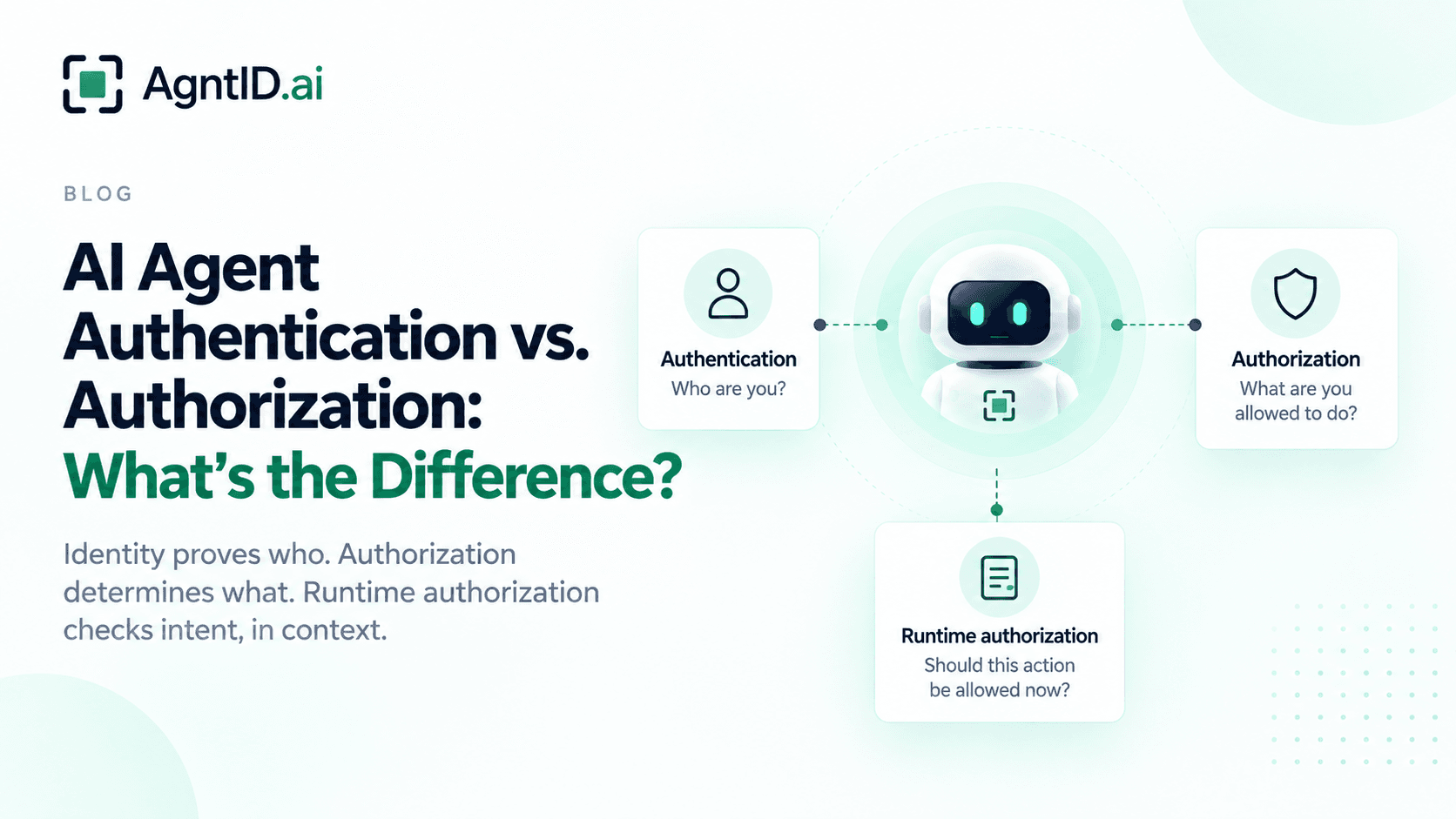
AI Agent Authentication vs. Authorization: What's the Difference?
AI agent authentication vs. authorization comes down to two different security questions. Authentication verifies who or what is making a request. Authorization determines what that authenticated identity is permitted to access or do.
For AI agents, the timing and context of the authorization decision can also matter. An agent may be authenticated and have access to a system, while a specific action still depends on the current task, tool, resource, parameters, user, or approval state. Runtime authorization is authorization evaluated when a specific action and its context are known.
| Authentication | Authorization | Runtime authorization |
|---|---|---|
| Verifies who or what is making the request | Determines what an authenticated identity is permitted to access or do | Evaluates a specific authorization decision when the action and context are known |
| Asks: "Who are you?" | Asks: "What are you allowed to do?" | Asks: "Should this action be allowed now?" |
| Uses API keys, workload identities, certificates, signed tokens, or other identity proofs | Uses roles, scopes, permissions, entitlements, or policy | Uses identity plus task, tool, action, resource, parameters, and runtime context |
| Establishes identity or credential validity | Defines or evaluates permitted access | Applies authorization at or near execution |
| Example: authenticate a GitHub App | Permit repository writes | Permit a README edit for this task but deny a deployment workflow change |
The practical answer is not authentication or authorization. Agent systems need both. Authentication establishes identity. Authorization defines permitted access and actions. Runtime authorization can evaluate whether a specific action is permitted when the agent attempts it.
What is AI agent authentication?
AI agent authentication verifies the identity or credential an agent uses to access another system. An agent may authenticate as a user, application, service account, workload, or another machine principal. Common AI agent authentication methods include API keys, workload identity, mTLS, certificates, signed tokens, and OAuth-based flows.
The core question is: "Who or what is making this request?" For example, a coding agent may connect to GitHub through an approved GitHub App. Authentication lets GitHub verify which application or installation is making the request.
Authentication establishes identity. It does not determine whether every action available to that identity should be performed. That is an authorization decision.
The authentication model depends on the architecture. An agent acting on behalf of a user may rely on delegated OAuth access. A background agent may authenticate as an application. An agent running in Kubernetes may use workload identity. For more on that distinction, see AI agent identity vs. workload identity.
What is AI agent authorization?
AI agent authorization determines what an authenticated agent is permitted to access or do. That can include which applications the agent may reach, which repositories it may access, which tools it may call, which API operations it may perform, and which records it may modify.
Authorization can rely on roles, scopes, permissions, entitlements, resource policies, or contextual policy. RBAC and ABAC for AI agents are two common approaches.
Consider a support agent. Authentication may establish that a request came from the approved support-agent workload. Authorization may allow that workload to read customer records and create support tickets. Those permissions establish an access boundary.
The harder decision appears when the same agent can perform several actions inside that boundary. A support agent might be able to view an account, revoke sessions, reset a password, or disable an account. Whether each action should run may depend on the task, affected user, parameters, or approval state.
Authentication vs. authorization in AI agent APIs
The same authentication vs. authorization distinction applies when AI agents call APIs. Authentication verifies the user, application, workload, or service making the request. Authorization determines whether that identity can access the requested endpoint, resource, or operation.
For example, an OAuth access token may allow an agent to call a SaaS API on behalf of a user. The token represents delegated access, while authorization policy determines which resources and operations that access permits.
An AI agent can therefore authenticate successfully to an API and still receive an authorization failure for a particular request. This becomes important when one credential provides access to several operations with different authorization requirements.
What is runtime authorization?
Runtime authorization is authorization evaluated when the requested action and its execution context are known. It is not an alternative to authorization. It describes a more specific authorization decision made when the system knows what the agent is trying to do.
An authorization system may consider the agent identity, delegated principal, task, selected tool, proposed action, target resource, generated parameters, environment, and approval state. The core question becomes: "Should this specific action be allowed in this context?"
This matters because the final tool call may not be known when an agent authenticates. An agent can interpret a task, choose a tool, generate arguments, inspect a result, and decide what to do next. Its identity and baseline permissions can remain unchanged while the authorization context changes.
AI agent permissions define what an agent is allowed to access or do. Runtime access control can evaluate the action against policy and enforce the resulting authorization decision.
Why does authentication vs. authorization become more complex for AI agents?
Many applications operate through workflows where developers know the main operations and access boundaries in advance. AI agents can introduce more runtime variability because they may select tools, resources, and parameters after interpreting a task.
Consider an IT support agent with access to account-management tools. An employee reports a stolen phone and asks the agent to revoke active sessions.
task = secure-stolen-device
action = revoke-sessions
target-user = employee-123
Now suppose the same agent proposes:
task = secure-stolen-device
action = disable-account
target-user = cfo
The agent may still be authenticated. Its baseline permissions may still be valid. The proposed action and its context have changed.
Authentication establishes who or what is acting. Authorization establishes permitted access. Runtime authorization can determine whether the proposed action is permitted under the current conditions.
GitHub example: authenticated does not mean every action is authorized
Consider a coding agent connected to GitHub through an approved GitHub App. The application has access to a repository and permission to write repository contents. A developer asks the agent to update the installation instructions in README.md.
The identity is valid. The repository is within the application's authorized scope. The proposed documentation change also matches the task.
Now suppose the agent decides to modify .github/workflows/deploy.yml. The authenticated identity has not changed. The application's GitHub permissions may not have changed either. The proposed action has.
At runtime, an authorization system could evaluate:
agent = coding-agent
user = developer-123
task = update-installation-docs
repository = product-api
action = modify-file
target = .github/workflows/deploy.yml
Policy may permit documentation changes for that task while denying changes to deployment workflows. GitHub's native permissions still define which repositories and operations the application can access. Runtime authorization adds a more specific decision inside that boundary.
How should authentication and authorization work together?
A practical AI agent access model combines identity, baseline permissions, runtime context, policy evaluation, and enforcement. Existing authentication and authorization controls still provide the foundation. More specific decisions can be added where the action itself changes the authorization requirement.
A typical flow looks like this:
- Authenticate the identity. Verify the user, application, workload, service account, or agent.
- Establish baseline permissions. Determine which systems, tools, resources, and operations the identity may access.
- Capture runtime context. Identify the task, proposed action, resource, parameters, user authority, and approval state.
- Evaluate the action. Determine whether the specific action is authorized under policy.
- Enforce the decision. Allow, deny, or require approval before execution. Where supported, narrow access for the approved action.
- Record the result. Log the identity, context, authorization decision, and outcome.
Not every AI agent needs action-level authorization for every tool call. A narrow background agent with one stable purpose and tightly scoped permissions may already have an appropriate access model. Runtime authorization becomes more useful when the authorization decision changes with the task, tool, resource, parameters, user, or approval state.
Common mistakes
Treating authentication as authorization
A valid credential proves identity. It does not grant permission to perform every available action. An authenticated agent can still be denied access to a resource, tool, or operation.
Treating tool availability as authorization
Making a tool available to an agent does not mean every action exposed by that tool should be authorized. A tool may expose several operations with different authorization requirements.
Assuming roles or scopes capture enough context
Roles and scopes create useful access boundaries. They may become too broad when authorization depends on the task, resource, environment, parameters, or approval state.
Putting the authorization decision in the prompt
A prompt can tell an agent what it should or should not do, but that instruction influences model behavior. Authorization should not rely on the model alone. Policy evaluation and enforcement should occur at an independent control point.
Treating runtime authorization as a replacement for IAM
IAM systems can remain responsible for identity, roles, groups, workload identities, and baseline access. Runtime authorization can work with those identities and permissions when a specific action requires a more contextual decision.
How AgntID fits
AgntID provides next-gen access control enforcement for AI agents. Traditional access control models were designed around more predictable applications and broader access boundaries. AI agents can select tools dynamically and execute actions after reasoning about a task.
AgntID provides runtime access control enforcement based on policy and runtime agent intent. At execution time, it narrows privileges for each tool action so the agent receives least-privilege, just-for-task access instead of broader session-level permissions.
AgntID supports both pass-through and AgntID-issued credentials for task-specific access. Runtime enforcement, control, and execution remain inside the organization's infrastructure.
AgntID works with existing IAM systems, tools, and vendor-hosted, customer-hosted, or custom MCP servers without requiring a rip-and-replace approach. Existing IAM and access systems remain in place while AgntID adds runtime enforcement when an agent turns task intent into a concrete tool action.
Bottom line
Authentication verifies who or what is acting. Authorization determines what that identity is permitted to access or do. Runtime authorization evaluates whether a specific action is permitted once its context is known.
For AI agents, the distinction matters because the final tool, resource, action, or parameters may only become clear during execution. Existing identity and access controls can define the broader boundary. Runtime authorization can evaluate whether a specific action is permitted when additional context is required.
FAQ
What is the difference between authentication and authorization?
Authentication verifies identity. Authorization determines what that authenticated identity is permitted to access or do. For AI agents, authentication may verify a user, application, or workload, while authorization governs access to tools, resources, and actions.
Which comes first, authentication or authorization?
Authentication usually comes first. A system typically verifies the identity before determining what that identity is authorized to access or do.
What is AI agent authentication?
AI agent authentication verifies the user, application, workload, service account, or other identity an agent uses to access a system.
What is AI agent authorization?
AI agent authorization determines which resources, tools, and actions an authenticated AI agent is permitted to access or perform.
Can an AI agent be authenticated but not authorized?
Yes. An AI agent can successfully prove its identity and still lack permission to access a resource, use a tool, or perform an action.
What is runtime authorization?
Runtime authorization evaluates whether a specific action is permitted when the action and its execution context are known.
How do authentication and authorization work with OAuth for AI agents?
OAuth can give an AI agent delegated access to resources on behalf of a user. Authorization determines which resources and actions that delegated access permits.