Runtime Access Control for AI Agents
Built for Infrastructure Teams· Developer-Light
Execution-time · Least-privilege · Byo Mcp & Cli · Customer-hosted
Agentic AI Breaks Static IAM
AI agents are fundamentally different from traditional applications:
Agents are non-deterministic
They dynamically discover and choose tools at runtime(accelerated by MCP, where tools and actions are not known ahead of time)
Execution happens after reasoning, not at design time
Static IAM was not designed for this execution model.
Why Static IAM Fails for Agents
Traditional identity systems rely on:
Long-lived credentials
Broad, pre-defined permissions
No awareness of agent behavior or tool schemas at execution time
This creates unacceptable risk when agents act autonomously.
Access Models Compared
| Access Model | Scope | Lifetime | Risk |
|---|---|---|---|
| Service Accounts | Broad, static | Long-lived | High |
| OAuth Impersonation | User-wide | Session-based | Medium |
| Scoped Runtime Access | Just-for-task | Ephemeral | Low |
Agents require scoped, ephemeral access — not standing privileges.
Just-for-Task Access at Runtime
AgntID introduces a runtime access model where:
Access is scoped dynamically per tool action
Credentials are ephemeral and derived
Enforcement happens at execution time, not configuration time
Agents never receive blanket permissions.
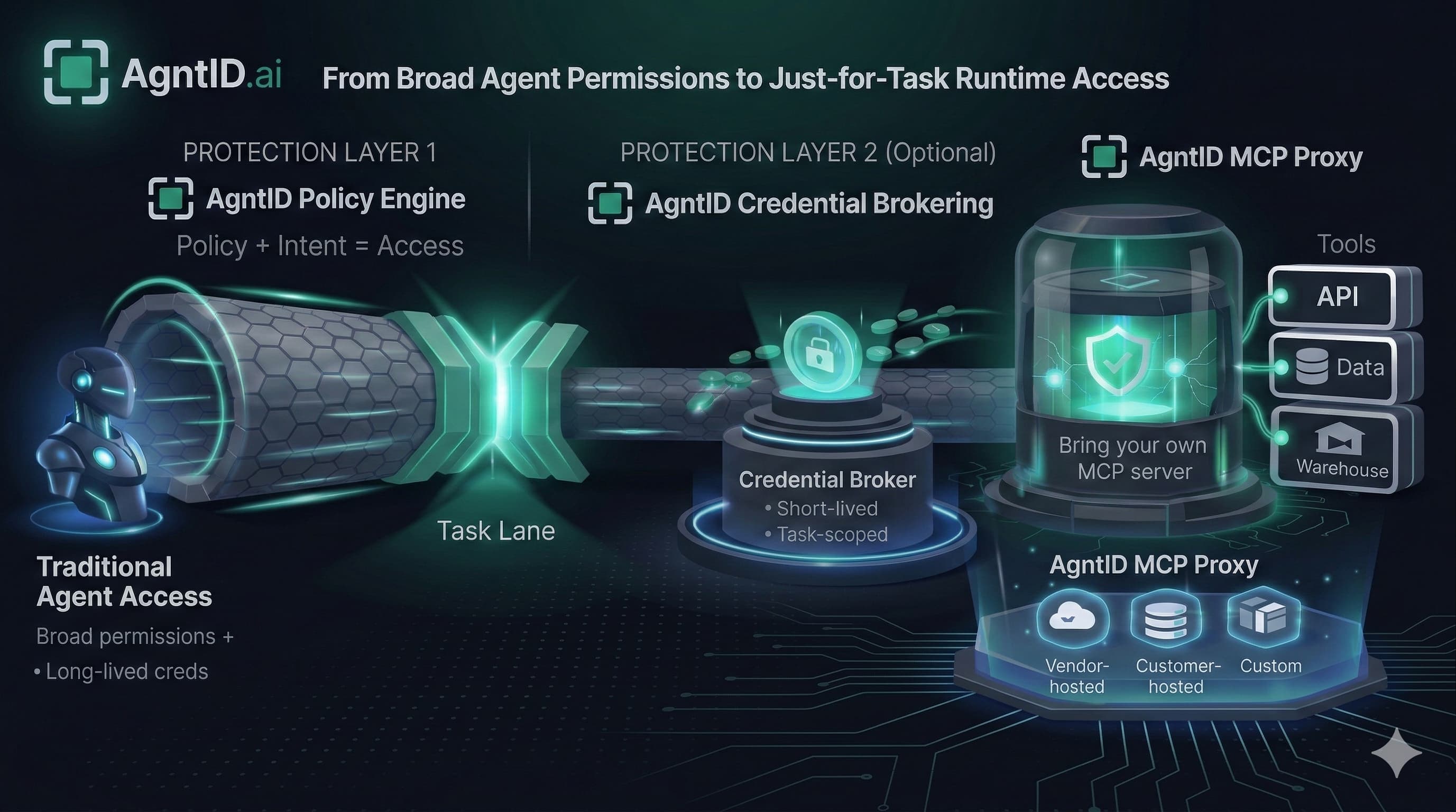
Policy + Intent Drive Access
Access decisions are driven by two inputs:
Policy
platform-defined boundaries
Intent
runtime evaluation of the agent’s intended action
Access Decision
scoped, ephemeral, per tool call
Every tool call is evaluated independently at execution time.
Access Model: Without vs With AgntID
Without AgntID
Broad, fixed access
No evaluation of agent intent
Long-lived credentials
With AgntID
Fine-grained policy per tool action
Optional intent evaluation against policy
Ephemeral, scoped credentials
End-to-End Runtime Execution Flow
Each tool invocation follows the same sequence:
Apply Policy-Driven Guardrails
Platform-defined boundaries restrict allowable actions
Evaluate Task Intent
Runtime evaluates task intent and parameters
Derive Scoped Credentials
Ephemeral credentials are generated
Scope is a subset of allowed policy boundaries
Execute Tool
Tool runs with derived credentials only
Audit and Visibility
Full execution context is logged
This sequence runs for every tool call.
Runtime Architecture
Flexible Credential Models
Pass-through or managed identities, scoped per tool call.
Separated Control & Execution
Policies are defined centrally; enforcement runs inside your infrastructure.
MCP-Compatible by Design
Works with vendor-hosted, customer-hosted, or custom MCP servers.
AgntID’s Bring-Your-Own MCP Model
AgntID is MCP-first without owning or replacing MCP:
Works with vendor-hosted, customer-hosted, or custom MCP servers
Does not require replacing tools or adopting a proprietary MCP layer
MCP remains the capability layer; AgntID governs access and execution
AgntID’s customer-hosted runtime includes an embedded MCP proxy that intercepts MCP tool calls, applies policy, derives scoped credentials, and enforces access at execution time.
Seven Principles Behind AgntID’s Design
Runtime Security Model
Policy + Intent–Driven Enforcement
Runtime decisions based on policy and task intent.
Credential Narrowing at Execution Time
Privileges reduced per tool action — not per session.
Scoped Credential Models
Supports pass-through identities or AgntID-issued credentials.
Infrastructure Ownership Model
Infrastructure-Owned Runtime Enforcement
Controlled by infrastructure and security teams — not dependent on developer changes.
Execution Stays Inside Your Infrastructure
Customer-hosted runtime; enforcement does not leave your environment.
MCP-Compatible — Bring Your Own MCP
Works with vendor-hosted, customer-hosted, or custom MCP servers — without replacing MCP.
IAM-Compatible — Extends, Doesn’t Replace
Integrates with your existing identity platform and permission model — no rip-and-replace.
See how AgntID enforces access at runtime
Explore credential enforcement models, deployment architecture, and MCP governance in detail.