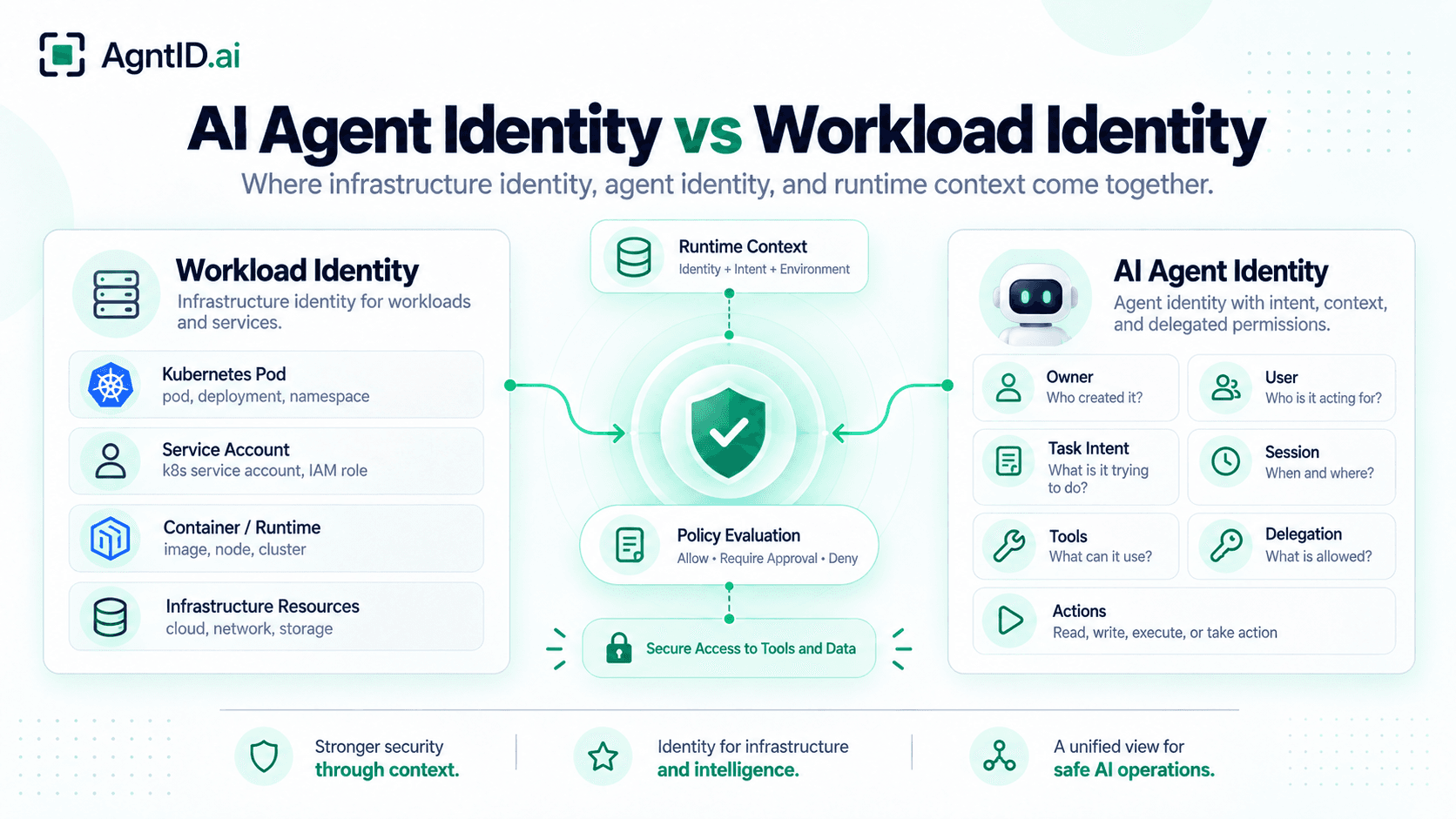
AI Agent Identity vs Workload Identity: What's Different?
AI agent identity and workload identity solve related identity problems, but they do not always represent the same actor. Workload identity gives software such as a service, pod, VM, process, or job a trusted non-human identity. For many applications, that is enough.
AI agents can make the identity model broader. A workload identity may identify which runtime is making a request, but it may not distinguish which agent inside that runtime is acting, who owns the agent, or which user or principal delegated authority to it. Authorization may also depend on the task, tool, action, resource, or parameters involved.
The practical answer is not "AI agent identity or workload identity." Workload identity can provide the infrastructure identity foundation. AI agent identity can represent the agent as a distinct actor and connect it to ownership, lifecycle, and access relationships. Runtime access control can then use identity and task context to determine and enforce the permissions allowed for a specific action.
| Question | Workload identity | AI agent identity |
|---|---|---|
| Primary subject | Service, pod, VM, process, job, or runtime | AI agent as a distinct actor |
| Core question | Which workload is making this request? | Which agent is acting? |
| Typical identity context | Service account, deployment, runtime, environment | Agent ID, owner or sponsor, lifecycle, delegated principal |
| Governance | Managed through workload, platform, or IAM lifecycle controls | May require agent-specific ownership, lifecycle, and access reviews |
| Authorization input | Can serve as an input to policy-based access decisions | Can be combined with user, task, session, tool, action, resource, and parameter context |
| Best fit | Stable machine-to-machine access | Agents that require distinct governance, delegation, or audit |
| Relationship | Provides infrastructure identity | Can build on workload identity rather than replace it |
The difference is not whether software uses an LLM. It is which actors and relationships the security architecture needs to represent.
What is workload identity?
Workload identity is a non-human identity assigned to running software. A workload might be a Kubernetes Pod, cloud service, VM, background job, application process, or another software component. Workload identity lets software authenticate to other systems as a distinct non-human principal.
In Kubernetes, a ServiceAccount can provide a workload with a distinct identity. Permissions can then be assigned through the surrounding authorization model. SPIFFE follows the same general principle across different infrastructure environments by giving workloads identities they can use to prove who they are to other services.
The core question is: "Which workload is making this request?" That remains important for AI agents. Running an agent does not remove the need to identify the software environment that hosts it.
Kubernetes example: when workload identity may be enough
Consider a reconciliation application running as a Kubernetes Deployment. Its job is narrow: read transaction events from an approved queue, compare them with billing records, and write reconciliation results to an approved database.
The Pods run under a reconciliation-service ServiceAccount. That workload identity receives the permissions required for the reconciliation process. The workload has one stable purpose, operates under one authority, and uses permissions that map directly to its function.
The application could even use an LLM to classify unusual transaction descriptions. That alone does not create a requirement for a separate AI agent identity. If the workload identity, assigned permissions, and audit model provide the required access control and accountability, workload identity may be enough.
What is AI agent identity?
AI agent identity represents an AI agent as a distinct non-human actor. It becomes useful when the agent needs to be identified or governed independently from the service or runtime that hosts it.
Consider an agent platform running in one Kubernetes Deployment. The underlying Pods may all use the same workload identity, while the application hosts several agents, serves many employees, and connects to multiple enterprise tools. The infrastructure identity can stay the same while the agent, user, or delegated relationship changes.
A finance agent may operate for an analyst, while a support agent acts for a customer service representative and another agent performs autonomous background work. Knowing that all three requests came from agent-runtime-prod identifies the runtime. It does not necessarily distinguish the agent that needs its own ownership, lifecycle, or access controls.
AI agent identity management and governance
AI agent identity management covers how agent identities are created, owned, reviewed, and retired. An identity system may associate an agent with a technical owner, business sponsor, lifecycle state, access assignments, or delegated principal.
AI agent identity governance covers the policies and review processes used to manage those identities over time. Security and identity teams may need to know which agents exist, who owns them, which systems they can access, who can delegate authority to them, and who is responsible for reviewing that access.
These are identity and governance questions. They are different from the runtime facts needed to authorize an individual action.
| Signal | What it tells you |
|---|---|
| Workload identity | Which software workload is running |
| AI agent identity | Which agent is acting |
| Owner or sponsor | Who is responsible for the agent |
| User or principal | Which principal is involved and whose authority may apply |
| Delegation | What authority has been passed to the agent |
| Task | What work the agent is performing |
| Session | Which workflow the action belongs to |
| Tool and action | What capability the agent wants to use |
| Resource and parameters | What the action will affect |
Task, session, tool, action, resource, and parameter data do not need to live inside the agent identity. They are runtime context. AI agent identity establishes the agent as a distinct principal, while authorization and access control can evaluate that identity with the additional context required for a specific action.
AI agent identity and delegation
AI agents often act on behalf of people. A user may ask an agent to retrieve a document, modify a customer record, schedule a meeting, update a support ticket, or perform another action using authority associated with that user.
The user and the agent are both relevant in that model. OAuth Token Exchange provides one way to represent this relationship, including an actor operating on behalf of another subject. The implementation can vary, but the security architecture may still need to preserve two separate questions: Who authorized the work? and Who is performing it?
A workload identity can correctly represent the runtime without representing that full delegation relationship. That is one reason workload identity and AI agent identity can coexist without being interchangeable.
AI agent example: one workload, different authorization decisions
Consider an IT support agent that can read device inventory, view account information, revoke sessions, reset passwords, disable accounts, and create support tickets. The agent runs in Kubernetes under an approved workload identity.
An employee asks the agent to revoke active sessions because a phone was stolen. The workload identity identifies the approved IT support runtime, while the AI agent identity identifies which support agent is acting. The authorization system can then evaluate the user, task, session, proposed action, and affected resource.
workload = it-support-runtime
agent = it-support-agent
user = employee-123
task = secure-stolen-device
session = support-session-7842
action = revoke-sessions
target-user = employee-123
Now suppose the agent proposes disable-account with the CFO as the target. The workload identity is still valid, and the agent identity is still valid. Neither identity has failed. The authorization context has changed. Identity tells the system who or what is acting. Authorization determines whether that actor may perform the proposed action.
Can workload identity be enough for AI agents?
Yes. A separate AI agent identity is useful when the architecture needs to distinguish or govern the agent independently, but not every agent requires one.
Workload identity may be enough when an agent has one narrow purpose, operates under one stable authority, uses a predictable set of resources, does not act for different users, and does not require separate ownership or lifecycle controls. An internal summarization agent that reads one approved document collection and writes results to one queue may fit this model.
Teams can also keep workload identity as the principal while passing task and action context separately to an authorization system. The right question is whether the existing identity model captures the actors and relationships required for governance, authorization, and audit. If it does, a separate agent identity may not add useful control.
When workload identity is not enough for an AI agent
Workload identity remains useful even when the architecture needs additional identity or authorization context. The distinction becomes important when one workload represents several agents or users that need to be identified or governed separately.
That can happen when one runtime hosts multiple AI agents, one agent serves many users, or the same agent works autonomously in one task and on behalf of a user in another. Different agents sharing infrastructure may also need different owners, access reviews, or lifecycle policies.
Multi-agent workflows add another case. The system may need to preserve who delegated work to whom even though the underlying workload remains unchanged. In these architectures, workload identity identifies the runtime, while AI agent identity, delegated authority, and runtime context answer additional questions.
AI agent identity, workload identity, and runtime authorization
Workload identity, AI agent identity, delegated authority, and runtime context serve different roles. They do not need to form a strict sequence. Instead, they can converge on an authorization decision.
Workload identity ───────────────────┐
AI agent identity ───────────────────┤
User identity / delegated authority ─┤
Runtime context ─────────────────────┤
(task, session, tool, action,        │
 resource, parameters)               │
                                    ↓
                         Authorization decision
                                    ↓
                          Enterprise resource
Workload identity identifies which software runtime is making the request. AI agent identity identifies which agent is acting and can connect it to ownership, lifecycle, and access relationships. User identity identifies the principal involved, while delegation records whose authority the agent is using.
Runtime context describes what the agent is attempting to do. Authorization evaluates the relevant signals and determines whether the action should run. Not every architecture needs every signal, but keeping the concepts separate makes it easier to determine which controls are required.
How AgntID fits
AgntID provides runtime access control enforcement for AI agents. Traditional access control models were designed for more predictable applications and broader, longer-lived permissions. AI agents behave differently because they can select tools dynamically, reason over tasks, and decide which actions to take at runtime.
Existing IAM systems can continue to manage users, workload identities, AI agent identities, roles, groups, and baseline access. AgntID complements those systems at the point where an agent attempts a tool action. At execution time, AgntID applies policy and task intent to the proposed tool action. It narrows access for that action so the agent receives least-privilege, just-for-task access.
AgntID supports both pass-through and AgntID-issued credentials for task-specific access. Enforcement stays inside the customer's infrastructure. AgntID works alongside existing IAM systems and tools, including vendor-hosted, customer-hosted, and custom MCP servers. The goal is not to replace IAM or MCP infrastructure. It is to enforce access at the point where an agent's task becomes a concrete tool action. For related identity and authorization topics, see AI agent authentication methods, AI agent authorization, and MCP server authentication.
Bottom line
Workload identity identifies the runtime. AI agent identity identifies and governs the agent. Delegation preserves whose authority the agent is using. Runtime authorization determines whether a specific action is allowed. Runtime access control can enforce that decision.
For narrow, predictable agents, workload identity may be enough. For agents that share runtimes, serve multiple users, operate under delegated authority, or require separate ownership and lifecycle controls, a distinct AI agent identity can add useful governance and accountability.
When authorization depends on the task, tool, action, resource, parameters, or other runtime conditions, those signals should be evaluated before execution. The goal is not to replace workload identity. It is to preserve enough identity and context to make the right access decision.
FAQ
What is workload identity?
Workload identity is a non-human identity assigned to software such as a service, pod, VM, process, or job. It lets software authenticate to other systems as a distinct principal.
What is AI agent identity?
AI agent identity identifies an AI agent as a distinct non-human actor. It can be connected to ownership, lifecycle, access assignments, and delegated principals.
What is the difference between AI agent identity and workload identity?
Workload identity identifies the software runtime. AI agent identity identifies the agent operating inside or through that runtime. Some architectures can use the same principal for both, while others need to govern them separately.
What is AI agent identity management?
AI agent identity management covers the creation, ownership, access review, audit, and retirement of AI agent identities. It helps organizations understand which agents exist, who owns them, and how their access is managed.
What is AI agent identity governance?
AI agent identity governance covers the policies and reviews used to manage agent ownership, lifecycle, access, and accountability.
Does every AI agent need its own identity?
No. A separate AI agent identity is most useful when agents share infrastructure, act for different users, need separate ownership, or require distinct lifecycle and audit controls.
Can workload identity and AI agent identity be used together?
Yes. Workload identity can identify the runtime while AI agent identity identifies the agent operating within it. Authorization can then evaluate those identities with delegated authority, task, and action context.
When is workload identity enough for an AI agent?
Workload identity may be enough when an agent has one narrow purpose, one stable authority, and predictable access. A separate AI agent identity becomes more useful when ownership, delegation, or agent-specific governance matters.
Is AI agent identity enough for authorization?
AI agent identity may provide enough context for simple, static access decisions. When authorization depends on the user, task, tool, action, resource, parameters, or approval state, the system also needs runtime context.