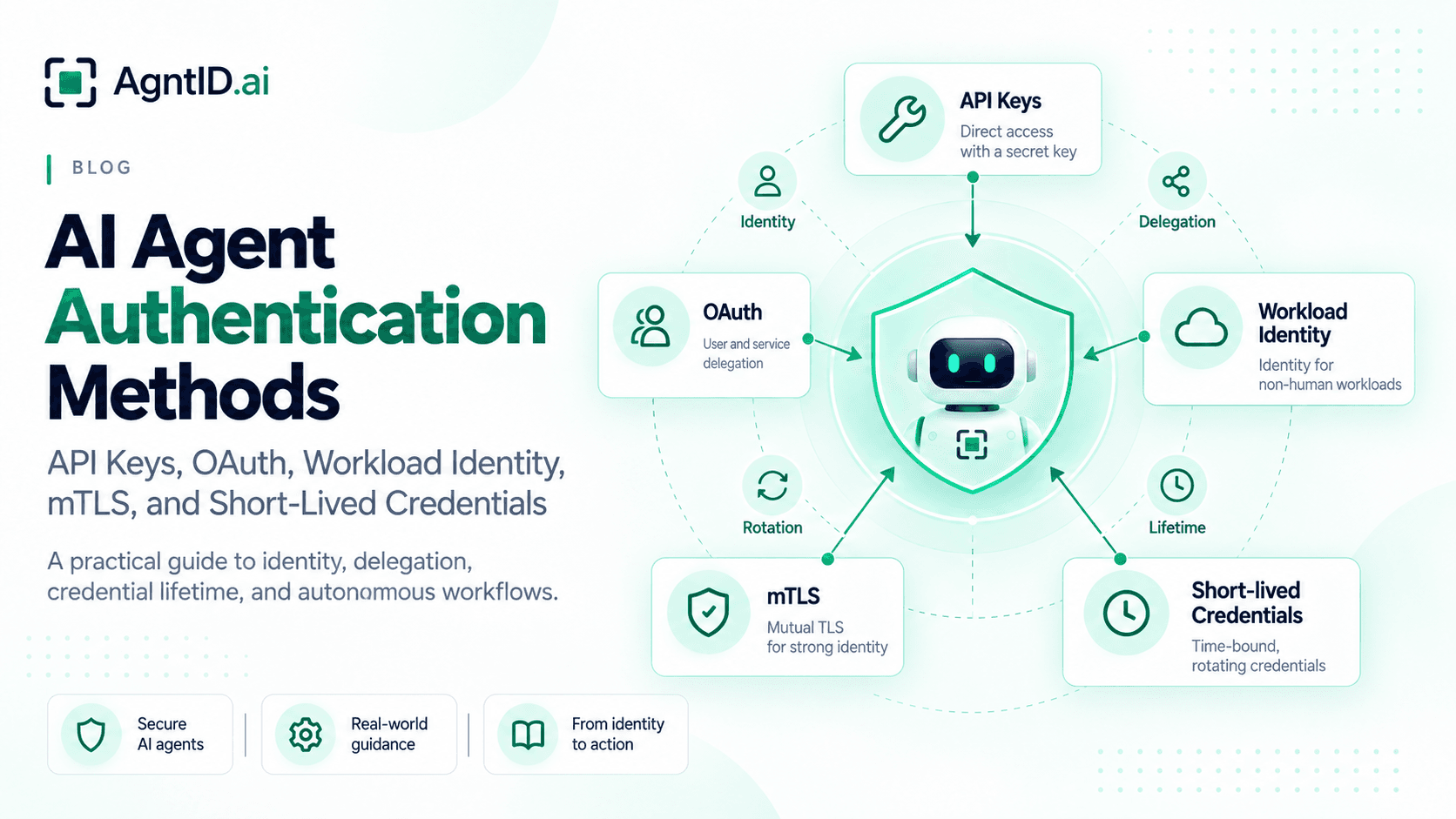
AI Agent Authentication Methods: API Keys, OAuth, Workload Identity, mTLS, and Short-Lived Credentials
AI agents call APIs, query databases, update records, invoke tools, and trigger workflows. Once an agent can act outside the model, it needs credentials.
The practical question is not simply, "How should an AI agent authenticate?" It is: What identity should the agent prove, to which system, for how long, and on whose behalf?
Common authentication methods answer that question in different ways. API keys usually identify an integration. OAuth can carry delegated user context. Client credentials identify an application. Workload identity identifies a runtime or workload. mTLS proves possession of a private key. SPIFFE provides workload identity. Short-lived credentials reduce how long any of those proofs remain valid.
These methods also overlap. A workload identity system may exchange an OIDC assertion for temporary cloud credentials. SPIFFE can issue short-lived X.509 or JWT identity documents. OAuth clients can authenticate using secrets, certificates, or signed assertions.
So these are not interchangeable alternatives. Some establish identity. Some carry identity claims. Others define how long the resulting credential remains valid.
What is AI agent authentication?
AI agent authentication is the process of verifying the identity or credential an agent uses to access an API, tool, service, or other system. That identity may represent a user, application, workload, service account, or another machine principal.
The right model depends on the workflow. An agent acting for a user may rely on delegated OAuth access. A background agent may authenticate as an application or service account. An agent running in Kubernetes may rely on workload identity.
Authentication establishes who or what is making the request. Permission scope, credential lifetime, and runtime access control are separate design questions.
What identity does an AI agent authenticate as?
An agent may authenticate using a user's delegated identity, an application identity, a service account, or an infrastructure-backed workload identity.
The correct identity depends on the trust boundary. The identity used for a SaaS API may differ from the identity used by the runtime, and both may differ from the user whose authority initiated the task.
AI agent authentication methods compared
| Method | Identity proven | Credential | Typical lifetime | Delegation context | Best fit | Main risk |
|---|---|---|---|---|---|---|
| API key | Integration or application | Shared bearer secret | Usually long-lived | Usually none | Simple API integrations | Replay and weak attribution |
| OAuth / OIDC | User | Access token, optional refresh token, optional ID token | Access token usually short-lived | User delegation | User-backed SaaS and API access | Refresh-token exposure and broad delegation |
| OAuth client credentials | Application or service | Client secret, private-key assertion, or certificate used to obtain an access token | Access token usually short-lived. Bootstrap credential may last longer. | Application context | Server-to-server agents and background workflows | Shared application identity |
| Workload identity / federation | Workload or runtime | Infrastructure-backed assertion exchanged for temporary credentials | Usually short-lived | Workload context | Cloud-native and cross-cloud workloads | Trust misconfiguration |
| mTLS / X.509 | Client or workload | X.509 certificate and private key | Configurable | Usually workload or client context | Service-to-service authentication | PKI and key-management overhead |
| Signed token / JWT assertion | User, application, workload, or other subject | Signed JWT or similar token | Usually time-bounded | Flexible | Federation, token exchange, and cross-domain identity | Bearer-token replay if not sender-constrained |
| SPIFFE workload identity | Workload | X.509-SVID or JWT-SVID | Short-lived by design | Workload context | Kubernetes, multi-cloud, and dynamic infrastructure | Attestation and trust-domain complexity |
| Short-lived credential | Depends on the issuer | Temporary token, certificate, or derived credential | Minutes, hours, or task duration | Depends on issuance context | Workflows where durable secrets should be minimized | Short lifetime does not fix broad identity or permissions |
The useful comparison is what identity each method establishes, how long the credential lasts, and what delegation context it carries.
In many agent systems, several of these AI agent authentication methods are used together.
How do API keys work for AI agents?
API keys remain common because they are easy to issue and easy to send with a request. Depending on the provider, a key may identify an application, project, tenant, account, or integration rather than an individual agent.
Most API keys behave as bearer secrets. If the same key is copied across several agent processes, anyone who obtains it may be able to use it until the key expires, is revoked, or is rotated.
API keys still make sense when the destination only supports them or when richer identity context is unnecessary. For autonomous workflows, keeping the durable key outside the agent process can reduce direct secret exposure.
How does OAuth work for AI agents?
OAuth for AI agents is useful when an agent needs to access another system on behalf of a user. The user authenticates with an authorization server, and the client receives an access token representing the delegated access. OpenID Connect can add identity claims about the authenticated user.
This pattern fits agents that access calendars, documents, ticketing systems, or other SaaS applications for a person. Access tokens are typically time-bounded, while longer-running workflows may rely on refresh tokens or another renewal mechanism.
The important distinction is between the user and the software acting for that user. OAuth preserves delegated user context across the workflow.
What are OAuth client credentials?
The OAuth client credentials flow is designed for machine-to-machine activity. An application authenticates with its own credential and receives an access token without involving an end user.
This works well for service-owned agent workflows and background automation. The issued access token can be short-lived even when the underlying client secret, certificate, or private key has a longer lifecycle.
The main limitation is identity granularity. If several agents share one OAuth client, the destination sees one application identity. That may be correct for the architecture, but it does not distinguish the individual agent processes using it.
What is workload identity for AI agents?
Workload identity lets software authenticate through the environment in which it runs instead of relying on a manually distributed long-lived secret. Cloud platforms and Kubernetes environments commonly use this model.
A workload can present an infrastructure-backed identity and exchange it for temporary credentials accepted by another system. Workload identity federation extends this model across trust boundaries, allowing an external workload identity to be exchanged for short-lived credentials in another platform.
The identity boundary still depends on the infrastructure. A workload identity may represent a pod, service account, application, or other runtime. It answers which workload is this? It does not by itself answer what access should this agent receive for the action it is taking now?
What is mTLS authentication?
Mutual TLS, or mTLS, uses certificates to authenticate communicating systems. On the client side, the client presents an X.509 certificate and proves possession of the corresponding private key.
Unlike a bearer credential, mTLS requires the client to prove that it holds the private key associated with the certificate. This makes mTLS authentication useful for machine-to-machine communication between agent infrastructure, internal APIs, gateways, and credential brokers.
The tradeoff is operational complexity. Certificate authorities, trust anchors, private-key protection, renewal, and trust distribution all need to be managed. mTLS also usually represents machine or workload identity rather than delegated user identity.
How do signed tokens and JWT assertions work?
Signed tokens such as JWTs provide a flexible way to carry identity assertions. Claims can describe a subject, issuer, audience, expiration, workload, application, actor, or other context.
The receiving system needs to validate the signature and the claims it depends on. A valid signature proves that a trusted issuer created the token. It does not prove that the party presenting a bearer token is the original intended holder.
Signed assertions are also useful in token exchange flows, where one trusted identity is exchanged for a credential understood by another system.
Sender-constrained approaches such as mTLS or DPoP can require the presenter to prove possession of a corresponding key, reducing the usefulness of a stolen bearer token.
What is SPIFFE?
SPIFFE defines a standardized model for workload identity. A workload receives a SPIFFE ID and proves that identity through a SPIFFE Verifiable Identity Document, or SVID. SPIFFE supports both X.509-SVIDs and JWT-SVIDs.
Implementations such as SPIRE can automatically issue and renew short-lived workload credentials. This works well across Kubernetes clusters, services, hosts, and multi-cloud environments where workloads need consistent identities without static shared secrets.
SPIFFE and mTLS are complementary. SPIFFE defines the workload identity. mTLS authenticates the connection.
What are short-lived credentials?
Short-lived credentials are better understood as a credential property than as a standalone identity model. OAuth access tokens, temporary cloud credentials, JWTs, projected service-account tokens, and X.509 certificates can all be short-lived.
The benefit is that a stolen credential remains useful for less time. A durable secret may remain valid until someone revokes or rotates it. A short-lived credential expires automatically.
Credential lifetime and permission scope still need to be evaluated separately. A five-minute credential tied to a broadly permissioned service account remains broadly permissioned for those five minutes.
What are the main AI agent authentication security considerations?
Review five things: which identity the credential represents, where the credential is stored, how long it remains valid, how it rotates, and whether user or tenant context needs to be preserved.
Autonomous agents may call several systems during one task, increasing the number of places where credentials can be exposed, copied, or reused. Multi-tenant systems add another boundary because credentials and delegated connections need to remain tied to the correct tenant or account. Tenant isolation becomes especially important when the same agent application serves multiple organizations.
Bearer credentials also deserve attention. Short expiration reduces exposure time, but a stolen bearer token may still be replayed while it is valid. Where stronger proof is required, sender-constrained approaches such as mTLS or DPoP can bind credential use more closely to the intended client.
Why is authentication not enough for autonomous agents?
Traditional application security often assumes a stable relationship between an application, an identity, and a predictable set of actions. Autonomous agents make that relationship less stable because the tool and action may only be selected after the agent reasons about the task.
One step may require read access. Another may require a narrow write. Authentication establishes which identity or credential the agent presents. It does not determine whether every permission available through that identity is needed for the next action.
That creates a separate AI agent access control question: Can permissions be narrowed for the specific task and tool action being executed?
Where does runtime access control fit?
Runtime access control limits an authenticated agent to the permissions needed for a specific action. AgntID provides runtime access control enforcement for AI agents and complements existing authentication and IAM systems.
OAuth can establish user delegation. Workload identity can authenticate the runtime. mTLS or SPIFFE can establish workload trust. When an agent selects a tool, AgntID can evaluate policy together with runtime task intent and narrow permissions for that tool action.
The goal is to give each tool action only the permissions required for that task. AgntID describes this as least-privilege, just-for-task access. It supports both pass-through credentials and AgntID-issued scoped credentials.
Runtime enforcement and control remain inside the organization's infrastructure. AgntID is designed to work with existing IAM systems, tools, and vendor-hosted, customer-hosted, or custom MCP servers without requiring a rip-and-replace approach. For the authorization layer that follows authentication, see AI agent authorization and runtime access control.
How should you choose an AI agent authentication method?
Start with the identity the destination needs to trust. An API key may be enough when the system only needs to recognize an integration. OAuth fits workflows that need delegated user context. Client credentials fit application-owned background work. Workload identity and SPIFFE fit infrastructure-backed machine identity.
Then evaluate credential lifecycle. Ask where durable secrets live, how credentials rotate, whether temporary credentials can replace static ones, and whether the agent needs to preserve delegated access across a longer workflow.
Finally, keep identity, credential lifetime, and permission scope separate. Authentication answers who or what is calling. Short-lived credentials reduce how long a credential remains useful. Runtime access control determines how much access should be available for a specific action.
Why do agent systems combine several authentication methods?
An agent system may use OAuth for delegated user context, workload identity for the runtime, SPIFFE or mTLS for internal service communication, and signed tokens or token exchange for identity across trust boundaries.
Short-lived credentials can reduce credential lifetime across several of those layers. Runtime access control can then narrow permissions for the particular tool action the agent is attempting.
Match the authentication method to the identity boundary, minimize credential lifetime, and treat runtime permission control as a separate layer.
Frequently asked questions about AI agent authentication
What is AI agent authentication?
AI agent authentication verifies the identity or credential an AI agent uses to access APIs, tools, services, or data. The identity may represent a user, application, workload, or service account.
How do AI agents authenticate?
AI agents can authenticate using API keys, OAuth, client credentials, workload identity, mTLS, signed tokens, or SPIFFE-style workload identities. The right method depends on which identity the destination needs to trust.
What is AI agent identity?
AI agent identity is the user, application, service account, workload, or other machine principal represented when an agent authenticates to another system. The correct identity depends on the workflow and trust boundary.
What is workload identity for AI agents?
Workload identity lets an agent runtime authenticate using an infrastructure-backed identity instead of a manually distributed long-lived secret. It is common in cloud and Kubernetes environments.
What is workload identity federation?
Workload identity federation lets a workload use an identity from one trusted environment to obtain temporary credentials in another. It reduces the need to store permanent credentials in the workload.
Is workload identity enough for AI agents?
Workload identity can authenticate the runtime hosting an agent. It does not by itself determine which permissions should be available for each agent tool action.
What is mTLS authentication?
mTLS authenticates communicating systems using certificates and private keys. It is commonly used for machine-to-machine and workload authentication.
What is SPIFFE?
SPIFFE is a standard for assigning cryptographic identities to workloads. It uses SPIFFE IDs with X.509 or JWT identity documents.
What is the difference between SPIFFE and mTLS?
SPIFFE defines workload identity. mTLS authenticates the connection and can use certificates associated with those workloads.
Are API keys suitable for AI agents?
API keys can work for simple integrations, especially when the destination requires them. Long-lived or broadly shared keys increase credential exposure and provide limited identity context.
What are short-lived credentials?
Short-lived credentials are tokens, certificates, or temporary credentials that expire after a limited period. They reduce how long a stolen credential remains useful.
What are sender-constrained tokens?
Sender-constrained tokens bind a token to a client-held key. Mechanisms such as mTLS or DPoP can require proof of possession so a stolen token alone is less useful.
What is just-for-task access for AI agents?
Just-for-task access limits an agent's permissions to what it needs for the specific task or tool action being executed. AgntID applies this model at execution time based on policy and runtime task intent.
How does AgntID work with existing IAM?
AgntID complements existing IAM by enforcing access at execution time. IAM can continue to establish identity and broader access while AgntID narrows permissions for each agent tool action based on policy and task intent.