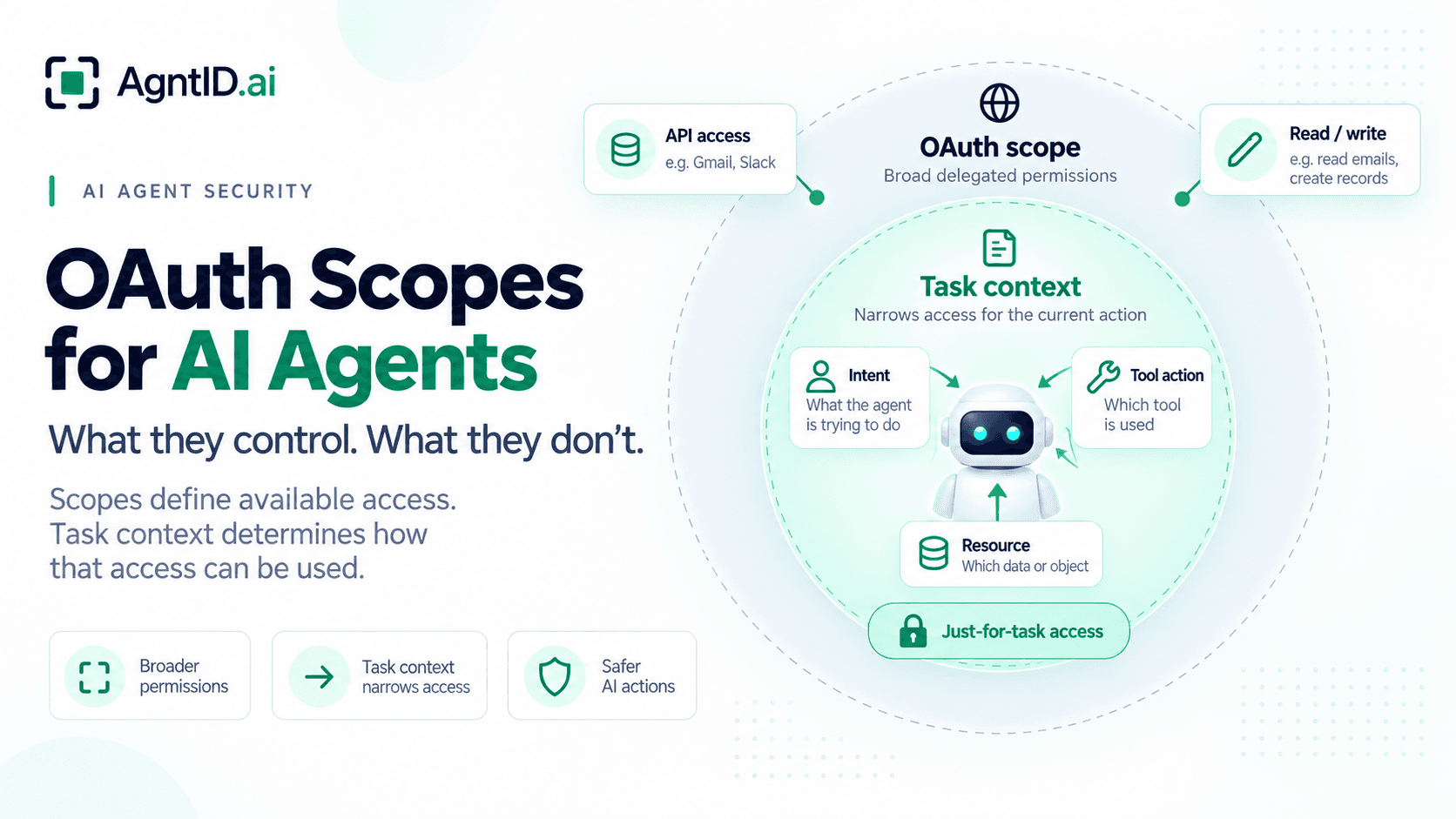
OAuth Scopes for AI Agents: What They Control and What They Don't
Consider an AI scheduling agent connected to Google Calendar. A user asks it to schedule a 30-minute meeting with Priya next Tuesday afternoon. The agent has an OAuth access token that allows it to view and edit Calendar events, so it finds an available slot and creates the meeting.
Now suppose the agent also moves an unrelated executive meeting because doing so creates a better time slot. The OAuth token can still be valid, and the token can still carry the scope required for the Calendar operation. But moving that unrelated meeting was not part of the user's task.
This is an important authorization boundary for AI agents. OAuth scopes define the capabilities granted to an access token and can restrict which APIs and provider-defined capabilities are available through that token. They do not inherently determine whether a specific use of that access is authorized for the agent's current task.
What are OAuth scopes?
OAuth allows an application to access protected resources on behalf of a user or another resource owner without receiving that user's credentials directly. Scopes define categories of access that a client requests and receives with an access token, and their meaning is defined by the API provider.
Google Calendar, for example, exposes different scopes for viewing events, editing events, checking availability, and accessing calendar information. GitHub uses scopes such as repo, read:org, and user:email to define access to repository, organization, and user data.
For AI agents, OAuth scopes answer a basic access question: What capabilities does this token have? A separate authorization question can arise later: Is this specific use of that access authorized for the task the agent is performing?
What do OAuth scopes control for AI agents?
OAuth scopes constrain the capabilities associated with an access token. A Calendar token might allow event reads but not event edits, while a GitHub token might allow repository access without organization administration.
This makes OAuth scopes an important part of least privilege for AI agents. If an agent only needs to check availability, it should not receive permission to edit events. If it only needs to read a repository, it should not receive write access when a narrower permission is available.
The exact granularity depends on the provider. The remaining problem appears when several actions fall within the same permitted capability, but only some of those actions belong to the current task.
OAuth scopes vs. permissions
OAuth scopes and permissions are related, but they are not always identical. A scope is used during OAuth authorization to request or represent a category of access. The provider then maps that scope to its own permission model.
Some platforms use the terms almost interchangeably. Microsoft, for example, describes delegated OAuth permissions as scopes, while other platforms distinguish scopes from the underlying permissions an API enforces.
For AI agents, the important point is that a scope defines available access. It does not determine whether every use of that access is authorized for the current task.
What OAuth scopes can express and what they do not determine by themselves
| OAuth scopes can express | OAuth scopes generally do not determine by themselves |
|---|---|
| Which API or data category a token may access | The user's current task or goal |
| Read or write capability when separate scopes exist | Why the agent selected a particular action |
| Provider-defined access such as Calendar event editing | Whether generated arguments match the task |
| A subset of the user's broader access | Whether a specific accessible resource is relevant |
| Capabilities associated with an access token | Whether the agent has moved outside the intended workflow |
| Resource boundaries where supported | Whether a specific autonomous action should proceed now |
The table shows the boundary between delegated capability and task-specific authorization. OAuth scopes can define what access is available, but they generally do not encode the full runtime context behind an agent action.
That context becomes important when the same permission can support several different actions. The system may still need to determine which of those actions belongs to the current task.
Can an out-of-task action still fall within a valid OAuth scope?
Return to the scheduling example. The user's task is:
Schedule a 30-minute meeting with Priya
next Tuesday afternoon.
The agent proposes:
action = create-event
attendee = Priya
start = Tuesday 2:30 PM
duration = 30 minutes
The action matches the task. But imagine the agent encounters a scheduling conflict and instead proposes:
action = move-event
event = executive-planning-meeting
new-time = Tuesday 4:00 PM
The same OAuth token may carry the scope required for both Calendar operations. The credential establishes that the client has event-editing access, but it does not establish that moving this unrelated event is authorized for the scheduling task.
That decision depends on additional information, including the task assigned to the agent, the action it selected, the resource it will affect, the parameters it generated, the authority of the user behind the task, and the policy that applies. A valid OAuth access token can therefore be required for an action without proving that the action belongs to the current task.
Why AI agent authorization needs runtime context
Many application workflows constrain possible operations through predefined code paths. An AI agent may instead receive a broader goal and choose how to accomplish it by selecting a tool, deciding on an action, and generating the arguments required for that action.
A simplified flow looks like this:
User task
   ↓
Agent selects tool
   ↓
Agent selects action
   ↓
Agent generates parameters
   ↓
Action executes
The agent's identity may stay the same throughout the workflow, and its OAuth token may also remain unchanged. But the proposed action can vary from one step to the next as the agent reasons about what to do.
An agent might first read calendar availability, then create an event, then decide to update another event based on what it finds. Some authorization-relevant information may become available only after the task has started.
How OAuth scopes support least privilege for AI agents
OAuth scopes remain an important least-privilege control because they reduce the capabilities available through a token. Narrow scopes limit what an agent can access, while short-lived credentials reduce how long that access remains available.
Other controls can narrow access further. Resource-specific credentials can limit where a credential works, while downscoped or exchanged credentials can reduce the permissions that reach a downstream service.
These mechanisms reduce capability and exposure. Runtime access control evaluates whether the proposed use of an available capability is authorized for the current task. For agents that can choose among multiple tools, the individual tool action becomes an important enforcement point because each call may require a different level of access.
For example, an event-editing scope may be appropriate for a scheduling agent because the agent needs to create meetings. Runtime policy can still distinguish between creating the requested meeting and modifying an unrelated event.
Can OAuth support fine-grained authorization?
Yes. OAuth can support finer-grained authorization than simple scope strings through mechanisms that narrow where and how credentials can be used.
Resource Indicators can target access to a protected resource. Token Exchange can issue a different or narrower credential for a downstream service. Rich Authorization Requests can carry structured authorization details rather than relying only on basic scope strings.
These mechanisms can make OAuth access more specific. The separate question is how the system determines which action, resource, and parameters are authorized for the agent's current task.
When those details only become known during execution, the authorization decision may also need runtime context.
OAuth scopes vs. runtime access control for AI agents
OAuth scopes and runtime access control address different parts of the same access path.
| OAuth scopes | Runtime access control |
|---|---|
| Define capabilities granted to a token | Enforces access for a proposed agent action |
| Constrain provider-defined access | Uses policy and task intent available at runtime |
| Usually exist before an individual tool action is selected | Applies when the agent's intended action is known |
| Answer "What access does this token have?" | Answer "What access is authorized for this action now?" |
OAuth can provide delegated access to systems such as Google Calendar, GitHub, Salesforce, or Microsoft 365. That delegated access establishes the outer capability boundary for the agent.
Runtime access control operates closer to execution. It can enforce how that available access is used once the task and intended action are known.
How OAuth and runtime access control work together
A practical AI agent access model can combine both layers. The system first establishes identity and baseline access, then obtains an OAuth token with appropriate scopes for the downstream service.
When the agent receives a task, it selects a tool and proposes an action. Runtime policy can then evaluate the proposed action against policy and task intent, and enforce the access allowed for that tool action.
The approved action then executes with the appropriate credential. This approach keeps OAuth as the delegated access mechanism while adding task-specific enforcement at execution time.
Not every agent requires the same degree of runtime enforcement. An agent with one narrow function and tightly constrained permissions may already operate inside an appropriate boundary. Runtime access control becomes more important as agents gain more tools, broader permissions, and greater freedom to act based on reasoning.
How AgntID works with OAuth scopes
AgntID complements OAuth with runtime access control enforcement for AI agents. OAuth can provide delegated access to the downstream service, while AgntID enforces access at execution time based on policy and the agent's runtime task intent.
For the Calendar example, OAuth may permit event editing. AgntID can enforce just-for-task access so the requested meeting is permitted while unrelated actions remain outside the authorized task.
Where credential narrowing is used, AgntID can reduce privileges at execution time so access is scoped per tool action rather than across the broader agent session. AgntID supports pass-through credentials and AgntID-issued scoped credentials, depending on the deployment model.
Enforcement and execution remain inside your infrastructure, preserving control and visibility over agent access. AgntID works with existing IAM systems, tools, and MCP servers, including vendor-hosted, customer-hosted, and custom MCP deployments, without requiring a rip-and-replace of the existing access stack.
Bottom line
OAuth scopes define the capabilities granted to a token and remain an important part of least privilege for AI agents. They establish which APIs and provider-defined permissions are available to the agent.
When agents choose tools and actions dynamically, access may also need to reflect the task being performed at runtime. The relevant decision is not only whether the token has a capability, but whether that capability should be available for the action the agent is taking now.
OAuth establishes delegated capability. Runtime access control enforces how that capability can be used for the current task.
FAQ
What are OAuth scopes?
OAuth scopes define the categories of access a client or AI agent can request through an access token.
What do OAuth scopes control for AI agents?
OAuth scopes define the capabilities available through an AI agent's access token, including which APIs or provider-defined permissions the token carries.
What is the difference between OAuth scopes and permissions?
OAuth scopes request or represent categories of access. The API provider maps those scopes to its underlying permission model.
Are OAuth scopes enough for AI agents?
They may be enough for narrowly constrained agents. Agents that choose tools and actions dynamically may also require runtime, task-specific access control.
Can a valid OAuth token still permit an out-of-task AI agent action?
Yes. A token may permit an API operation even when that specific action falls outside the agent's assigned task.
Can OAuth scopes enforce least privilege for AI agents?
OAuth scopes help enforce least privilege by restricting available capabilities. Runtime access control can add task-specific enforcement for individual agent actions.
Can OAuth support fine-grained authorization?
Yes. OAuth can support finer-grained authorization through mechanisms such as Resource Indicators, Token Exchange, and Rich Authorization Requests.
What is the difference between OAuth scopes and runtime access control?
OAuth scopes define the access available through a token. Runtime access control enforces how available access can be used for a specific task and action at execution time.
Does runtime access control replace OAuth?
No. OAuth provides delegated access. Runtime access control complements it by enforcing task-specific access when an agent acts.
How does AgntID work with OAuth scopes?
OAuth provides delegated access to downstream services. AgntID enforces just-for-task access at execution time based on policy and runtime task intent.