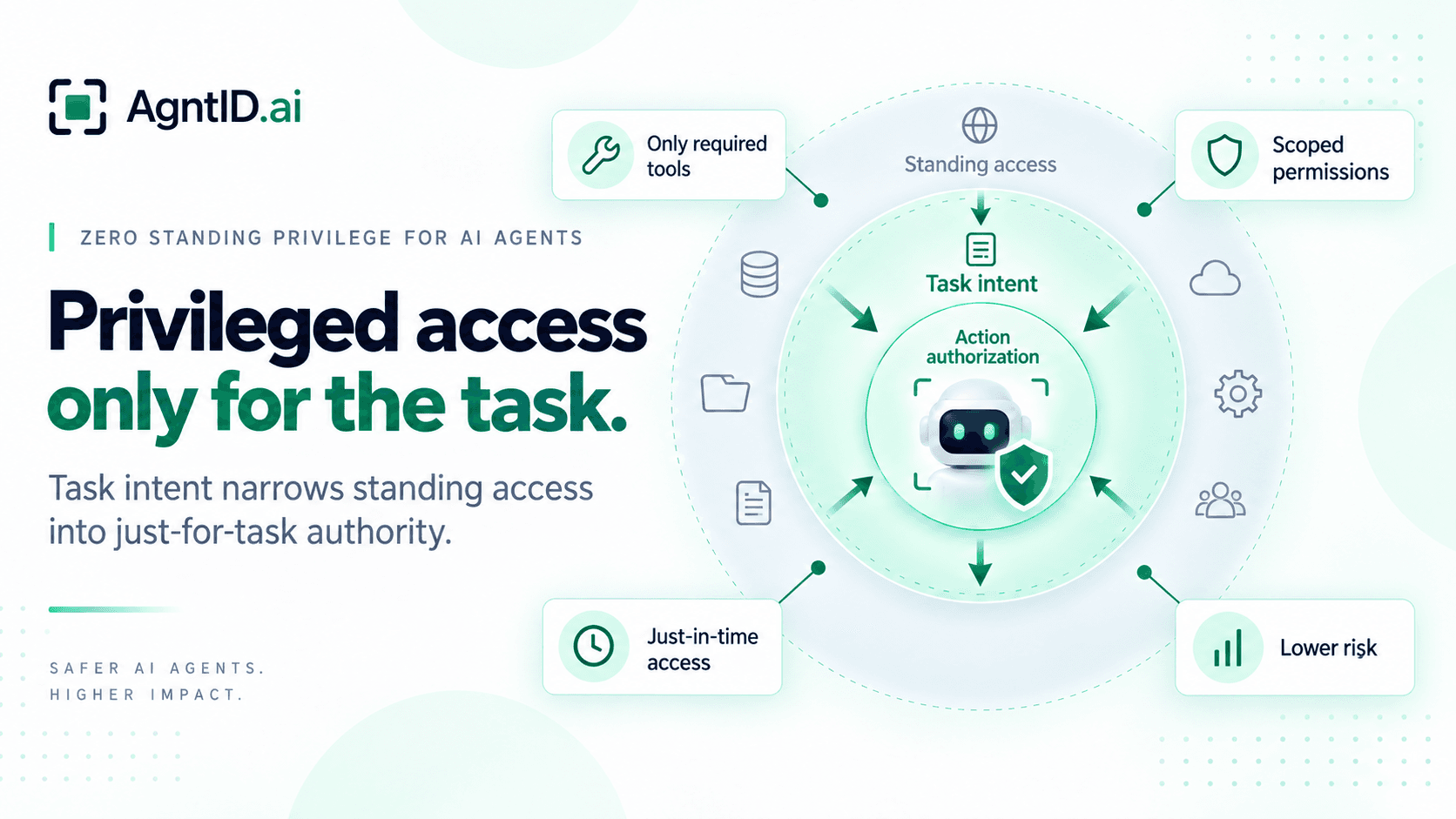
Zero Standing Privilege for AI Agents: Why Privileged Access Should Exist Only for the Task
An AI agent needs to investigate a failed deployment and update one configuration value in production. The task takes ten minutes, but the agent has a service account with permission to read logs, restart workloads, modify service configuration, rotate secrets, and change infrastructure resources.
That privileged authority was available before the task started. It remains available while the agent reads logs and decides what to do, and it may still be available long after the change is complete. The problem is not only how much access the agent has. It is that privileged authority exists when there is no current task that requires it.
Zero Standing Privilege, or ZSP, changes that model. Privileged authority becomes available when a task requires it and becomes unavailable again when that need ends. For AI agents, the principle is simple: privileged access should follow the task.
What is Zero Standing Privilege for AI agents?
Zero Standing Privilege is an access model in which privileged authority does not remain continuously available when there is no active need for it. You may also see the term written as Zero Standing Privileges, or ZSP. An AI agent can still have a stable identity while privileged authority remains unavailable until a task requires it.
IAM can define which systems the agent may generally reach. Policies can establish baseline access, and downstream applications can continue to enforce their own authorization rules. What changes is the default state of privileged authority.
An infrastructure agent does not need permanent production-write access simply because a future task may require a configuration change. The agent reaches a point where the task requires additional authority. The request is evaluated, and the required authority becomes available only when the action is allowed. Identity can persist. Privileged authority does not need to.
Standing privilege vs. Zero Standing Privilege
Standing privilege keeps authority available before the task exists. Zero Standing Privilege changes that default so privileged authority is unavailable to the agent until a legitimate need appears.
| Access dimension | Standing privilege | Zero Standing Privilege |
|---|---|---|
| Default state | Privileged authority is already available | Privileged authority is unavailable to the agent until required |
| Access decision | Often based on preassigned permissions | Can be evaluated against the current task and action |
| Task context | Often not part of credential availability | Can be part of the authorization decision |
| Privileged access lifetime | Long-lived or continuously available | Temporary or task-bound where supported |
| Permission scope | Often based on everything the identity may need | Can be narrowed to the current task or action |
| Agent idle state | Privileged credentials may remain usable | Privileged authority should no longer be available |
| Credential availability | Reusable secrets or tokens may remain continuously available | Credentials can be issued, exchanged, or brokered with narrower scope when needed |
| Blast radius | Includes everything the standing credential can reach | Reduced by scope, policy, and access lifetime |
| Audit context | Access may not be tied to the task that required it | Access can be connected to the task and action that required it |
The central question is not whether the agent has an identity. It is whether privileged authority remains available before there is a current reason to use it.
Why standing privilege increases AI agent risk
Standing privilege is not a new security problem, but AI agents change how that privilege can be exercised. Traditional applications usually follow execution paths defined in code. Agents can interpret goals, select tools, choose actions, generate parameters, read results, and change their next step while a task is already running.
That means the same identity can take different actions across different tasks. An infrastructure agent may legitimately need permission to read logs, restart workloads, change configuration, rotate secrets, and modify infrastructure across its lifetime. A single log-investigation task does not require all of those capabilities.
If a broad production credential is already available, every privilege attached to it remains technically usable. A bad plan, manipulated input, or compromised tool response can trigger actions that use authority unrelated to the current task. ZSP reduces the attack surface and blast radius by reducing the privileged authority available before it is needed.
The access lifecycle should follow the task lifecycle
A ZSP architecture changes the order in which privilege appears. With standing privilege, authority exists first and the agent decides how to use it later. With ZSP, the task creates the need first, and privileged access follows.
Agent receives task
        ↓
Agent reasons and plans
        ↓
Agent reaches a privileged action
        ↓
Access request is created
        ↓
Task + policy + action are evaluated
        ↓
        ├── Deny
        │     ↓
        │   Block and record
        │
        └── Allow
              ↓
      Required authority becomes available
              ↓
         Approved action executes
              ↓
       Decision and result are recorded
              ↓
   Task completes or access need ends
              ↓
   Privilege expires, is revoked, or
        becomes unavailable
              ↓
      No standing privileged access
The order matters because the system first knows what the agent is trying to do. It can then determine whether that action is allowed and what authority should be available for it.
This ties the access decision and resulting authority to the task being performed.
Long-lived service account credentials vs. ephemeral access
Service accounts can still provide a stable workload identity for AI agents. They can support authentication and connect an agent to an existing IAM system. The risk appears when that identity is paired with broad, reusable credentials that remain continuously available.
Long-lived service account credentials
Agent starts
    ↓
Loads reusable production credential
    ↓
Receives Task A
    ↓
Uses credential
    ↓
Task A ends
    ↓
Credential remains valid
    ↓
Agent sits idle
    ↓
Receives Task B
    ↓
Same credential is still available
The credential remains usable after the task that required it has ended. The agent may be idle, but the authority attached to that credential is still available.
Ephemeral task-scoped access
Agent starts with stable identity
    ↓
Receives Task A
    ↓
Task requires privileged action
    ↓
Request is evaluated
    ↓
Required authority becomes available
    ↓
Approved action executes
    ↓
Task or access need ends
    ↓
Authority expires, is revoked,
or becomes unavailable
Ephemeral credentials are one way to implement ZSP, but they are not the definition of ZSP. A five-minute credential can still carry more authority than the task requires. The broader requirement is that privileged authority should not remain continuously usable when there is no active need.
A system may use short-lived cloud credentials, OAuth token exchange, temporary database access, workload identity, or a credential broker. The mechanism can change. The principle does not.
AI agent access control needs more than short-lived credentials
A short credential lifetime reduces exposure, but it does not answer why the access exists. An administrator token that lasts five minutes is still an administrator token during those five minutes.
Consider a finance agent connected to a payment platform. One task asks it to inspect a transaction. Another asks it to refund a confirmed duplicate charge. A third asks it only to summarize billing history. The agent identity and API may be the same, but the authority required for each task is different.
Runtime access control can consider the current task, selected tool, requested action, policy, and execution context. This moves the access decision closer to the work being performed. The agent can propose an action, but it should not decide for itself that the action is authorized.
Zero Standing Privilege, JIT access, and least privilege solve different problems
Zero Standing Privilege, Just-in-Time access, and least privilege are related, but they answer different questions. Least privilege asks what minimum authority is required. Just-in-Time access asks when that authority should become available and for how long. Zero Standing Privilege asks whether privileged authority should remain available when there is no active task that requires it.
A ZSP architecture may use both least privilege and JIT access. Least privilege reduces scope. JIT access limits when authority becomes available and how long it remains active. ZSP defines the default state: privileged authority should not remain available to the agent when there is no active need.
For a broader discussion of static and contextual permissions, see RBAC vs ABAC for AI Agents.
Runtime authorization evaluates each privileged action
Removing standing credentials reduces persistent exposure, but it does not determine whether every action taken during an approved task is valid. An agent may receive temporary authority for ten minutes and make dozens of tool calls during that period.
Runtime authorization evaluates the specific action the agent is attempting before it runs. This creates two separate questions: should privileged authority be available for this task? and should this specific action execute using that authority?
Both matter for autonomous agents. A task may legitimately require an infrastructure agent to change one configuration value, but that does not mean every production modification attempted during the same access window should be allowed. ZSP limits when privileged authority is available. Runtime authorization determines whether a specific action should be allowed.
Zero Standing Privilege across APIs, cloud, databases, and SaaS
A ZSP architecture does not require every system to support the same credential model. A cloud platform may support temporary workload credentials, an OAuth-based SaaS application may support scoped tokens, a database may support temporary users, and a legacy API may still require a reusable key.
Where ephemeral credentials are supported, the system can issue or exchange credentials when the task requires privileged access. Where a downstream system still requires a reusable secret, that credential can remain in a trusted broker or secrets system rather than inside the agent runtime.
This matters in hybrid and legacy environments where complete removal of standing credentials may not be immediately practical. ZSP can still guide the architecture by limiting when privileged authority is exposed to the agent and narrowing how it can be used. For more on the identity side of this model, see AI Agent Authentication.
How ZSP improves AI agent auditability
Standing credentials can make it difficult to explain why a particular privilege was available at the time an action occurred. When access is tied to a task or action, teams can create a clearer record of why privileged access was needed, what decision was made, what authority became available, and when it became unavailable.
For AI agent access reviews, useful records can connect the agent identity, task, access decision, tool action, credential used, and execution result. This gives security teams clearer context for investigations and access reviews.
ZSP does not by itself prove regulatory compliance or replace an organization's audit controls. It provides a stronger access model for connecting privileged activity to a specific need rather than leaving authority continuously available.
How AgntID fits into Zero Standing Privilege
A practical ZSP architecture benefits from a control point between agent intent and privileged execution. AgntID provides that control through runtime access control enforcement for AI agents. Traditional IAM systems can continue to establish identity and baseline access, while AgntID works alongside existing IAM systems, tools, and MCP servers rather than requiring a rip-and-replace.
At execution time, AgntID uses policy and runtime agent intent to scope permissions for a specific tool action. Credential narrowing limits the permissions available through the credential for a specific tool action rather than across the full session. AgntID supports both pass-through and AgntID-issued credential models for task-specific access.
Existing IAM
Establish identity and baseline access
        ↓
Agent receives task
        ↓
Agent reasons and selects a tool action
        ↓
AgntID runtime enforcement
Policy + task intent
        ↓
Credential narrowing
What permissions does this action need?
        ↓
Scoped access
Pass-through or AgntID-issued credential
        ↓
Tool / API / MCP server
Execute the permitted action
Runtime enforcement stays inside your infrastructure, so execution and access control remain within your environment. AgntID works with vendor-hosted, customer-hosted, and custom MCP servers. The result is least-privilege, just-for-task access at execution time.
How to implement Zero Standing Privilege for AI agents
A practical ZSP implementation starts by identifying where standing privilege exists today and then moving privileged authority closer to the task that requires it. The goal is not to redesign every identity system. It is to reduce how much privileged authority remains available between tasks.
1. Identify standing privilege
Inventory the credentials available to the agent, including service account keys, API tokens, OAuth credentials, database passwords, cloud roles, and delegated user access. For each one, determine what it can reach, how long it remains valid, where it is stored, and whether the agent can use it while idle.
This helps reveal the current blast radius. It also shows which credentials are broad because they represent everything the agent might need across its lifetime rather than what the current task requires.
2. Separate identity from privileged authority
Keep the stable agent identity where it is useful, but do not assume that every privilege associated with that identity must remain continuously available. An agent can be known to the system without carrying every credential it may need later.
This separation lets IAM continue to provide identity and baseline access while privileged authority is introduced only when a task creates a legitimate need.
3. Add runtime access control
Identify the actions that require privileged access and evaluate the task and requested action when the agent reaches the point of execution. The access control layer can then determine whether the action is allowed and what authority it requires.
This is also where credential narrowing can limit the credential to the permissions required for the work being performed. Instead of applying the same authority across an entire agent session, the system can make an access decision at the point of action.
4. Remove authority when the task ends
Define an explicit end condition for privileged access. Use expiration where supported, revoke access when practical, and end brokered access when the task completes or is terminated.
Do not depend on the agent to remove its own privileges correctly. The safest default state is one the system returns to automatically. For the time-bound access model behind this pattern, see Just-in-Time Access for AI Agents.
The architecture test: what can the AI agent do while idle?
A simple question can reveal whether an agent still depends on standing privilege: what privileged authority can the agent exercise when it is doing no work?
If the answer includes production cloud credentials, broad SaaS tokens, database passwords, or long-lived service account keys, privileged authority still exists independently of the task. A ZSP architecture aims for a different state. The agent can retain a stable identity, IAM can retain baseline access, secrets can remain protected, and tools can remain available.
Privileged authority becomes usable because an active task requires it. When the task ends, that authority should no longer remain available to the agent. For autonomous systems, privileged access should not exist because an agent might need it later. Privileged access should exist for the task. Then it should disappear.
Frequently asked questions about Zero Standing Privilege for AI agents
What are Zero Standing Privileges?
Zero Standing Privilege, or ZSP, keeps privileged authority out of an identity's default access state. Privileged access becomes available only when there is an active need.
What is the difference between Zero Standing Privilege and Just-in-Time access?
ZSP defines the desired default state of no continuously available privileged authority. JIT access is one mechanism for making that authority available temporarily when it is needed.
Is Zero Standing Privilege the same as least privilege?
No. Least privilege limits how much authority is granted. ZSP limits whether privileged authority remains available when it is not needed.
How do you grant AI agents access safely?
Start with a stable identity and baseline access, then evaluate privileged actions at runtime. Scope authority to the current task and action, then make that privileged authority unavailable when the need ends.
How do developers secure AI agent access to APIs?
Use stable agent identity, runtime access control, and scoped or temporary credentials. Privileged API access should become available only when the current task and action require it.
How do you prevent unauthorized AI agent access?
Do not rely only on broad session permissions. Evaluate privileged actions at runtime and limit available authority to the current task and action.
How do you audit and certify AI agent access rights?
Audit AI agent access by recording the agent identity, task, access decision, tool action, credential used, and result. Access certification should also review the agent's baseline access, its eligibility for privileged access, and whether those permissions are still required.
Does Zero Standing Privilege replace IAM or PAM?
No. IAM and PAM can continue to manage identity, baseline access, and privileged access. ZSP changes the default state so privileged authority does not remain continuously available to the agent.
How does AgntID support Zero Standing Privilege for AI agents?
AgntID provides runtime access control enforcement for AI agents. It uses policy and task intent to scope permissions at execution time and supports pass-through or AgntID-issued credentials for task-specific access.