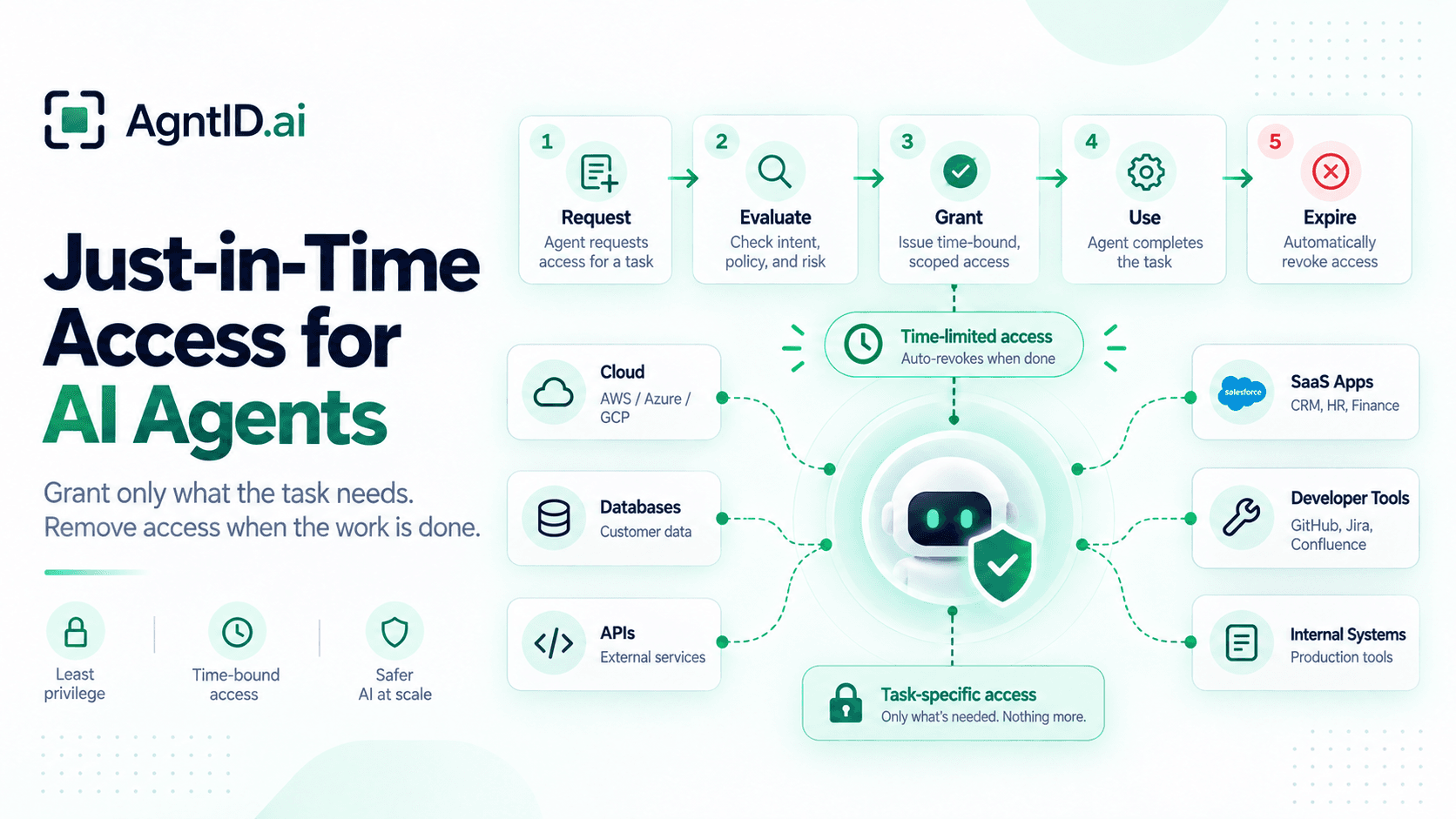
Just-in-Time Access for AI Agents: How JIT Access Works
An AI agent needs to inspect an AWS environment, find the cause of a failed deployment, and update one configuration value. The task takes ten minutes. The agent already has an AWS role that can read and modify infrastructure. That access existed before the task started, and it remains available after the task finishes.
The problem is not only permission scope. It is permission lifetime. If the agent needs privileged AWS access for ten minutes, that authority should not remain available for the rest of the day. Just-in-Time access addresses that gap by making authority available when a task requires it and removing that authority when the need ends. For AI agents, JIT access is a time-bound access model. The lifecycle is request, evaluate, grant, use, and expire or revoke.
What is Just-in-Time access for AI agents?
Just-in-Time access gives an identity temporary authority only when it is needed. Instead of assigning privileged access permanently, the system makes that authority available for a defined task or time window and removes it afterward. JIT is commonly used in Privileged Access Management, or PAM, to replace persistent privileged access with temporary elevation.
The same principle applies to non-human identities such as AI agents. Just-in-Time permissions let an agent receive access to infrastructure, applications, APIs, or data when a current task creates a legitimate need. This matters because agents can reason about a task, select tools dynamically, generate arguments, and decide what action to take while a workflow is running. Permanent permissions therefore tend to represent what an agent might need across many tasks rather than what the current task requires. For AI agents, the principle is simple: authority should follow the work.
Standing access vs. Just-in-Time access
Consider an infrastructure agent that occasionally needs permission to modify AWS resources.
Before: standing access
Agent deployed
      ↓
AWS role assigned
      ↓
Privileged access remains available
      ↓
Agent receives 10-minute task
      ↓
Agent modifies AWS resource
      ↓
Task finishes
      ↓
AWS authority remains available
The agent may need the privilege for only a few minutes, but the permission remains active outside that period. If the agent is manipulated, misdirected, or triggered by an unexpected input later, the same authority may still be available.
After: Just-in-Time access
Agent receives task
      ↓
Agent requires privileged action
      ↓
Access request is evaluated
      ↓
Temporary scoped authority is granted
      ↓
Agent performs the action
      ↓
Task completes or access window ends
      ↓
Authority expires or is revoked
The difference is the time boundary. Traditional access asks what the agent may access. JIT adds another question: should that authority exist now?
Why JIT access matters for AI agents
JIT access reduces the period in which privileged authority remains available without an active need. If an agent is compromised, manipulated, or runs the wrong workflow later, authority from an earlier task does not need to remain available. It also creates a clearer relationship between access and purpose. Teams can connect a temporary grant to the task that required it, record how long the authority existed, and show when it expired or was revoked. This creates a clearer audit trail for security investigations and compliance reviews.
JIT limits when authority exists and how long it remains available. Least privilege limits scope, while runtime access control evaluates the specific action the agent is attempting and enforces the resulting access decision.
JIT access vs. least privilege
Least privilege and JIT access solve different parts of the access problem. Least privilege limits scope. If an agent needs to read logs from one AWS account, it should not receive administrator access across the organization. But even a narrowly scoped permission can remain active longer than necessary.
Suppose an agent has only logs:Read. The permission may be correct for the task. If it remains assigned every day while the agent uses it for five minutes each week, the permission is narrow but still standing. Least privilege asks how much authority the agent should have. JIT asks when that authority should exist and for how long. Strong access control for AI agents needs both.
JIT access vs. Zero Standing Privileges
Zero Standing Privileges, or ZSP, describes the default privileged state. Under a ZSP model, privileged authority is not permanently assigned while there is no active need for it. JIT is one mechanism that can support ZSP. Temporary access appears when a legitimate need exists and disappears when the work finishes. An organization can use JIT for some privileged workflows while maintaining standing access elsewhere. JIT and ZSP are related, but they are not the same control.
A useful distinction is:
- Least privilege: How much authority should the agent have?
- JIT access: When should that authority exist, and for how long?
- ZSP: Should privileged authority exist by default between tasks?
For agent workloads, these distinctions matter because the task is often known closer to execution than deployment.
How JIT access fits into Zero Trust
JIT supports a Zero Trust model by making privileged authority temporary and tied to a current need instead of leaving it permanently available. Identity establishes who or what the agent is, while policy determines what access may be granted and JIT limits how long that authority remains available.
Runtime access control adds another decision point at execution time. It determines whether the specific action the agent is attempting is allowed for the current task and enforces that decision before the action runs.
How Just-in-Time access works for AI agents
A useful JIT model has five stages: request, evaluate, grant, use, and expire or revoke. The lifecycle starts with a real task. Access is not provisioned because the agent may need it someday. It becomes available because the current workflow requires it. Each stage answers a different question: what access is needed, whether that access is appropriate, what authority should be granted, how it should be used, and when it should disappear.
1. Request
The agent reaches a point where the task requires authority it does not currently hold. An infrastructure agent investigating a failed deployment, for example, may determine that it needs to update one ECS service. That requirement creates the access request.
The system should have enough context to understand why the authority is needed. Depending on the architecture, that may include the agent, initiating user, task, tool, requested action, target resource, arguments, and execution state. The request begins when the need appears, not when the agent is deployed.
2. Evaluate
The system determines whether the requested authority is appropriate for the current task. Existing IAM remains the identity and broader access foundation. Roles, groups, workload identities, and permissions can define which systems the agent may generally reach.
The harder question is whether the requested access makes sense for the work being performed now. An infrastructure agent may legitimately work with AWS. That does not mean every AWS modification belongs to every workflow. The evaluation should consider the current task and requested authority rather than relying only on access that was assigned before execution.
3. Grant
If the request is approved, the system makes the required authority available. The grant should be narrow enough for the task and limited in duration. Depending on the target system, this may involve assuming a restricted cloud role, issuing a temporary token, activating an entitlement, or providing scoped credentials.
JIT permissions should match the resource, action, and duration the task requires. Where the underlying system supports it, expiration should be enforced automatically rather than depending on the agent to surrender access.
4. Use
The agent performs the approved work using the temporary authority. A temporary credential can still permit several actions. A human administrator may receive an elevated role for 30 minutes, while an AI agent could make dozens of tool calls during the same window, ranging from reads to changes in production.
Temporary authority does not automatically authorize every action performed during that window. Runtime access control can evaluate a tool action as it occurs and enforce the resulting access decision before execution. AgntID provides runtime access control enforcement for AI agents. It uses policy and task intent to make access decisions at execution time and can narrow permissions for the specific tool action being performed.
5. Expire or revoke
The authority should disappear when its useful lifetime ends. That may happen because the task completes, the credential expires, the workflow terminates, policy changes, or access is explicitly revoked.
Automatic expiration matters because cleanup should not depend on successful agent behavior. If an agent completes an infrastructure change and then crashes, privileged access should not remain active because a cleanup step failed. Expiration sets the maximum lifetime, while revocation provides an earlier stop when the task finishes sooner or the security context changes.
Common JIT access models for AI agents
JIT access does not require one credential mechanism. The implementation depends on the system the agent needs to access. Temporary privilege elevation gives an existing identity elevated permissions for a limited period, while short-lived credentials provide temporary tokens, certificates, or other credentials that expire automatically.
Ephemeral access creates authority for a specific workflow and removes it when the work ends. In some environments, this may involve a temporary account or entitlement rather than changing a persistent identity. Brokered access keeps the underlying credential away from the agent and provides access through an intermediary that handles the credential required for the action.
These models can be combined. The important property is not the credential format. The authority should appear for a current need, remain limited to that need, and disappear when the need ends.
How long should JIT access last?
There is no universal JIT duration. Five minutes is not inherently better than fifteen. The useful access window depends on the task. A deployment agent may need several minutes of AWS access, while a reporting agent may need database access for one query and another agent may need authority for a single API action.
The goal is to align access lifetime with task lifetime. Shorter access windows reduce the period in which unused authority remains available, but the access window still needs to support legitimate execution. A practical design sets a maximum lifetime and revokes access earlier when the work completes.
JIT access and runtime access control solve different problems
JIT limits when temporary authority is available and how long it remains active. Runtime access control determines whether a specific action is allowed and enforces that decision while the authority exists.
Consider an agent with a ten-minute temporary AWS credential. The credential may legitimately allow an ECS configuration change. If the agent attempts to delete an unrelated production resource during the same ten-minute window, the credential is still valid and temporary. The action may still fall outside the task.
The controls address different decisions. IAM establishes identity and broader access. Least privilege narrows scope. ZSP reduces standing privilege. JIT limits when temporary authority exists. Runtime access control evaluates the action the agent is attempting and enforces the resulting access decision.
Common JIT access implementation challenges
Temporary access is not automatically narrow access. An administrator credential that lasts five minutes still represents administrator authority for those five minutes. If the task requires one read or update action, the temporary grant may still be broader than the work requires.
JIT can also create operational problems when access windows are too short or approval workflows are too slow. Agents may fail midway through valid tasks, retry unnecessarily, or require exceptions that weaken the intended policy. Systems that do not support dynamic provisioning or short-lived credentials may also need a different enforcement model.
A practical design therefore needs more than a short expiration time. The access scope should match the task. Approval should happen at the right level of risk. Expiration and revocation should be reliable. Sensitive actions should still be evaluated at runtime, with the resulting access decision enforced before execution.
JIT access for AWS, databases, SaaS, and APIs
The same operating model can apply across different systems. An AWS remediation agent may assume a temporary role to update one service. A database agent may receive temporary read access to a specific dataset. A SaaS agent may use a short-lived OAuth token for an approved workflow. An agent calling an internal API may receive temporary authority limited to a resource or action.
The mechanism changes, but the objective stays the same: avoid giving an agent permanent authority because it may need that authority in a future task. Where possible, the access system should preserve the task context that caused the temporary authority to be issued. That makes it easier to explain why access appeared, what the agent did with it, and when it ended.
How AgntID fits into JIT access for AI agents
Existing IAM systems continue to provide the broader identity and access foundation. They manage identities, roles, permissions, and access relationships. AgntID complements those systems by adding runtime access control enforcement for the specific task and tool action being executed.
AgntID uses policy and runtime task intent to make access decisions at execution time. It can narrow privileges for individual tool actions rather than relying only on broad session-level permissions. This enables least-privilege, just-for-task access as the agent moves through a workflow.
AgntID supports scoped credential models, including pass-through credentials and AgntID-issued credentials for task-specific access. AgntID enforcement and control remain inside your infrastructure, and the product works with existing IAM systems, tools, and vendor-hosted, customer-hosted, or custom MCP servers without requiring a rip-and-replace of the existing stack.
How to implement Just-in-Time privileged access for AI agents
A JIT access design should answer a small set of operational questions:
- Start state: Does the agent begin without unnecessary privileged access?
- Task binding: Is temporary authority connected to the task or workflow that created the need?
- Request context: Can the system identify the agent, task, tool, action, resource, and relevant arguments?
- Scope: Is the granted authority limited to what the task requires?
- Approval: Does higher-risk access require additional policy checks or human approval where appropriate?
- Lifetime: Does the authority expire automatically?
- Revocation: Can access end before its maximum lifetime when the work finishes or conditions change?
- Runtime enforcement: Can sensitive tool actions be evaluated individually and can the resulting access decisions be enforced?
- Credential scope: Can credentials be narrowed to the specific task or tool action where needed?
- Auditability: Can you explain why access was granted, what the agent did, and when the authority ended?
Several "no" answers usually point to the same problem: the agent carries more standing authority than its work requires.
Authority should follow the task
AI agents should not hold permanent AWS, database, or SaaS access because they may need it later. Privileged authority should appear because the current task requires it. JIT adds time as an access boundary, while least privilege narrows scope and Zero Standing Privileges reduces unnecessary standing authority.
Runtime access control evaluates the specific tool action and enforces the resulting access decision at execution time. The practical model is straightforward: give the agent the authority required for the approved task, keep that authority only for as long as the task requires it, narrow permissions to the action being performed, and remove the authority when the work is done.
Frequently asked questions about Just-in-Time access for AI agents
What is Just-in-Time (JIT) access?
Just-in-Time access gives users, services, or AI agents temporary permissions only when they are needed. The access expires or is revoked when the task or approved time window ends.
How does Just-in-Time access work?
JIT access follows a request, evaluate, grant, use, and expire or revoke lifecycle. Authority becomes available when a current task requires it and ends when the task or approved access window is complete.
What is Just-in-Time access in PAM?
In Privileged Access Management, JIT access makes elevated permissions available for a limited need instead of assigning them permanently. The privilege is removed or expires after the approved task or access window ends.
What is the difference between JIT access and least privilege?
Least privilege limits how much access an agent receives. JIT limits when that access exists and how long it remains available.
What is the difference between JIT access and Zero Standing Privileges?
JIT provides temporary authority when it is needed. Zero Standing Privileges makes the absence of permanent privileged authority the default state.
What is Just-in-Time access in a Zero Trust model?
JIT supports Zero Trust by making privileged authority temporary and tied to a current need instead of leaving that authority permanently available.
What is the difference between Just-in-Time and Just-Enough-Access?
Just-in-Time limits access duration. Just-Enough-Access limits permission scope. Together, they reduce both standing access and excessive privilege.
How do you implement Just-in-Time privileged access?
Identify standing privileges, define what should trigger temporary access, limit the scope and lifetime of the grant, automate expiration or revocation, and preserve an audit trail of the access decision and resulting actions.
How long should JIT access last for an AI agent?
JIT access should last only as long as the task requires. The system should enforce a maximum lifetime and end access earlier when the work completes.
How does AgntID support Just-in-Time access for AI agents?
AgntID provides runtime access control enforcement for AI agents. It uses policy and task intent to make access decisions at execution time, narrows permissions for individual tool actions, and supports scoped credential models including pass-through and AgntID-issued credentials.
Does AgntID replace IAM or MCP servers?
No. AgntID works with existing IAM systems, tools, and MCP servers. It adds runtime access control enforcement without requiring teams to replace their existing access stack.