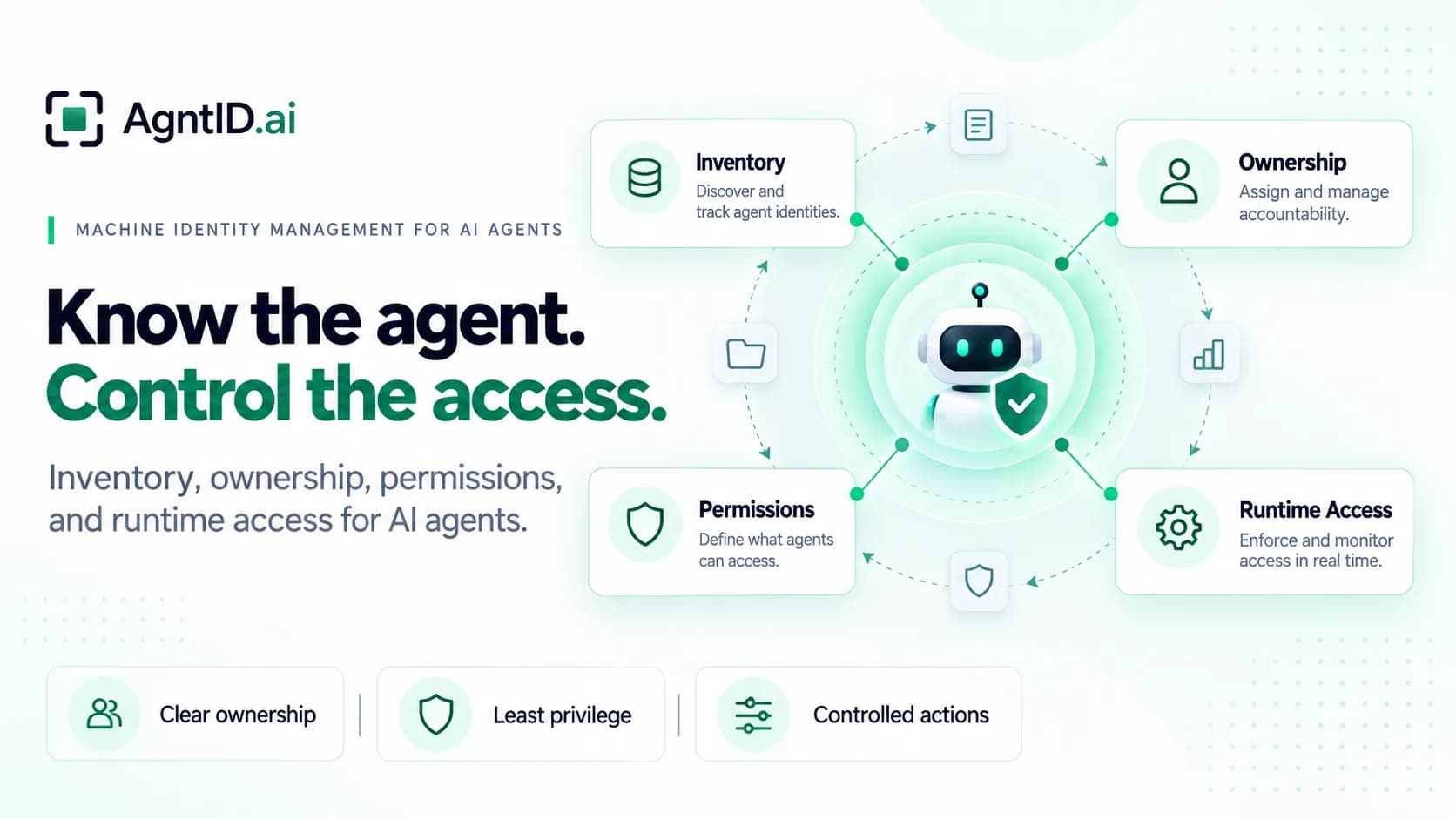
Machine Identity Management for AI Agents: Inventory, Ownership, and Runtime Access
An engineering team deploys an AI agent to reconcile invoices. The agent retrieves payment records, compares transactions, and generates reports using an approved identity. Three months later, the engineer who deployed it changes teams. The agent continues operating, but nobody is certain who owns it, whether its connected tools have changed, or which permissions it still needs.
The organization discovers that the agent's payment integration also exposes a refund capability. Whether the agent can use that capability depends on its credentials and the controls protecting the payment system. But even if refunds are available to the agent, investigating an invoice discrepancy does not establish permission to issue one.
This creates two responsibilities. The organization needs to maintain the agent's identity, ownership, and approved access. It also needs to determine whether individual actions are appropriate for the tasks the agent performs.
Machine identity management addresses the first responsibility through identity registration, ownership, credential management, permission reviews, and retirement procedures. Runtime authorization addresses the second by evaluating individual actions against applicable policy and task context before execution.
Both matter when agents move beyond retrieving information and begin making changes to enterprise systems.
This guide explains how to manage AI agent identities throughout their lifecycle, identify access that requires closer examination, and control how agents exercise their authority.
What Is Machine Identity Management for AI Agents?
Machine identity management for AI agents is the process of identifying agents, establishing ownership, managing credentials and permissions, reviewing access, and removing that access when agents are retired.
These responsibilities extend established practices for managing application and machine identities. AI agents introduce an additional consideration because they can select tools, construct requests, and determine subsequent actions while completing a task.
Four concepts form the foundation of agent identity management.
| Concept | What it represents |
|---|---|
| Agent identity | The registered identity used to identify and manage an agent |
| Workload identity | The identity of the running workload executing the agent |
| Credentials | Authentication material or tokens used to access connected systems |
| Permissions | The authority granted to an identity or principal |
An agent's registration establishes how it is identified for management and accountability. Authentication may rely on an associated workload identity or a separate principal, depending on the deployment.
Organizations should maintain a trusted relationship between registered agents and their executing workloads. That relationship connects ownership records, permissions, and observed activity to the infrastructure running each agent.
For agents connected to sensitive systems, identity information must also support decisions about how their available authority can be exercised.
The AI Agent Identity Management Lifecycle
An agent's identity needs attention throughout its operational lifecycle. Initial registration establishes its identity, ownership, and approved permissions. Monitoring and reviews keep this information aligned with the agent's deployment and business purpose.
Changes to connected tools, permissions, ownership, or operational responsibilities may require additional reviews. Retirement must include removing unnecessary access and verifying that the removal was effective.
Figure 1: AI Agent Identity Management Lifecycle
DISCOVER
    |
    v
REGISTER
    |
    v
ASSIGN OWNERSHIP
    |
    v
BIND WORKLOAD IDENTITY
    |
    v
PROVISION PERMISSIONS
    |
    v
ACTIVE OPERATION
    |
    |-- Runtime authorization
    |-- Activity monitoring
    |-- Inventory reconciliation
    |
    v
ACCESS REVIEW
    |
    +---------------+---------------+
    |               |               |
    v               v               v
 APPROVE          CHANGE          RETIRE
    |               |               |
    |               v               v
    |            REAPPROVE      DECOMMISSION
    |             ACCESS           |
    |               |              v
    |               v         REVOKE ACCESS
    |             UPDATE           |
    |            INVENTORY         v
    |               |        VERIFY REMOVAL
    |               |              |
    |               |              v
    |               |        RETIRED RECORD
    |               |
    +---------------+
            |
            v
     ACTIVE OPERATION
Runtime authorization, monitoring, and inventory reconciliation continue during active operation. Access reviews occur periodically or when material changes are detected.
The inventory connects these activities by recording each agent's identity, ownership, deployment, credentials, connected systems, approved permissions, and operational status.
Runtime authorization operates alongside the lifecycle. It evaluates protected actions while the agent performs its tasks.
The following sections use a finance reconciliation agent to demonstrate how these activities work together.
1. How to Discover and Inventory AI Agents
The first requirement is knowing which agents exist and where they operate. Enterprises may have agents deployed across cloud environments, internal applications, orchestration platforms, and development projects.
Some agents use dedicated workload identities. Others share service accounts or existing application infrastructure. Consequently, an inventory of machine identities may not identify every agent operating under those identities.
Discovery should combine information from deployment repositories, cloud workloads, identity providers, credential stores, agent platforms, and connected tools. Teams should reconcile discovered agents against existing records and investigate unexpected deployments, unapproved tool connections, and agents without registered owners.
Each investigation should produce a documented outcome. An organization may register an unrecorded agent, correct an existing inventory entry, restrict access pending investigation, or retire an agent that no longer serves an approved purpose.
What Should an AI Agent Inventory Contain?
An inventory should establish which agent is operating, who owns it, where it runs, and what access it has been approved to use.
It should also identify connected tools and sensitive capabilities that require additional controls. Recording these details helps teams distinguish agents that retrieve information from agents that can modify or delete data.
Consider a finance reconciliation agent that retrieves invoices, examines payment records, and generates reports.
Example AI agent inventory schema:
{
  "agent_id": "finance-reconcile-prod",
  "name": "Finance Reconciliation Agent",
  "purpose": "Reconcile invoices and payment records",
  "business_owner": "finance-operations",
  "technical_owner": "finance-platform",
  "environment": "production",
  "agent_identity_reference": "iam/agents/finance-reconcile",
  "workload_identity_reference": "iam/workloads/finance-reconcile",
  "deployment_reference": "finance/reconcile/prod",
  "credential_references": [
    "vault/finance/invoice-api"
  ],
  "connected_systems": [
    "invoice-api",
    "payments-api"
  ],
  "approved_permissions": [
    "invoice.read",
    "payment.read"
  ],
  "sensitive_actions_to_review": [
    "payment.refund"
  ],
  "runtime_policy": "finance-reconcile-policy",
  "status": "active",
  "ownership_verified_at": "2026-09-28",
  "permissions_reviewed_at": "2026-09-28",
  "access_verified_at": "2026-09-28",
  "access_verification_reference": "reviews/finance-reconcile/2026-09-28",
  "inventory_last_reconciled_at": "2026-09-28",
  "next_access_review": "2026-10-28"
}
Illustrative inventory schema. Listing a sensitive action identifies a capability that needs review. It does not grant permission to perform that action.
The refund capability is recorded for review because the connected payment system exposes it. The agent's registered permissions do not authorize refunds.
The inventory stores credential references rather than the credentials themselves. Existing credential-management systems remain responsible for protecting authentication material.
Verification records should identify which identities, credentials, tools, and resources were evaluated. A verification date establishes when a check occurred. It does not guarantee that every access path has been discovered or that configurations have remained unchanged.
Discovering MCP Tool Access
An agent may connect to several MCP servers exposing different tools and capabilities. Changes to those connections can alter what the agent can attempt without changing its registered identity.
Teams should examine which tools are exposed, how authentication is configured, and which identities can access them. They should also identify tools capable of making changes to production infrastructure, customer records, financial systems, or other sensitive resources.
AgntID's free MCP scanner can help teams examine exposed tools, schemas, authentication configurations, and identity-based tool visibility in supported MCP environments.
These findings can support access investigations and inventory reconciliation. The scanner complements broader discovery rather than replacing an enterprise-wide agent inventory.
2. AI Agent Registration and Ownership
Every production agent should have an approved business purpose and an accountable owner.
The business owner approves the agent's purpose and continued operation. The technical owner manages its deployment, maintenance, and operational support. These responsibilities should be established during onboarding and updated when organizational responsibilities change.
IAM teams maintain relevant identity records and baseline permissions. Security teams establish access requirements and review sensitive capabilities. Engineering teams implement the approved deployment and maintain its connections to other systems.
Ownership becomes especially important when agents operate for extended periods. A deployment may continue running after its original developer changes teams, its business purpose evolves, or its connected tools are reconfigured.
Example: Onboarding a Finance Reconciliation Agent
Suppose the finance team introduces an agent that compares invoices with payment records and generates reconciliation reports.
The business owner approves the use case. Engineering registers the agent, identifies its deployment environment, and establishes its relationship with the executing workload.
IAM provisions the required permissions. Security reviews the connected systems and identifies actions requiring additional restrictions or approval.
The approved workflow permits the agent to retrieve invoices, inspect payment records, and prepare reports. It does not authorize the agent to issue refunds or modify payment instructions.
Before deployment, the teams verify the identity relationship, configured credentials, connected tools, and approved access. They should test both permitted actions and actions that must be denied.
Onboarding is complete when the business purpose is approved, ownership is recorded, the required access is configured, and relevant access paths have been tested.
3. Managing AI Agent Workload Identities and Credentials
An AI agent needs a trusted identity when accessing protected systems. Existing cloud identities, managed credentials, and workload identity mechanisms can provide that foundation.
An organization may register an agent separately for management purposes while allowing it to authenticate through an existing workload identity. This preserves established authentication infrastructure without necessarily creating a separate principal for every agent.
The relationship between the registered agent and its executing workload should come from trusted deployment or runtime information. An agent's self-reported identity should not independently establish which workload is executing it.
Once this relationship is verified, IAM can provision the credentials and baseline permissions required for the approved use case.
Organizations should use managed credential delivery and short-lived credentials where supported. Credential issuance, storage, rotation, and revocation should remain part of their existing operational processes.
For the finance agent, baseline permissions allow read access to invoice and payment records. Any additional authority required for another approved workflow must be provisioned through an authorized process.
4. Registered Permissions vs. Effective Agent Access
An inventory records an agent's approved permissions and connected systems. Effective access represents what the agent can currently do through its available credentials, connected tools, delegated authority, and applicable access controls.
These two views can differ.
Suppose the finance agent's inventory records read-only access to payment information. Later, its payment integration is reconfigured with credentials that also permit refunds.
The inventory remains unchanged, but the underlying credentials now carry broader authority. Whether the agent can exercise that authority depends on additional access controls protecting the payment system and the agent's execution path.
Teams should compare recorded permissions with deployed credentials, connected tools, and applicable policies. Unexpected differences require investigation and corrective action.
However, even an accurate inventory leaves another question unanswered.
An agent may legitimately need a sensitive capability for one approved task without needing that capability for every subsequent task.
Which AI Agents Need Closer Access Reviews?
Not every agent presents the same access-control requirements.
An agent that retrieves public information has different operational requirements from one that can modify production infrastructure or execute financial transactions.
For agents that can take consequential actions, security and engineering teams should be able to answer the following questions:
| Question | What it establishes |
|---|---|
| Which agents can modify or delete sensitive information? | Identifies agents whose actions may have significant consequences |
| Which tools and credentials make those actions possible? | Establishes the authority available through connected systems |
| Can the same agent perform different tasks using those tools? | Identifies where task-specific restrictions may be relevant |
| What determines whether an individual sensitive action is permitted? | Establishes the authorization boundary |
| What prevents the agent from reaching a protected tool through another path? | Establishes whether the intended controls cover the relevant execution paths |
These questions help teams move from maintaining an inventory to understanding the access an agent can exercise.
For organizations with agents already connected to production systems, the answers can identify where additional authorization checks, credential restrictions, or approval requirements are needed.
Which of Your Agents Need Closer Access Controls?
Use the Agent Access Readiness assessment to examine your current approach to agent ownership, permissions, credential scope, and runtime authorization.
Identify areas that need further investigation before agents perform sensitive actions.
The assessment helps identify potential gaps rather than certifying that an environment is secure.
5. Why an Agent's Current Task Matters
AI agents can select tools and determine subsequent actions while completing a request.
An agent investigating a billing discrepancy may conclude that issuing a refund would resolve the problem. However, identifying a possible solution does not establish permission to execute it.
The organization's policy establishes the permitted boundaries. Approved task context can provide additional information for determining which actions are justified within those boundaries.
Consider three situations involving the same finance agent.
| Current task | Proposed action | Illustrative authorization outcome |
|---|---|---|
| Investigate an invoice discrepancy | Retrieve the relevant payment record | Allow |
| Investigate an invoice discrepancy | Issue a refund | Deny or require separate approval |
| Process an explicitly approved refund | Issue the specified refund | Allow if the required underlying authority, approvals, and policy conditions are satisfied |
The agent's registered identity and connected payment system may remain unchanged. What changes is the task and the authorization conditions associated with the requested action.
These outcomes are illustrative. The agent's ordinary reconciliation permissions do not authorize refunds. Before a separately approved refund task can proceed, the organization must make the necessary authority available through an authorized access process.
Task-specific authorization then determines whether the proposed refund satisfies the approved task and applicable policy. An approved task cannot override missing underlying permissions or application-level restrictions.
From Available Permissions to Task-Specific Authority
An agent may require several capabilities across its approved responsibilities. However, the authority needed for one task may represent only a small part of its overall access.
The finance agent retrieves payment records during reconciliation. During a separately approved refund workflow, it may receive the additional authority required to issue a specified refund.
Each task has different access requirements.
Restricting authority to the approved task reduces unnecessary access during execution. For sensitive operations, the organization may also require additional approval before an action proceeds.
The objective is not to predict every decision the agent will make. It is to establish authorization boundaries and enforce them when an agent attempts an action.
6. Runtime Authorization for AI Agents
Runtime authorization evaluates an action when an agent attempts to perform it.
A decision can consider the agent's verified identity, selected tool, requested action, target resource, request parameters, applicable policy, and trusted task context where available.
For the finance agent, retrieving a payment record may be appropriate during an investigation. Issuing a refund requires the necessary underlying authority and may also require a separately approved workflow or human approval.
The agent proposes an action. The authorization system determines whether the action satisfies the applicable requirements before it proceeds.
Task context should not independently grant access. An agent's own description of its intentions is not sufficient evidence that a sensitive action has been authorized.
Authorization and Credential Scope
Authorization and credential scoping address related but different problems.
Authorization determines whether an action should proceed. Credential scoping determines the authority available when an authorized action executes.
A system may authorize an agent to retrieve a payment record while allowing the request to execute using a credential that also permits refunds.
The action was authorized, but the credential still carries broader authority than that particular task requires.
Where the connected system supports it, narrower credentials can reduce the authority available during execution.
The objective is to align the approved task, the requested action, and the access available to perform it.
How AgntID Enforces Just-for-Task Access
AgntID provides runtime access control for AI agents. It evaluates protected tool calls against the applicable policy, requested action, relevant parameters, and available task context before execution.
Policy establishes the authorization boundaries. Task intent can provide additional context for determining whether a proposed action is justified by the work the agent has been authorized to perform.
Task intent must be evaluated within the applicable policy and supported by trusted context rather than relying exclusively on the agent's description of its intentions.
For every protected tool call, AgntID applies the configured authorization decision. An action can be allowed, denied, or routed for approval according to the applicable policy.
Where supported, AgntID can also provide scoped credentials so an authorized action executes with appropriately restricted authority.
This connects the authorization decision with the authority available during execution.
Figure 2: Runtime Authorization and Just-for-Task Access
APPROVED TASK
     |
     v
AGENT SELECTS A TOOL
AND CONSTRUCTS A REQUEST
     |
     v
PROTECTED TOOL CALL
     |
     v
AGNTID
     |
     +--> Evaluate applicable policy
     |
     +--> Evaluate action and parameters
     |
     +--> Consider available task context
     |
     v
AUTHORIZATION DECISION
     |
     +--> DENY
     |
     +--> REQUIRE APPROVAL
     |
     +--> ALLOW
             |
             v
       APPLY CONFIGURED
       CREDENTIAL MODEL
             |
             v
       AUTHORIZED ACTION
           EXECUTES
Illustrative execution flow. Credential scoping depends on the connected system and configured credential model.
AgntID supports authorization using existing credentials through its pass-through model. Where supported, it can also provide appropriately scoped credentials for authorized tasks and actions.
Authorization and credential issuance are separate operations. Each protected tool call receives an authorization decision, but a new credential does not necessarily need to be issued for every call. An appropriately scoped credential may be reused for permitted calls within its authorized scope and lifetime.
What This Means for an Agent With Sensitive Access
Consider the finance agent investigating an invoice discrepancy.
The agent requests a payment record. AgntID evaluates the protected tool call against the applicable policy and available task context. If the request is authorized, the action proceeds using the configured credential model.
If the agent attempts to issue a refund during reconciliation, AgntID evaluates that action independently. The request may be denied or routed for approval according to the applicable policy.
During a separately authorized refund workflow, the agent must also receive the underlying authority required to perform the specified refund. AgntID evaluates the protected request against the applicable policy and task context and, where supported, restricts the authority available during execution.
The agent's registered identity and connected tools can remain unchanged while its authorized task and appropriately provisioned authority change.
Enforcement Within Existing Infrastructure
AgntID is designed to work with existing identity infrastructure, tools, and MCP servers. Organizations can retain their established authentication, credential-management, and application authorization processes.
Its customer-hosted enforcement component evaluates protected tool calls within the customer's configured infrastructure.
This allows organizations to introduce runtime authorization without replacing their existing identity systems or requiring every agent to adopt an entirely new tool environment.
The enforcement boundary must still be configured correctly. Direct tool connections and API paths outside the protected execution path require their own controls.
For teams evaluating runtime access control, a useful technical test is to select one existing agent, identify a sensitive tool action, and verify how authorization, credential restrictions, and enforcement behave under different approved tasks.
See How Access Changes With the Task
Explore how AgntID evaluates the same sensitive tool action under different approved tasks, applies the authorization decision, and restricts execution authority where supported.
Explore AgntID's runtime access controls and request a technical walkthrough focused on an agent action relevant to your environment.
7. AI Agent Access Reviews and Ownership Transfers
Access reviews should examine an agent's approved purpose, registered permissions, deployed configuration, connected tools, and observed activity.
IAM teams should compare recorded entitlements against current permissions. Engineering should verify the deployed workload, credentials, and connected systems. Security should review sensitive capabilities, authorization records, and outstanding policy exceptions.
Each review should produce a documented decision. Access may be retained, modified, suspended, or removed. Required changes should be implemented and verified before the review is considered complete.
Review frequency should reflect the agent's capabilities and the sensitivity of the systems it accesses. Ownership transfers, new tool connections, and material changes to permissions or business purpose should trigger additional reviews.
Example: Transferring Ownership
Suppose responsibility for the finance agent moves from Finance Operations to the Finance Systems team.
The incoming owner confirms that the agent's purpose remains valid and explicitly accepts responsibility for its continued operation.
IAM reviews the associated identities and permissions. Engineering transfers maintenance responsibilities, deployment access, documentation, and operational alerts. Security reviews sensitive capabilities and outstanding policy exceptions.
The existing agent identity may remain unchanged when the agent's purpose and architecture remain the same. However, the previous owner's approval should not automatically extend to the new arrangement.
The transfer is complete when the incoming owner has approved continued operation, necessary access changes have been verified, and the inventory reflects the new ownership.
8. How to Decommission AI Agent Identities
Decommissioning should remove an agent's effective access rather than merely stopping its deployment.
Suppose the finance agent is replaced by another application. The business owner approves retirement and confirms that the agent's responsibilities have ended.
Engineering disables its deployment, schedules, automated triggers, and relevant tool connections. IAM removes dedicated permissions and revokes credentials that are no longer required. Security reviews outstanding exceptions and confirms that applicable policies no longer authorize the retired agent.
Shared identities require additional care. Before disabling a workload identity or revoking shared credentials, teams should identify other applications and agents that depend on them.
Retirement should remove the agent's access without disrupting workloads that legitimately share infrastructure.
Verify That Access Has Been Removed
Technical verification is necessary before retirement is complete.
IAM should confirm that dedicated credentials have been revoked and identity-specific permissions removed. Engineering should verify that deployments and automated triggers have stopped.
Security should confirm that relevant policies and other access controls prevent the retired agent from performing protected actions.
Access logs can help identify unexpected continued activity. Direct checks provide additional evidence that revoked credentials and identities can no longer access the resources being retired.
Decommissioning is complete when relevant access paths have been checked, required changes have been verified, the business owner has approved retirement, and the inventory record has been closed.
Who Is Responsible for AI Agent Identity Management?
AI agent identity management requires coordination between business owners, IAM, security, and engineering.
Business owners determine whether agents serve an approved purpose and whether continued access is justified. IAM manages the relevant identities and baseline permissions. Security establishes access requirements, while engineering maintains deployments and implements the necessary controls.
The following responsibility matrix illustrates one possible operating model.
A = Accountable, R = Responsible, C = Consulted
| Activity | Business owner | IAM | Security | Engineering |
|---|---|---|---|---|
| Approve business purpose | A/R | C | C | C |
| Discover and reconcile agents | C | A | C | R |
| Maintain identity records | C | A/R | C | R |
| Associate agents with workloads | C | C | C | A/R |
| Provision baseline permissions | C | A/R | C | C |
| Approve business need for sensitive access | A/R | C | C | C |
| Establish security requirements | C | R | A/R | C |
| Define runtime authorization policies | C | C | A/R | R |
| Implement runtime enforcement | C | C | C | A/R |
| Coordinate identity access reviews | R | A | R | C |
| Approve ownership transfers | A/R | R | C | R |
| Approve retirement | A/R | C | C | C |
| Revoke identity-specific access | C | A/R | C | R |
| Verify deployment retirement | C | C | C | A/R |
| Verify security controls and policy removal | C | R | A | R |
Organizations should adapt these assignments to their operating models. Each activity should have one accountable role, with technical responsibilities assigned to the teams managing the relevant systems.
Practical AI Agent Identity Management Checklist
Use this checklist when onboarding agents, reviewing production deployments, or preparing agents for retirement.
Discovery and Registration
- Identify deployed agents and associated workload identities.
- Record each agent's approved business purpose and accountable owner.
- Document deployment environments and connected systems.
- Reconcile discovered agents against existing inventory records.
Identity and Access
- Establish trusted relationships between agents and workloads.
- Register credential references and approved permissions.
- Apply least privilege to baseline access.
- Identify sensitive actions that require additional authorization.
- Define policies for actions agents may perform.
Runtime Access
- Identify agent tool calls that require runtime authorization.
- Establish how trusted task context reaches the authorization process.
- Test permitted, denied, and approval-dependent actions.
- Use appropriately scoped credentials where supported.
- Verify that agents cannot bypass protected execution paths.
Ongoing Operations
- Compare registered permissions with effective access.
- Review connected tools and observed activity.
- Investigate authorization exceptions.
- Reapprove access following ownership or purpose changes.
- Document review outcomes and verify required changes.
Decommissioning
- Obtain retirement approval from the accountable owner.
- Disable deployments, schedules, and tool connections.
- Revoke dedicated credentials and remove unnecessary permissions.
- Check dependencies before disabling shared identities.
- Verify access removal and preserve relevant audit evidence.
Connecting Machine Identity Management With Runtime Access
Machine identity management establishes which agents exist, who owns them, and what permissions they have. Accurate inventories, ownership records, access reviews, and retirement procedures maintain that foundation throughout the agent lifecycle.
For organizations running agents that can modify sensitive systems, another requirement becomes important: controlling how agents exercise their available authority.
Runtime authorization evaluates individual actions against applicable policy and available task context. Where supported, credential scoping can restrict the authority available when an authorized action executes.
Organizations should be able to identify their agents, understand their effective access, and demonstrate how sensitive actions are controlled before execution.
Frequently asked questions
What is machine identity management for AI agents?
Machine identity management for AI agents covers discovery, registration, ownership, credential management, permission reviews, and decommissioning throughout the agent lifecycle.
How can enterprises discover AI agents?
Enterprises can examine deployment repositories, cloud workloads, identity providers, credential stores, agent platforms, and connected tools. Findings should be reconciled against existing inventory records.
What should an AI agent inventory contain?
An inventory should record each agent's identity, business purpose, owner, workload, credential references, connected systems, approved permissions, and lifecycle status.
Can existing IAM systems manage AI agent identities?
Yes. Existing systems can manage workload authentication, identities, credentials, and baseline permissions. Organizations can introduce additional controls where they need more detailed authorization during agent execution.
What is the difference between registered permissions and effective access?
Registered permissions document approved access. Effective access represents what an agent can currently do through its credentials, connected tools, delegated authority, and applicable controls.
Which AI agents need additional runtime access controls?
Agents capable of modifying sensitive systems, executing financial transactions, changing production infrastructure, or performing other consequential actions warrant closer examination. The required controls depend on their existing authorization protections and operational risks.
Does runtime authorization require issuing new credentials for every tool call?
No. Authorization and credential issuance are separate operations. Every protected tool call can receive its own decision without requiring a new credential for each call. Credential scoping depends on the connected systems and configured access model.
How should enterprises decommission AI agent identities?
Disable retired agents, revoke dedicated credentials, remove unnecessary permissions, and verify access removal. Check shared identity dependencies before completing retirement.