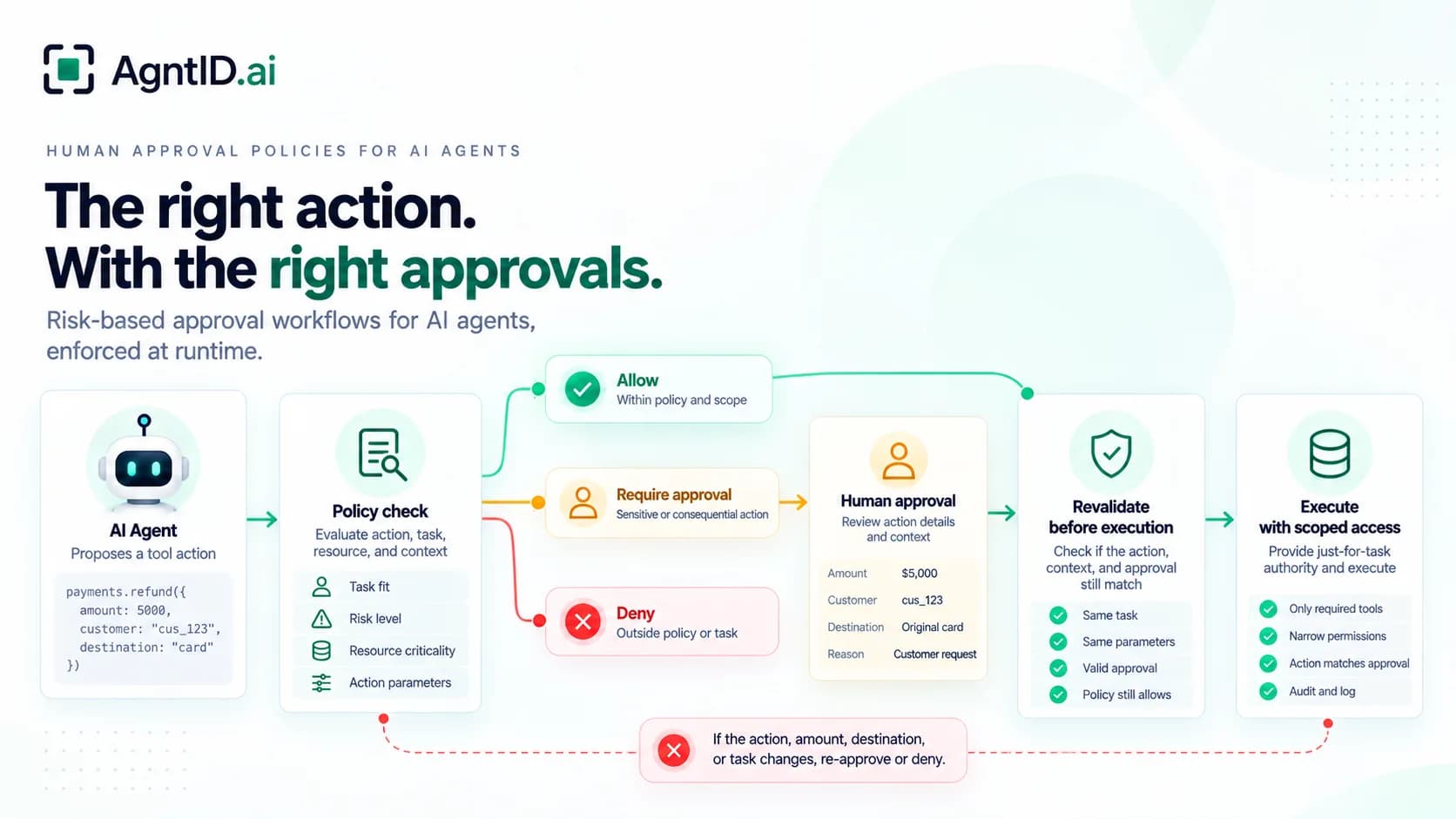
Human Approval Policies for AI Agents: Designing Risk-Based Authorization Workflows
An AI agent is assigned to process a customer's refund. It has access to the payment tool and can retrieve the transaction record. The agent proposes a $75 refund to the original payment method. The action fits the customer case, stays within the agent's limit, and can proceed automatically.
Now change one detail. The same agent proposes a $5,000 refund for the same customer. The organization requires finance approval for refunds of that size, so the action is paused and routed to a finance manager.
Now change another detail. After approval, the agent attempts to send the $5,000 to a different destination. The agent is still using the same tool, but the action is no longer the same action that was approved.
This is the problem human approval policies for AI agents need to solve. The question is not only whether someone approved an action. The question is whether the action the agent is about to execute still matches the approved task, scope, and policy.
When Should AI Agents Require Human Approval?
Human approval should be reserved for actions where the risk justifies additional review. Requiring approval for every tool call slows down routine work and creates reviewer fatigue. Allowing every action to proceed automatically creates a different problem: sensitive or consequential operations may run without the right authorization.
A risk-based approval policy helps determine which actions can run automatically, which require approval, and which should be denied outright. The decision should depend on the action, the target resource, the task, and the likely impact.
AI Agent Approval Decision Matrix
| Action category | Example | Risk considerations | Policy decision |
|---|---|---|---|
| Routine read | Retrieve an ordinary support ticket | Low sensitivity, authorized task | Allow automatically |
| Sensitive read | Access restricted financial records | Data classification, purpose, scope | Allow within approved scope or require additional authorization |
| Limited modification | Update an approved customer record | Reversibility, verified request | Allow within defined limits |
| Sensitive modification | Issue a $5,000 refund | Financial impact, transaction amount | Require human approval |
| Consequential action | Delete production backups | Resource criticality, recovery impact | Require designated approval if authorized by policy. Otherwise deny |
| Prohibited action | Export customer data to an unauthorized destination | Unauthorized disclosure | Deny regardless of approval |
These categories are examples, not universal rules. A read action can be sensitive if it retrieves regulated customer records at scale. A modification can be low risk if it is narrow, reversible, and tied to an authorized task.
Approval is also not a bypass. Some actions should remain blocked even if a person clicks approve. Human approval is useful for permitted actions that need review. It should not override hard restrictions.
Five Factors for Risk-Based Approval Policies
An approval policy should start with what the agent is trying to do. Tool access alone does not answer that question. The same tool can support ordinary reads, sensitive writes, bulk exports, payments, and destructive changes.
Five factors help determine whether an action should proceed automatically, require approval, or stop.
1. Action Sensitivity
Action sensitivity describes what the agent is attempting. Reading a ticket, updating a customer record, issuing a payment, and deleting a database carry different levels of risk.
A policy should evaluate the operation and its arguments. A payment tool might allow transaction lookups automatically, require approval for high-value refunds, and deny changes to unverified destinations.
2. Reversibility
Reversibility describes what happens after execution. Updating an internal draft may be easy to undo. Sending money, exposing confidential data, or deleting production resources may be difficult or impossible to reverse.
A technically reversible action can still cause disruption before recovery. Approval policies should account for both the ability to undo an action and the harm that could occur before reversal.
3. Resource Criticality
Resource criticality describes the importance of what the action affects. Restarting a development service is not the same as restarting a production service that supports customer transactions.
The same operation can require different treatment depending on the environment, resource classification, and business impact. Policies should evaluate the resource, not only the action name.
4. Task Fit
Task fit asks whether the action makes sense for the work the agent is supposed to perform. An agent may have access to a payment tool, but that does not mean every payment action is appropriate for the current customer case.
For example, refunding the customer in the assigned ticket may fit the task. Sending funds to a different destination may not. The agent's available tool access has not changed, but the action no longer matches the authorized work.
For a deeper explanation of this control pattern, read our guide to task-aware authorization for AI agents.
5. Scale and Impact
Scale changes risk. Updating one approved customer record is different from modifying thousands of records. Issuing a $75 refund is different from issuing a $5,000 refund.
Approval thresholds should consider financial exposure, data volume, affected systems, and operational impact. A low-value action may still require escalation if the destination changes or the task no longer justifies it.
Approval Answers One Question. Execution Requires Another.
Human approval answers: did an authorized person approve this proposed action?
Execution requires another question: is the action the agent is about to perform still permitted under the current task, policy, and approved scope?
Both questions matter. A finance manager may approve a $5,000 refund to a verified customer. That approval should not authorize a different amount, a different destination, or an unrelated payment. The approval applies to a specific action under specific conditions.
The execution system needs to check the action at the point where the agent attempts it. If the proposed tool call no longer matches the approved scope, the action should stop or return for fresh authorization.
AI Agent Authorization and Approval Workflow
The following workflow shows how approval can fit into runtime authorization. Approval is not the final step. It becomes one input into the final execution decision.
flowchart TD
    A["Agent proposes a tool action"]
    B["Capture identity, task, tool, resource, and arguments"]
    C["Evaluate policy and task fit"]
    D{"Decision"}

    E["Deny and record"]
    F["Allowed within existing scope"]
    G["Additional authorization required"]
    H["Human approval required"]

    I["Obtain additional authorization"]
    J{"Requirement satisfied?"}

    K["Send verified request to reviewer"]
    L{"Approval decision"}
    M["Bind approval to action, task, scope, and expiration"]

    N["Revalidate action before execution"]
    O{"Still authorized?"}

    P["Provide scoped authority"]
    Q["Execute action"]
    R["Record outcome"]

    A --> B
    B --> C
    C --> D

    D -->|Deny| E
    D -->|Allow| F
    D -->|Step-up| G
    D -->|Review| H

    G --> I
    I --> J

    J -->|No| E
    J -->|Yes| C

    H --> K
    K --> L

    L -->|Rejected or unavailable| E
    L -->|Approved| M

    F --> N
    M --> N

    N --> O

    O -->|No| E
    O -->|Yes| P

    P --> Q
    Q --> R
The workflow starts before the target system executes the action. The authorization layer evaluates the proposed tool call, its arguments, the current task, and the applicable policy. An agent-generated explanation can provide context, but it should not be the only basis for authorization.
Some actions can proceed within existing permissions. Others require additional authorization or human review. When a reviewer approves an action, the approval becomes part of the authorization context. It must be bound to that specific request rather than granting open-ended access to the underlying tool.
Before execution, the action must be checked again. If the amount changed, the destination changed, the task changed, the approval expired, or the policy no longer permits the action, execution should stop.
Three Enterprise Scenarios
The same pattern applies across different enterprise workflows. The details change, but the core decision remains the same: does this exact action make sense for this task under this policy?
Scenario 1: Customer Refunds
A support or finance agent is assigned to process a customer refund. The organization allows refunds below $200 automatically when the transaction is verified and the destination matches the original payment method.
Refunds between $200 and $10,000 require finance approval. The approval identifies the customer, transaction, amount, destination, and task. It does not grant the agent open-ended access to issue any refund through the payment tool.
If the agent later changes the destination or attempts to refund another transaction, the original approval no longer applies. The new action must be rechecked. Depending on policy, it may require fresh approval or be denied.
Scenario 2: Production Infrastructure
An engineering agent is investigating a production incident. It can read logs, inspect service health, and suggest a remediation. Restarting a development service may be allowed automatically. Restarting a production service may require approval from the on-call owner.
The approval should identify the service, environment, incident, action, and time window. It should not authorize unrelated production changes.
If the incident closes or the maintenance window ends, the approval may no longer be valid. The timestamp alone is not enough. The action must still fit the current operational context.
Scenario 3: Sensitive Customer Data
An analytics agent is preparing a customer retention report. It can retrieve aggregate metrics automatically. Accessing restricted customer records requires additional authorization.
A data owner approves an export of 50,000 customer records to an approved internal workspace for a defined purpose. That approval does not authorize sending the same records to an external destination.
If the agent attempts an external transfer, the request should be denied. Human approval for one destination should not override restrictions on another.
How Approvals Should Expire and Be Revalidated
An approval creates a time gap between review and execution. During that gap, the proposed action, task, policy, or resource state may change.
Approval policies should define what was approved, how long it remains valid, and what must be checked before execution.
Bind Approval to the Action
An approval should identify the agent, initiating user, task, operation, target resource, and material arguments. For a refund, that means the transaction, amount, destination, and customer case.
This creates a clear approved scope. If the agent changes a material detail, the system can detect that the action no longer matches the approval.
Set Expiration Rules
Approval validity should match the sensitivity of the action. A payment approval may expire quickly. A production change may remain valid only during a maintenance window.
An expired approval should not authorize execution. If the action is still necessary, the agent should obtain fresh authorization.
Revalidate Before Execution
An approval can remain unexpired while becoming invalid for another reason. The task may change. The user may lose authority. The destination may change. The affected service may no longer be in an approved change window.
Before execution, the system should verify that the approval still applies to the proposed action and that the action still satisfies policy.
What an Approval Audit Record Should Include
Approval logs should make it possible to understand what the agent requested, why review was required, who approved it, and what eventually executed.
A useful audit trail separates three events.
- Request: agent identity, initiating user, task, proposed action, target resource, material arguments, policy version, and initial decision.
- Approval: reviewer, decision, approved scope, request time, approval time, expiration, and approval status.
- Execution: final authorization decision, authority used, execution timestamp, and downstream result.
The audit trail should distinguish verified task context from the agent's own explanation. The agent can explain why it wants to act, but that explanation should not be the only evidence used for authorization.
Avoid storing secrets or unnecessary sensitive data in plaintext. Protected references or digests may be enough for investigation.
How to Implement Risk-Based Approval Policies
Start by listing the actions your agents can perform. For each action, identify the resource, arguments, possible impact, and task conditions that make the action appropriate.
Then define approval rules using combinations of conditions. A refund below $200 may be allowed only when the agent is assigned to the relevant customer case, the transaction is verified, and the destination matches the approved payment method. A higher-value refund may require approval. A refund to an unrelated destination may be denied.
Connect these rules to an enforcement point that can inspect the proposed action before execution. Approval requests should show verified details instead of relying only on the agent's summary.
Test the workflow against changed amounts, changed destinations, expired approvals, unavailable approval services, reused approvals, and actions unrelated to the assigned task. The test should prove that an approval for one action does not become open-ended permission to perform another.
From Approval to Execution
An organization may already know who the agent is, which systems it can reach, and whether a sensitive action has received human approval. Another question remains when the agent attempts execution: does this specific action fit the task and policy right now?
That check should evaluate the proposed tool action, its arguments, the current task, and the applicable policy. If the action no longer matches the approved scope, it should stop. If the action is allowed, the agent should receive only the authority needed to complete that action.
AgntID focuses on this execution-time decision. It checks the proposed tool action before execution and helps narrow access to what the authorized action requires.
Where an external approval workflow is integrated, verified approval context can inform the runtime decision. Reviewer routing and approval management remain responsibilities of the approval system. AgntID's role is to enforce policy- and task-aware access decisions when the agent acts.
Conclusion
Human approval should apply to a specific action under defined conditions. It should not become open-ended permission to use a tool.
AI agents need a final authorization check before execution. That check should verify the action, task, arguments, policy, approval state, and required authority.
Combining selective approval with runtime enforcement helps organizations give agents autonomy while keeping sensitive actions inside clear access boundaries.
Frequently asked questions
When should an AI agent require human approval?
An AI agent should require human approval when a permitted action crosses a defined risk threshold, such as a high-value transaction, sensitive data access, or production change. Prohibited actions should remain blocked regardless of approval.
What is the difference between human approval and runtime authorization?
Human approval records a reviewer's decision about a proposed action. Runtime authorization determines whether the action the agent is about to execute still satisfies policy, task, and scope requirements.
Can AI agents act without human approval?
Yes. AI agents can act without human approval when the action is low risk, within policy, and appropriate for the assigned task.
What happens if an agent changes an action after approval?
The action should be revalidated. If the new request no longer matches the approved scope, the agent needs fresh authorization or the request should be denied.
Do AI agent approvals expire?
Yes. Approvals should have explicit expiration rules. Once approval expires, the agent must obtain fresh authorization before executing the action.
What should an approval policy evaluate?
An approval policy should evaluate the action, resource, arguments, task, scale, reversibility, operational context, and potential impact.
What should an approval audit log include?
An approval audit log should include the agent identity, task, proposed action, policy decision, reviewer decision, approved scope, final authorization decision, and execution outcome.
How does AgntID relate to human approval?
AgntID evaluates what the agent is trying to do at runtime. Verified approval context can inform that decision when integrated, but approval management remains separate from runtime enforcement.