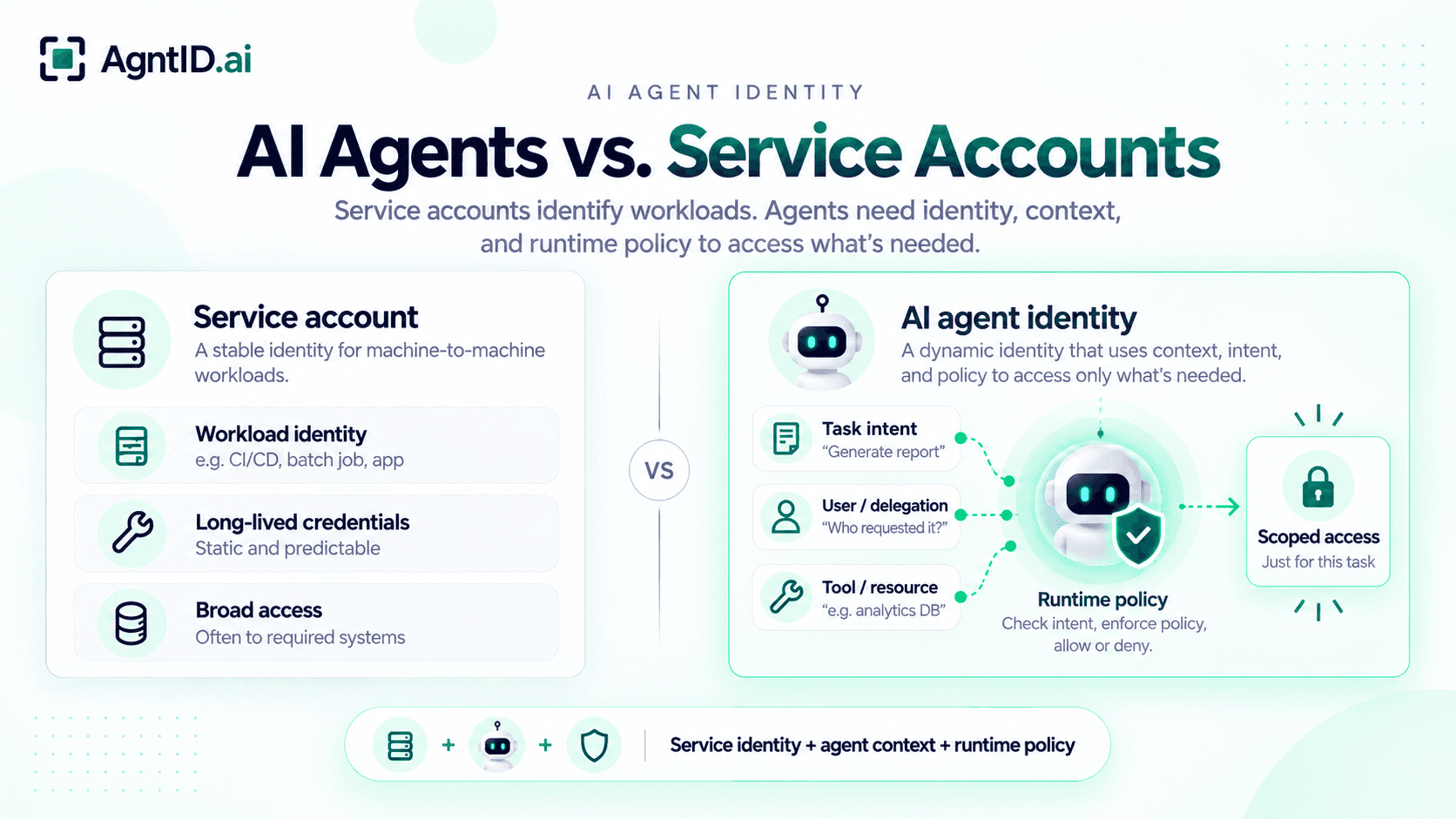
AI Agents vs. Service Accounts: Why Agents Need a Different Access Model
Service accounts give software a non-human identity. A backend service, scheduled job, deployment pipeline, or application can authenticate as a stable principal and receive the permissions required for its function. For many workloads, that model is enough.
AI agents can require a more contextual access model. A service account may identify the runtime executing an agent, but it may not distinguish which agent is acting, who owns the agent, whose authority it is using, or what task it is performing. Those distinctions can matter when an agent selects tools, generates parameters, and decides which action to take at runtime.
The practical answer is not "AI agent or service account." A service account can remain the underlying service identity. AI agent identity can distinguish the agent operating through that service. Delegation can preserve whose authority is being exercised. Runtime context can describe what the agent is attempting to do. An authorization system can then evaluate those signals before the action runs.
AI agents vs. service accounts: key differences
Service accounts and AI agent identities answer different identity questions. Service accounts typically represent a service, application, or workload. AI agent identity becomes useful when the agent itself needs distinct ownership, lifecycle management, delegation, or audit controls.
The difference becomes more important when the same workload hosts several agents or when one agent acts for multiple users. The runtime identity can stay the same while the agent, delegated principal, task, and required authorization change.
| Question | Service account | AI agent identity |
|---|---|---|
| Primary subject | Service, application, workload, or runtime | AI agent as a distinct actor |
| Core question | Which service or workload is making this request? | Which agent is acting? |
| Ownership | Usually tied to an application, project, environment, or team | Can associate the agent with an owner, sponsor, or responsible team |
| Credentials | API keys, certificates, managed identity, federation, or short-lived credentials | May authenticate through the workload identity or an agent-specific credential |
| Delegation | Commonly represents the workload itself | Can distinguish the agent from the principal whose authority it is using |
| Task context | Usually separate from the identity | Remains separate from identity and can be evaluated alongside task, tool, action, resource, and parameter context |
| Privilege scope | Often reflects what the workload needs across its normal function | Can be associated with baseline access assignments. Runtime authorization can further constrain specific actions |
| Auditability | Identifies which service account made the request | Can distinguish the agent alongside user, task, and delegation context |
| Lifecycle | Usually follows the application or workload lifecycle | Can support agent-specific ownership, access reviews, and retirement |
| Blast radius | Depends on the permissions available to the workload | Agent identity does not reduce blast radius by itself. Narrower permissions and scoped access can |
| Best fit | Stable machine-to-machine access | Agents requiring distinct ownership, delegation, governance, or audit |
The important distinction is not whether an application uses an LLM. It is whether the security architecture needs to represent the workload and the agent as different subjects.
What is a service account?
A service account is a non-human identity used by software to authenticate to another system. It lets an application, process, job, or workload access resources without using a human user's identity. A reconciliation service, for example, may read transaction events, compare them with billing records, and write results to a database under one stable service identity.
The surrounding authorization model determines which resources the service may access and which actions it may perform. This works well when the service has a stable purpose and predictable access requirements. A service account also does not imply a long-lived static credential. Managed identities, federation, certificates, and short-lived credentials can all support a stable workload identity.
The core question is: "Which service or workload is making this request?" For many applications, that is the right identity question.
What is AI agent identity?
AI agent identity represents an AI agent as a distinct non-human actor. It becomes useful when the system needs to identify, govern, or audit the agent independently from the runtime hosting it.
Consider a shared platform hosting a finance agent, support agent, and IT agent. The underlying workload identity could remain the same for all three, while each agent has a different owner, purpose, lifecycle, tool set, and access requirement. Knowing that a request came from agent-runtime-prod identifies the workload. It does not tell you which agent initiated the action.
The agent identity can also be associated with ownership, lifecycle state, and access assignments. Other information remains separate. The user, delegated principal, task, selected tool, action, resource, and parameters are runtime or authorization context. For a deeper comparison of these concepts, see AI Agent Identity vs. Workload Identity.
When AI agents need more than service account identity
The important difference is not authentication alone. Both AI agents and traditional workloads can authenticate with machine identities. The difference becomes important when authorization depends on runtime context beyond the authenticated identity.
Traditional applications often follow execution paths defined in code. AI agents can introduce more runtime variability because an agent can receive a goal, choose a tool, generate arguments, inspect a result, and decide what to do next. The exact action may not be known when the session begins.
Consider an IT support agent responding to a stolen phone. Revoking the employee's own active sessions may match the task:
agent = it-support-agent
task = secure-stolen-device
action = revoke-sessions
target-user = employee-123
Now suppose the same agent proposes disable-account with the CFO as the target. The service identity, agent identity, and credential may all remain valid. The proposed action and target have changed. Identity tells the system who or what is acting. Authorization determines whether that specific action is permitted.
AI agents and delegated access
AI agents often act on behalf of users or other systems. A sales agent may update a CRM for a salesperson. A coding agent may modify a repository for a developer. An IT agent may perform account actions for an employee. In these cases, the user and the agent may need to be represented as separate principals.
A service account can identify the runtime. Agent identity can identify the agent. Delegation can preserve whose authority is being exercised. That distinction helps answer two separate questions: Who authorized the work? and Which agent performed it?
Giving an agent all of a user's authority may provide more access than the task requires. Representing every user through one shared service account can make attribution harder. The goal is to preserve the identity and delegation relationships needed for authorization and audit.
Why AI agent auditability needs more context
A conventional service account audit record might show only that service-account-prod called a billing API. That can be enough when the application has one narrow purpose and the reason for the action follows directly from the application flow.
For an AI agent, security teams may need to record the workload, agent, user, task, action, target, and access decision. A billing event might therefore identify the agent that acted, the analyst who initiated the task, the affected customer, the refund amount, and whether approval was required.
The service account still identifies the workload. Agent identity distinguishes the actor inside it. Delegation records whose authority is being exercised. Task and action context explain what the agent attempted to do. This context becomes more important when one runtime hosts several agents or one agent serves many users.
When a service account is still fine for an AI agent
Not every AI agent needs a separate identity model. A service account may be enough when the agent has one narrow purpose, operates under one stable authority, accesses a predictable set of resources, and does not need separate ownership, lifecycle, or access controls.
Consider an internal summarization agent. It reads documents from one approved repository and writes summaries to one approved queue. It does not serve users with different access rights or perform sensitive write operations against the source system. Even if an LLM generates the summary, the access model remains narrow.
The useful question is: "Does the security model need to distinguish the agent, delegated authority, or current task to make the required access decision?" If the existing service identity and authorization model already provide enough control and accountability, a separate agent identity may not add useful value.
When is service account identity not enough for AI agents?
A broader model becomes useful when one service account represents several agents, users, or authority relationships that need to be distinguished. The service account may still identify the workload correctly. The architecture simply needs more identity or runtime context for specific decisions.
Common cases include a runtime hosting multiple agents, one agent serving several users, delegated user authority, autonomous and user-directed work sharing one agent, or tools exposing both low-risk and sensitive actions. Authorization may also change based on the target resource, generated parameters, task, or approval state.
These cases do not require replacing service identity. They require preserving more context around the actor and action so authorization and audit can distinguish what the service account alone does not represent.
A better target architecture: service identity + agent identity + delegation + runtime policy
The better target architecture keeps the responsibilities separate. Service identity establishes the trusted workload. AI agent identity identifies the agent. Delegation preserves whose authority is being exercised. Runtime context describes the task and proposed action.
Service identity ────────────────────┐
AI agent identity ───────────────────┤
Delegated principal ─────────────────┤
Task and runtime context ────────────┤
(tool, action, resource, parameters) │
                                    ↓
                         Authorization policy
                                    ↓
                              Enforcement
                                    ↓
                         Enterprise resource
An authorization policy can evaluate the relevant signals once the action is known. The decision may allow the action, deny it, or require an approval step. Enforcement can then apply that decision and, where supported, reduce the privileges available for the specific tool action at execution time.
Not every architecture needs every signal. The goal is to preserve enough identity and context to make and enforce the authorization decision the action requires. This keeps service identity in place while adding agent-specific controls only where they provide additional value.
How to move beyond service-account-only access
Teams do not need to rebuild their identity infrastructure before deploying agents. Start by mapping each AI agent to its service accounts, workload identities, OAuth clients, API keys, tools, and downstream permissions. Then identify where multiple agents or users share one identity and whether they need to be distinguished for ownership, authorization, audit, or lifecycle management.
Next, identify actions where authorization changes with context. Sensitive writes, production changes, financial operations, administrative actions, and external communications are useful starting points. Determine whether existing permissions provide enough control or whether the decision also needs the agent, delegated principal, task, resource, parameters, or approval state.
Where supported, narrow authority through temporary credentials, scoped access, or token exchange. Use action-level policy for more specific authorization decisions. Add approval workflows when sensitive actions require human review. The migration can remain incremental:
service identity
+ existing authorization

        ↓

service identity
+ agent attribution
+ existing authorization

        ↓

service identity
+ agent and delegation context
+ runtime authorization and enforcement

        ↓

task-scoped or action-scoped access where needed
How AgntID fits
AgntID provides runtime access control enforcement for AI agents. It works alongside existing IAM systems, tools, and MCP servers without requiring a rip-and-replace approach.
At execution time, AgntID evaluates policy and runtime agent intent for each tool action. It narrows privileges per action so the agent receives least-privilege, just-for-task access. AgntID supports both pass-through and AgntID-issued credentials for task-specific access.
Runtime enforcement and execution remain inside the customer's infrastructure. AgntID works with vendor-hosted, customer-hosted, and custom MCP servers. Its role is to enforce access when an agent attempts a specific tool action as part of a task.
Bottom line
Service accounts remain a strong foundation for machine identity. For narrow AI agents operating under one stable authority, they may be enough.
As agents serve multiple users, operate under delegated authority, select sensitive tools, or perform actions whose authorization depends on runtime context, service account identity alone may not provide enough information for the decision.
Keep service identity where it works. Add agent identity, delegation, and runtime authorization where the architecture requires them.
FAQ
What is the difference between AI agent identity and a service account?
A service account identifies a service or workload. AI agent identity identifies the agent operating within or through that workload.
Can an AI agent use a service account?
Yes. A service account can provide the underlying workload identity for an AI agent. Additional agent identity or runtime context may be useful when access varies by user, task, or action.
Does every AI agent need its own identity?
No. A separate AI agent identity is most useful when the agent needs distinct ownership, lifecycle management, delegation, access assignments, or auditability.
When is a service account enough for an AI agent?
A service account may be enough when the AI agent has one narrow purpose, one stable authority, predictable resources, and tightly scoped permissions.
What is the difference between AI agent identity and workload identity?
Workload identity identifies the software runtime. AI agent identity identifies the agent operating within or through that runtime.
What is delegated access for AI agents?
Delegated access lets an AI agent act using authority associated with a user, service, workflow, or another agent while preserving whose authority is being exercised.
Are service accounts always long-lived credentials?
No. Service accounts can use short-lived credentials, federation, certificates, or managed identities. Service account identity and credential lifetime are separate concerns.
How do you reduce the blast radius of an AI agent?
Limit baseline permissions. Evaluate sensitive actions using runtime context. Use scoped or temporary credentials where appropriate.
Does AgntID replace service accounts or IAM?
No. AgntID works alongside existing IAM systems, service identities, tools, and MCP servers. It adds runtime access control enforcement for specific AI agent tool actions.