MCP Server Authentication: How Identity Works Across Clients, Users, and AI Agents
An AI agent calls an MCP server. The request includes a valid access token, and the server accepts it. But whose identity has the MCP server authenticated? It may be the user who started the task. It may be the application or workload running the MCP client. The credential may contain both user and client context. The AI agent itself may not have a distinct authenticated identity.
The challenge is determining which identity has been established at each point in the MCP chain. A single agent task can cross a user, agent runtime, MCP client, MCP server, and downstream API. Each connection creates a separate trust boundary, and identity context available at one boundary does not automatically reach the next.
Understanding MCP server authentication therefore starts with two questions: Who authenticates to whom? And what identity context reaches each system? This guide follows that chain across service-to-service MCP and user-delegated MCP architectures.
How does MCP authentication work?
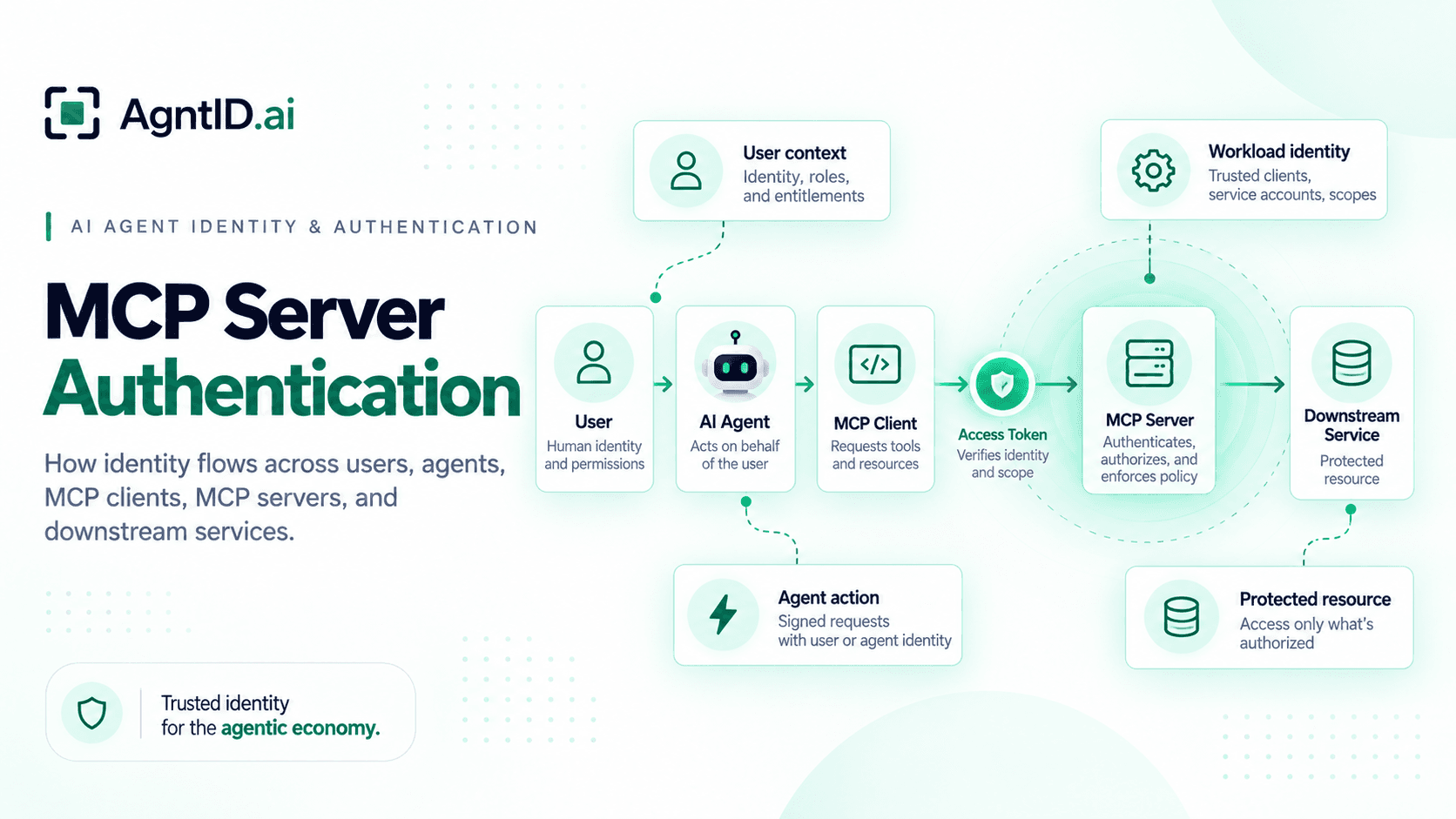
MCP authentication is easiest to understand by following the identities across a request. A typical workflow contains a user, an AI application or agent, an MCP client, an MCP server, and often a downstream service.
User
  ↓
AI application / agent
  ↓
MCP client
  ↓
MCP server
  ↓
Downstream service
The user may authenticate to the AI application. The application may run one or more agents. An MCP client communicates with an MCP server, and the MCP server may then call a database, SaaS platform, internal API, or another service. This creates several authentication boundaries rather than one continuous identity session.
A simplified MCP OAuth flow for a user-delegated request looks like this:
User              MCP Client        Authorization       MCP Server       Downstream
    |                  |                Server               |              Service
    | Start task       |                   |                 |                 |
    |----------------->|                   |                 |                 |
    |                  | Request access    |                 |                 |
    |                  |------------------>|                 |                 |
    |                  |                   | Authenticate user                 |
    |<-------------------------------------|                 |                 |
    |                  |<------------------|                 |                 |
    |                  | Access token for MCP server         |                 |
    |                  |                                     |                 |
    |                  | MCP request + token                 |                 |
    |                  |------------------------------------>|                 |
    |                  |                                     | Downstream call |
    |                  |                                     |---------------->|
    |                  |                                     |<----------------|
    |                  |<------------------------------------|                 |
For protected remote HTTP deployments, MCP uses an OAuth 2.1-based authorization framework. The MCP server acts as a protected resource, and the MCP client obtains an access token intended for that server. Authentication happens at specific trust boundaries. MCP does not automatically make the user, AI agent, MCP client, and downstream service one authenticated identity.
What is MCP server authentication?
When people refer to MCP server authentication, they usually mean the server validating the credential presented with a protected MCP request and establishing the security context available for that request.
A protected request may include an access token such as:
Authorization: Bearer <access-token>
A simple MCP server authentication example looks like this:
POST /mcp HTTP/1.1
Host: crm-mcp.example.com
Authorization: Bearer eyJhbGciOi...
MCP-Protocol-Version: 2026-07-28
Mcp-Method: tools/call
Mcp-Name: get_customer
Content-Type: application/json
The MCP server validates the credential and obtains the security context associated with it. That context may identify a user, an application, a workload, or a combination of user and client context. What it does not automatically identify is the AI agent that selected the tool. This distinction matters when several agents share the same application, workload, or MCP client.
What should an MCP server validate?
For identity context to be trusted, the MCP server must validate that the access token is valid and intended for that resource. Depending on the token format and authorization architecture, this can include issuer, expiry, signature, and audience or resource checks.
A token issued for one MCP server should not be treated as a general credential for another service. Audience or resource binding helps establish which protected resource the token was intended to access.
Does every MCP server use OAuth?
No. MCP's OAuth-based authorization model applies to HTTP-based deployments. Local MCP servers using stdio typically rely on local credentials, environment-based credentials, or another mechanism appropriate to the host environment.
Most of the identity questions in this article arise with remote MCP servers because the client and server communicate across a network trust boundary. The rest of this guide focuses on that model.
MCP authentication vs. authorization
Authentication establishes who or what a credential represents. Authorization determines what that principal can access. For example, an access token may establish user or workload context while scopes limit what the credential can access at the MCP server.
This article focuses on identity: which principal is established at each MCP boundary. A valid identity and valid OAuth scope still do not necessarily describe the minimum access an AI agent needs for its current task.
Which identities exist in an MCP system?
Several identities can participate in a single MCP request. The important distinction is that they describe different actors in the chain and may be established by different systems.
User identity
User identity represents the person who initiated or approved an interaction. An employee may sign in to an enterprise AI assistant and ask it to retrieve a customer contract.
If the authorization flow preserves delegated user context, the credential presented to the MCP server may represent that user. The server can then obtain trusted user context through the credential validation process.
Application, client, and workload identity
The application using the MCP client may have an identity associated with its OAuth client registration. The runtime hosting that client may separately have a workload identity, such as a service account or cloud workload principal.
These identities describe the software side of the request, not the individual user. One application can serve many users, and one workload can host several AI agents or client instances.
AI agent identity
AI agent identity refers to a distinct identity assigned to the individual AI agent responsible for an action. That identity is separate from the workload or runtime unless the architecture deliberately makes them the same principal.
Research Agent ─┐
Support Agent  ─┼─> Shared Agent Runtime
Finance Agent  ─┘          ↓
                         MCP Client
                             ↓
                         MCP Server
If all three agents use the same workload credential, the MCP server may authenticate the shared runtime without knowing which individual agent selected the tool. Workload identity answers which runtime made the request. Agent identity answers which agent inside that runtime caused the action.
Identity at downstream services
An MCP server often calls another system such as Salesforce, GitHub, Snowflake, a database, or an internal API. That connection creates another identity boundary.
The downstream service may receive a credential representing the MCP server's workload, delegated user context, or another principal. The identity seen downstream depends on the credential used for that specific connection.
Architecture 1: Service-to-service MCP authentication
Consider an AI agent that reconciles invoices overnight. No user is actively participating when the task runs, so the request may rely entirely on machine or workload identity.
Invoice Agent
     ↓
Agent Runtime
     ↓
MCP Client
     ↓
Machine / workload credential
     ↓
MCP Server
     ↓
Credential for Accounting API
     ↓
Accounting API
The credential presented to the MCP server may represent the application, workload, service account, or another machine principal. That tells the MCP server which runtime is authenticated.
Now suppose several agents share the same runtime:
Invoice Agent ─┐
Tax Agent     ─┼─> finance-runtime-prod
Audit Agent   ─┘          ↓
                       MCP Client
                           ↓
                       MCP Server
The MCP server may authenticate finance-runtime-prod, but it cannot determine from that credential alone whether the invoice, tax, or audit agent selected the tool. The authenticated workload may represent several agents, so its credential may not identify the individual agent responsible for the action.
Architecture 2: User-delegated MCP authentication
MCP server user authentication becomes relevant when a protected MCP request carries trusted context for the person who initiated the task. Consider an employee using an enterprise AI assistant to search company documents.
Employee
   ↓
Enterprise AI Assistant
   ↓
AI Agent
   ↓
MCP Client
   ↓
Authorization Server / IdP
   ↓
Access token for Document MCP
   ↓
Document MCP Server
The identity provider authenticates the user. The authorization server can then issue an access token for the MCP resource. The resulting security context might conceptually contain:
{
  "iss": "https://identity.example.com",
  "sub": "user-48291",
  "client_id": "enterprise-assistant",
  "aud": "https://documents-mcp.example.com",
  "scope": "documents.read"
}
This is illustrative. An MCP deployment does not have to use this exact JWT structure, and access tokens may be opaque. What matters is the trusted identity context established by the authorization system.
The user may ask, Find the latest renewal agreement for Acme. The agent may then select documents.search. The user initiated the task, while the agent selected the action. Those are different facts even when both are part of the same workflow.
What identity context reaches the MCP server?
Identity context reaches another trust boundary only when a trusted credential, assertion, or identity mechanism carries or re-establishes it. A user authenticating to an AI application does not automatically mean the MCP server knows who that user is.
User
 ↓
AI Agent
 ↓
MCP Client
 ↓
MCP Server
 ↓
CRM API
The MCP client may obtain a credential that represents or resolves to delegated user context. In that architecture, trusted user context reaches the MCP server. The application may separately know an internal identifier such as agent = customer-renewal-agent-17, but that value does not automatically become authenticated agent identity at the MCP server.
The same issue appears downstream. If the MCP server calls a CRM using its own service credential, the CRM may see only the MCP server's workload identity. Identity continuity depends on the trusted credentials and assertions carried across each boundary.
What the MCP server actually knows
The MCP server may verify identity context from credentials, while it observes tool and request context from the MCP call itself. These two categories should not be treated as equivalent.
Verified identity context may include the token issuer, a user or workload subject, the OAuth client, the intended audience or resource, and token scopes. Request context may include the MCP method, selected tool, tool arguments, and request metadata.
Consider MCP clientInfo:
{
  "_meta": {
    "io.modelcontextprotocol/clientInfo": {
      "name": "finance-agent",
      "version": "2.4"
    }
  }
}
A server should not interpret this as proof that it authenticated an AI agent called finance-agent. clientInfo describes the client implementation. Authenticated identity comes from a trusted credential and its validation process.
A valid credential may tell the server which principal is authenticated. The MCP request tells it which tool is being requested. Neither necessarily tells it why this individual agent selected this action for this task.
What happens to identity at the downstream service?
The identity chain continues when the MCP server calls another API. Suppose the MCP server receives a token intended specifically for itself:
Authorization: Bearer <token-for-crm-mcp>
That token should not be treated as a generic credential that can automatically be forwarded to another resource.
MCP Client
   ↓
Credential intended for MCP Server
   ↓
MCP Server
   ↓
Credential intended for CRM
   ↓
CRM API
The downstream credential may represent the MCP server or preserve delegated user context, depending on the architecture. Each trust boundary needs a credential appropriate for that resource.
Authentication does not determine task-specific access
Once identity is established, another question remains: What should the AI agent be allowed to do for this specific task?
Traditional IAM establishes identity and standing access well. It does not by itself evaluate the intent and minimum permissions required for each AI agent tool action at runtime. AI agents are runtime-dependent. They reason about tasks, select tools dynamically, and generate arguments based on changing context.
Consider an authenticated customer-support workload with CRM read and write access, refund permissions, email access, and customer database access. If the current task is only to check the status of order 4821, the action may require nothing more than permission to read that order.
The problem is not that the identity is wrong. The problem is that the permissions available to the workload may be broader than the specific action requires.
Where AgntID fits
AgntID provides runtime access control enforcement for AI agents. It works alongside existing IAM, identity providers, workload identity systems, MCP clients, and MCP servers. Identity remains an input to the access decision.
AgntID addresses a different question: Given the authenticated identity, policy, and task intent, what access should be enforced for this specific agent action?
Identity / IAM
      ↓
Establish user or workload identity
      ↓
Agent reasons about task
      ↓
Agent selects tool
      ↓
AgntID evaluates
  - identity context
  - policy
  - task intent
  - selected tool
  - tool arguments
      ↓
Enforce just-for-task access
      ↓
MCP server / downstream service
AgntID combines policy with runtime task intent. It evaluates the action when the agent is about to execute it instead of relying only on broad permissions assigned to the agent session or workload.
For example, a customer-support agent checking the status of order 4821 may select orders.get. The required access is limited to reading that order. The agent only needs the permissions required for that task, which is the basis of least-privilege, just-for-task access.
Credential narrowing at execution time
A broad credential may remain available throughout an agent session. The credential can be valid while still carrying more privilege than the current tool action requires.
Agent session
   ↓
Broad credential
   ↓
Tool A
Tool B
Tool C
Tool D
AgntID narrows privileges for each tool action at execution time. The access decision happens after the agent selects the tool and before the action executes.
Agent task
   ↓
Tool selected
   ↓
Policy + task intent evaluated
   ↓
Credential narrowed for this action
   ↓
Tool executes
AgntID supports pass-through and AgntID-issued credential models, with effective access scoped to the current task and tool action. This keeps effective access ephemeral and task-specific instead of relying only on long-lived or broadly scoped credentials.
Infrastructure-owned runtime enforcement
AgntID runs as an infrastructure-owned enforcement layer. Runtime access decisions and execution control stay inside the customer's environment, giving the infrastructure owner control over how agent actions are evaluated before they reach tools and downstream services.
AgntID works with existing IAM, agent runtimes, tools, and vendor-hosted, customer-hosted, or custom MCP servers. Teams can add runtime enforcement without replacing those systems.
Existing IAM
     ↓
Existing agent runtime
     ↓
AgntID runtime enforcement
     ↓
Existing MCP servers
     ↓
Existing tools and APIs
IAM continues to establish identity and standing access. MCP continues to connect agents to tools. AgntID enforces least-privilege, just-for-task access when the agent acts.
How should you think about MCP identity?
Start with each trust boundary. Ask who presents the credential, what principal that credential represents, and which user, workload, client, or agent context remains trusted at that point.
Then ask what access the current action requires. A user identity is not automatically an AI agent identity. An AI agent is not automatically the MCP client. A credential issued for an MCP server is not automatically appropriate for a downstream service.
MCP connects agents to tools. IAM establishes trusted identity and standing access. AgntID evaluates policy and task intent at execution time to enforce least-privilege, just-for-task access for each agent action.
FAQ
What is MCP authentication?
MCP authentication validates the credential presented to a protected MCP server. The credential may represent a user, application, workload, or both user and client context.
How does MCP authentication work?
For a protected remote MCP server, the MCP client obtains an access token intended for that server and sends it with the request. The MCP server validates the token before processing the protected call.
Does MCP use OAuth?
Protected remote HTTP MCP deployments use an OAuth 2.1-based authorization framework. The MCP client obtains an access token intended for the MCP server acting as the protected resource.
What is MCP OAuth 2.1?
MCP uses OAuth 2.1-based mechanisms for authorization with protected HTTP-based MCP servers. The framework defines how an MCP client obtains and presents an access token for the MCP resource.
What is MCP server authentication?
MCP server authentication refers to validating the credential presented with a protected MCP request and establishing the security context available to the server.
What should an MCP server validate in an access token?
The server should verify that the token is valid and intended for its resource. Depending on the token and identity architecture, validation can include issuer, expiry, signature, and audience or resource checks.
What identity can an MCP client credential represent?
It may represent an application, workload, user-delegated context, or a combination of client and user context. It does not automatically identify the individual AI agent using the client.
What is the difference between MCP authentication and authorization?
Authentication establishes who or what the credential represents. Authorization determines what that principal can access.
Can an MCP server authenticate a user?
An MCP server can receive trusted identity context representing a user when the credential and authorization flow preserve that context.
Is an MCP client the same as an AI agent?
No. An MCP client is the protocol component that communicates with MCP servers. Multiple AI agents can share the same client infrastructure.
Does MCP clientInfo authenticate an AI agent?
No. clientInfo is self-reported implementation metadata. It should not be treated as proof of authenticated AI agent identity.
Does user identity pass through MCP automatically?
No. User identity reaches another system only when a trusted credential, assertion, or identity mechanism carries or re-establishes that context.
Should an MCP server pass its access token to a downstream API?
No. The downstream API should receive a credential intended for that resource rather than assuming a token issued for the MCP server is valid there.
What is AI agent access control?
AI agent access control determines which resources, tools, and actions an agent can use. Runtime access control can narrow that access based on policy and the task being executed.
What is just-for-task access?
Just-for-task access gives an AI agent only the permissions required for its current task and tool action.
How does AgntID work with MCP authentication?
MCP authentication establishes identity context. AgntID combines that context with policy, task intent, tool selection, and arguments to enforce least-privilege, just-for-task access at execution time.
Does AgntID replace IAM or MCP servers?
No. AgntID works with existing IAM, tools, and MCP servers. It adds runtime access control enforcement inside the customer's infrastructure for AI agent actions.