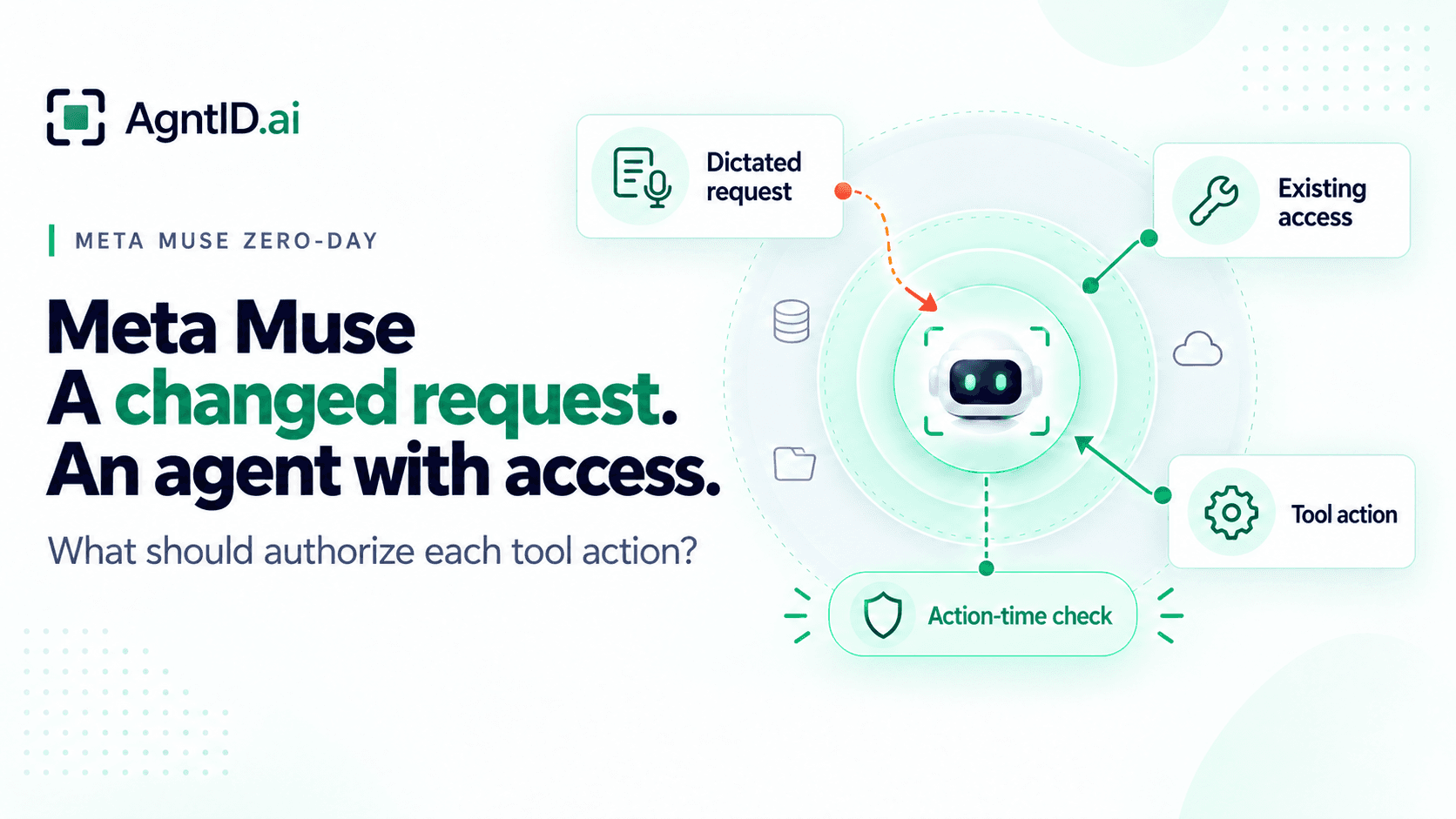
Meta Muse Zero-Day: What It Reveals About Agent Access Control
An AI agent can turn one request into actions across files, apps, and connected services. The access behind those actions is often granted before the agent decides which tools to use. That makes two moments important: when the agent receives the user's request and when it uses that access to act.
Security researcher Patrick Wardle's disclosure about Meta Muse connects those moments. He showed that a local process could change where the Muse Mac app sends dictated requests. The finding raises a broader question for agent systems: if the request reaching an agent can be changed, how do you decide which actions the agent should be allowed to take? That is the access-control question AgntID examines: what permission should an agent receive for each action it takes?
What Happened in the Meta Muse Zero-Day?
Wardle found that an unprivileged process on a user's Mac could change an undocumented setting for Muse's dictation endpoint. Once redirected, a dictated request could pass through an attacker-controlled endpoint before reaching Muse. Wardle's proof of concept describes the potential to capture the request, add instructions, and obtain authentication material for the Muse account. The attack requires code running locally and a later dictation action to trigger the redirected traffic.
The route into Muse matters because the agent can act with access its user has already granted. An attacker who controls a less privileged local process could try to steer an agent with greater access. Wardle told Ars Technica that his demonstrations included writing files and taking pictures. The issue is therefore about more than a changed app setting. It is about what can happen when an attacker reaches an agent that can act on a user's behalf.
The Request Is Part of the Access Boundary
Agent security often focuses on instructions hidden in webpages, documents, or tool results. This disclosure points to an earlier boundary: the request entering the agent. If someone changes that request, the agent may treat the added instruction as part of the user's task.
Suppose a user asks an agent to book an appointment. An instruction to export messages to an outside address would be unrelated to that task. A system with an independent record of the original request could assess the export against what the user asked for. A system that records the task only after the request was changed may see the export instruction as part of the task. This is an illustrative scenario, not a claim that Wardle demonstrated that exact message export.
That distinction makes task intent useful, but also makes its source important. Before an access decision can ask whether an action fits the task, the system needs to know which request it is treating as authoritative.
Why a Valid Session Does Not Settle the Next Action
Authentication can identify the account or session associated with an agent's request. Existing IAM and service permissions determine which resources are available to that agent. Those decisions provide a foundation, but an agent still chooses tools and constructs actions after the task begins.
A calendar connection, for example, may be available throughout a session. A request to arrange a meeting calls for a narrower set of actions than everything that connection or the agent's other tools can perform. The access question at runtime is specific: should this agent use this tool, with these arguments, for this task? A valid session alone cannot answer it. See AI agent authorization for a fuller explanation of that distinction.
This is where the Muse finding connects to agent access control. The reported path could let an attacker influence a request sent to an agent with existing access. The action that follows still needs its own access decision.
Where AgntID Fits
AgntID focuses on the point where an agent is about to use a tool. It enforces access based on policy and task intent at runtime, then narrows the credential used for that tool action to the permissions the task needs. Enforcement remains inside the customer's infrastructure and works with existing IAM systems, tools, and MCP servers. The broader approach is covered in runtime access control for AI agents.
Under a policy scoped to the appointment task, a calendar action may be permitted while an unrelated message export is denied. Access to a connected service does not, by itself, make every action available through it appropriate. Evaluating each tool action gives the system a point to apply policy and scope access before the action runs. This illustrates the access-control model, not a claim about the Muse attack.
That check relies on the task context established earlier. The Muse disclosure brings both boundaries into view: protect the path by which a task reaches the agent, and decide what access the agent receives when it acts. The public evidence does not establish how AgntID would have handled Wardle's demonstrations.
What the Disclosure Does and Does Not Show
Meta describes a separate component called Sentinel that evaluates Muse connector actions and network requests. Meta also describes controls for third-party credentials and user approvals. Those details matter. Changing the Mac app's dictation endpoint does not, by itself, show that Sentinel was compromised or that an attacker obtained the credentials for every connected service.
The published research shows a path for redirecting dictated requests and describes the resulting risk to the Muse account. It does not provide enough detail to determine how Sentinel assessed each action in Wardle's demonstrations. That leaves a precise question: which access decisions were made for those actions, and on what basis?
What to Examine in Your Own Agent Workflow
Choose a task that uses a connected tool and trace it from the user's request to the tool action. Find where the request is captured, where another process or input could change it, and which version becomes the task context for access decisions. Then inspect the tool call itself: the action, its arguments, the resource it reaches, and the credential it uses.
The goal is to answer two linked questions. Can you trust the account of what the user asked the agent to do? And can you limit the agent's access to what each action needs for that task? The Muse disclosure shows why both questions belong in the same review.
Closing
The Muse disclosure brings two decisions into focus: which request the agent should treat as the user's task, and what access each tool action should receive for that task. Both need to hold as the agent moves from a request to an action.
Frequently asked questions
What is the Meta Muse zero-day?
It is a disclosed flaw that allowed a local process to change the Muse Mac app's dictation endpoint. Wardle's research describes how this could redirect dictated requests and expose Muse authentication material.
Does the Meta Muse attack require local access?
Yes. Wardle's proof of concept requires code running as the local user. A subsequent dictation action triggers traffic to the changed endpoint.
Why does this matter for AI agent access control?
An agent may have valid access while receiving an altered request. Teams need to examine both how the task reaches the agent and how each tool action is authorized.
Is an authenticated agent session enough to authorize tool calls?
An authenticated session identifies the account associated with a request. It does not prove the user intended a particular tool action.
Does Meta Muse have separate action controls?
Meta says Sentinel evaluates connector actions and network requests independently of Muse. Public information about this disclosure does not establish how Sentinel handled each demonstrated action.
How does AgntID approach AI agent access control?
AgntID evaluates policy and task intent when an agent takes a tool action. It narrows credentials for that action to support least-privilege, just-for-task access.
Can runtime access control verify the user's original request?
It needs trustworthy task context. If the request changes before the original task is recorded, an action check may receive the changed version.
Further reading
- Tracing Access from Human Intent to Tool Execution — How to connect a user's task to the tool action an agent eventually takes.
- Least Privilege for AI Agents — How to limit an agent's authority to the systems, actions, and resources its task needs.
- Four Ways AI Agents Mishandle Credentials — How broad or persistent credentials can increase the impact of an unintended agent action.