AWS TOLAP and Runtime AI Agent Access Control: What Comes First
AWS TOLAP is a useful signal for the AI agent security market. It shows that static IAM and broad tool permissions are not enough when agents can call tools, query systems, and pull data into their context. TOLAP, short for Tool-Object Level Access Protocol, focuses on what data a tool can return to an agent. Teams building a broader AI agent access-control program can use this distinction to separate runtime permissioning from data filtering.
That is an important layer. But it is not the first layer a horizontal agent access program should solve. Before a team filters rows, columns, fields, files, or API results, it needs a runtime decision point for the agent's tool action itself.
That is the distinction AgntID is built around. AI agents are runtime-dependent. They reason, choose tools, and execute actions after a task begins. Access control for those actions has to happen at execution time, with least-privilege, just-for-task permissions based on policy and task intent.
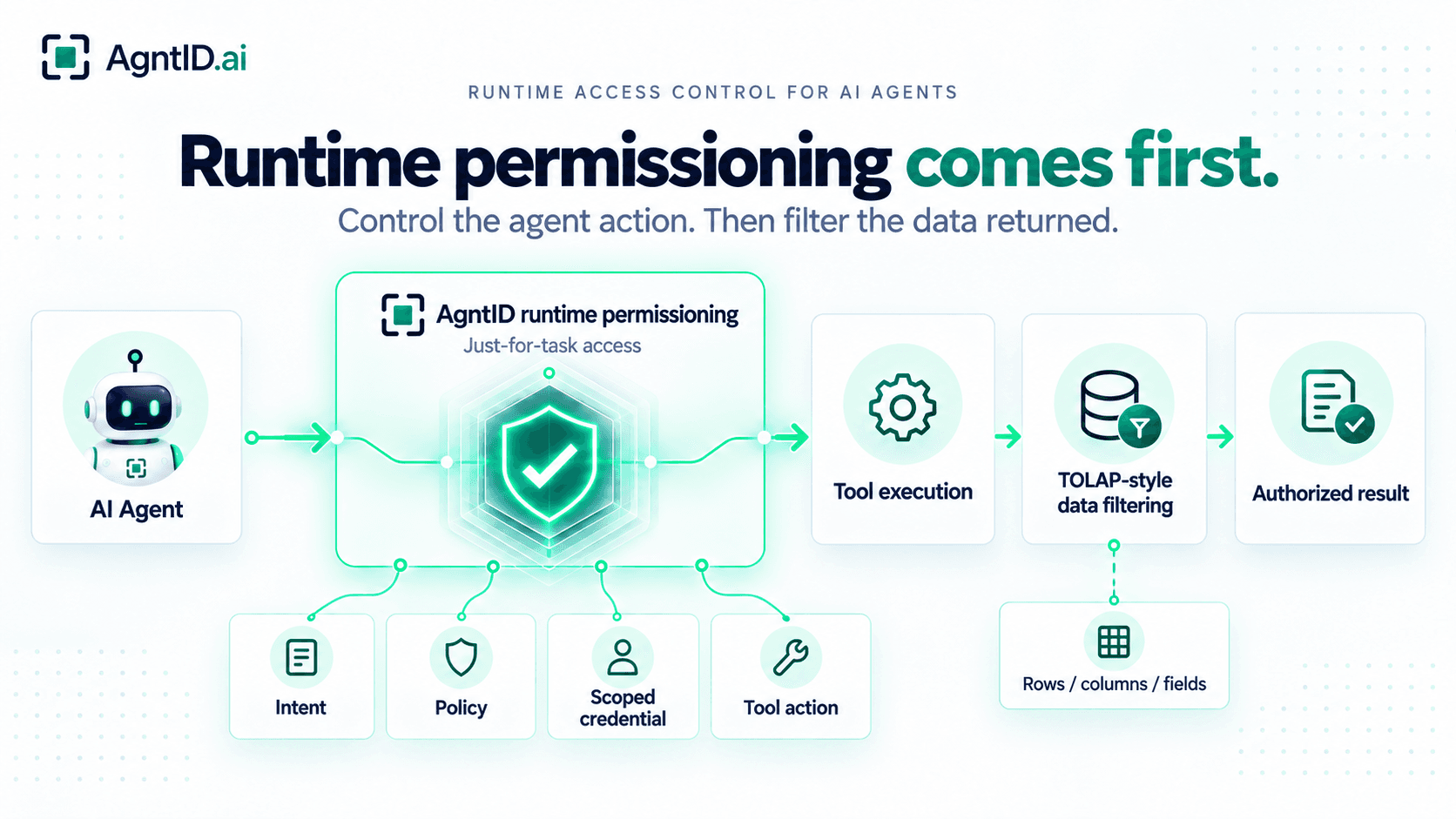
This is not TOLAP versus AgntID. It is a layered model with a clear order. IAM establishes identity and baseline access. AgntID enforces runtime access control for agent tool actions. TOLAP-style controls refine what data comes back from specific tools.
What AWS TOLAP Solves For AI Agent Access Control
TOLAP moves object-level data control closer to the source. In AWS's TOLAP announcement, the tool becomes the enforcement point between the agent and the data source. The tool applies policy before data enters the agent's context. The agent receives only the authorized result.
That matters for agent systems that query databases, call APIs, search knowledge bases, or retrieve files from storage. TOLAP can enforce controls such as row filters, column hiding, field masking, endpoint restrictions, HTTP method restrictions, tag-based filtering, result limits, file prefix rules, and similarity thresholds.
The value is clear. Once sensitive data enters the model context, downstream control gets harder. The agent can summarize it, reason over it, or reuse it in a later step. A prompt injection can also try to extract it. Filtering at the source is cleaner. The agent cannot leak data it never received.
But object-level filtering starts from one part of the problem: what the tool returns. It does not answer the broader runtime permission question: should this agent get this credential, for this tool action, for this task, at this moment?
Why Traditional IAM Is Not Enough For AI Agents
IAM remains the identity foundation. It answers questions such as who the user is, what service an identity can access, which resources are in scope, and which permissions were granted. Those questions still matter. But AI agents introduce a second layer of risk.
Agents do not follow a fixed application path. They reason across context, select tools dynamically, construct queries, call APIs, and may take multiple steps after a user gives one broad task. An agent can have valid access and still use that access in a way the task did not require.
A token can be valid and still be too broad. A tool can be available and still be wrong for the task. For example, an agent asked to summarize customer feedback may have access to a CRM export tool. That does not mean the agent should export the full customer table. An agent asked to review a pull request may have access to GitHub write tools. That does not mean it should merge code, delete branches, or update unrelated files.
The key question is no longer only: can this identity access this tool? The sharper question is: should this agent receive this permission for this task, right now?
What A Horizontal Agent Access Program Should Do First
A horizontal agent access program should start with the layer that applies across agents, tools, MCP servers, IAM systems, and environments. That layer is runtime permissioning for agent tool actions. It answers whether an agent should be allowed to act before the action runs.
This matters because agent risk is not limited to data retrieval. Agents can send emails, update tickets, delete records, trigger refunds, open pull requests, deploy code, rotate secrets, change cloud infrastructure, query production systems, and call internal APIs. A team needs a control point that can evaluate the task, tool, arguments, credential scope, policy, and intent before the tool action executes.
That is why a horizontal agent access program should start with runtime permissioning before adding object-level filtering for specific data tools. First, the organization needs visibility into what agents can call. Then it needs runtime access control that determines whether the agent should receive permission for a specific tool action. Then it can narrow credentials for that action. After that, TOLAP-style controls can refine what data specific tools return.
The cadence is simple: discover the agent tool surface, enforce runtime permission, narrow credentials per action, then add object-level filtering where data tools need it. This positions AgntID as the horizontal runtime access layer. TOLAP-style controls remain useful, especially when a team needs finer control over what data a tool returns.
Where TOLAP Fits In The AI Agent Security Stack
TOLAP fits the data-return layer. It helps answer what rows, columns, fields, records, files, or API response fields should come back from a tool. That is a useful pattern for object-level access control in AI agent systems.
AWS's architecture reflects this. TOLAP uses policy profiles, a policy resolution engine, a signed security context, a secure tool factory, and secure tool wrappers. The secure tool wrapper enforces policy at the data boundary so the agent receives only authorized results.
This points to the right security direction. Agent access control is moving closer to the tool boundary. Security teams are no longer relying only on static setup, prompt instructions, or broad tool permissions.
But returned-data policy is different from execution-time permission. A tool may return the right data and still perform an action the agent should not have been allowed to perform. A tool may expose a safe subset of results and still run under credentials that are broader than the task needs.
The Remaining Gap: Runtime Access Control For AI Agent Tool Actions
Many agent risks are runtime permission risks. Agents do not just read. They act. They can trigger workflows, modify systems, write to business applications, and call production APIs. For those workflows, the issue is not only what data comes back. The issue is whether the agent should receive permission for that tool action.
That decision needs policy, task intent, tool context, credential scope, environment, and approval requirements. It also needs to happen at execution time. A static role or broad session token cannot know what the agent is trying to do after reasoning through a task.
This is AgntID's core position. AgntID provides access enforcement at execution time for AI agents. It scopes permissions dynamically based on policy and task intent, so agents receive least-privilege, just-for-task access for every agent tool action. This complements the practical guidance in Runtime Access Control for AI Agents, AI Agent Authorization, and MCP Security Best Practices.
That is the difference between a tool returning less data and an agent receiving less power. Both matter. But they solve different control problems.
How AgntID Fits With IAM, MCP, And TOLAP
AgntID enables ephemeral, just-for-task access without disrupting existing tools, IAM systems, or MCP servers. Instead of relying on broad, session-based permissions, it narrows privileges per tool action at execution time.
AgntID supports multiple credential models. Teams can use pass-through credentials or AgntID-issued credentials for task-specific access. This gives security and platform teams a way to reduce privilege without replacing their identity stack or agent tooling.
AgntID provides infrastructure-owned runtime enforcement. Enforcement and control remain inside the customer's environment, with compatibility across existing IAM systems, vendor-hosted MCP servers, customer-hosted MCP servers, and custom MCP servers.
That matters because most enterprises will not rebuild their stack around one agent framework or one tool protocol. They need a runtime layer that works across their existing systems, while still making access decisions at the moment an agent tries to act.
TOLAP And AgntID Solve Different Parts Of The Stack
IAM, AgntID, and TOLAP answer different security questions. IAM asks whether an identity can access a service. AgntID asks whether an agent tool action should receive permission at execution time. TOLAP asks what data a tool should return after that tool is in use.
| Layer | Question It Answers | Best For |
|---|---|---|
| IAM | Can this identity access this service? | Identity and baseline access |
| AgntID | Should this agent tool action receive permission now? | Runtime access control, policy + intent enforcement, and credential narrowing |
| TOLAP | What data should this tool return? | Object-level data control |
The order matters for a horizontal security program. IAM gives the agent an identity foundation. AgntID narrows permission for the agent's runtime tool action. TOLAP-style controls refine the data returned by tools that need object-level filtering.
The mistake is treating returned-data filtering as the full access-control answer. Identity alone does not control runtime intent. Returned-data filtering alone does not narrow the agent's permission at execution time. Runtime access control connects the agent's task, intent, tool action, and credential scope before access is granted.
The AgntID View
TOLAP helps answer what data comes back from a tool. AgntID enables least-privilege, just-for-task access for AI agent tool actions. That distinction matters because agents do not only retrieve data. They send emails, modify records, open pull requests, trigger workflows, deploy code, and call production systems.
Those tool actions need policy + intent-driven enforcement at execution time. Security teams need to know what tool the agent is calling, what action it is taking, what arguments it is passing, whether the action is aligned with task intent, what credential should be used, and whether access should be narrowed for that action.
Those decisions cannot sit only in static IAM. Traditional IAM systems rely on long-lived credentials and broad permissions. AI agents are runtime-dependent and non-deterministic. AgntID addresses that gap by enforcing least-privilege, task-specific access at execution time while working with existing tools, IAM systems, and MCP servers.
For an organization building a horizontal agent access layer, AgntID should come first. Once runtime permissioning is in place, object-level controls such as TOLAP can add precision for data-heavy tools.
Closing
AWS TOLAP points to the right market shift. AI agent access control is moving away from broad, static permissions and toward enforcement closer to the tool boundary.
But object-level data control is one layer. The bigger production question is execution-time permission: what should this agent be allowed to do for this task, with this tool, right now?
For horizontal agent security, start with runtime access control. Add object-level filtering where data tools need finer control. TOLAP helps answer what data comes back. AgntID enforces whether the agent should receive permission for the tool action itself.
Frequently asked questions
What is AWS TOLAP?
TOLAP stands for Tool-Object Level Access Protocol. It is an open protocol from AWS for enforcing object-level access control when AI agents use tools to access data.
What problem does TOLAP solve?
TOLAP controls what data a tool returns to an AI agent. It can filter rows, hide columns, mask fields, restrict endpoints, and enforce result limits before data enters the agent context.
Is TOLAP the same as IAM?
No. IAM determines whether an identity can access a service or resource. TOLAP controls what data a tool can return after access is granted.
How is AgntID different from TOLAP?
TOLAP focuses on object-level data return. AgntID provides runtime access control enforcement for AI agent tool actions. It scopes permissions dynamically based on policy and task intent before the action executes.
Why should a horizontal agent access program start with AgntID?
It should start with runtime permissioning because that layer applies across agents, tools, MCP servers, IAM systems, and environments. AgntID provides that runtime access layer for agent tool actions.
Why do AI agents need runtime access control?
AI agents need runtime access control because they select tools dynamically, reason across context, and execute actions after a task begins. Static IAM permissions can be too broad for a specific agent tool action. Runtime access control scopes permission based on policy, task intent, and execution context.
Can TOLAP and AgntID work together?
Yes. IAM, AgntID, and TOLAP can work as complementary layers. IAM provides identity. AgntID enables least-privilege, just-for-task access for agent tool actions. TOLAP filters returned data for tools that need object-level control.
Further reading
- Runtime Access Control for AI Agents — Learn how execution-time controls evaluate an agent's task, tool, and context before access is granted.
- Least Privilege for AI Agents — See how to narrow agent permissions to the systems, actions, and resources a task actually requires.
- Four Ways AI Agents Mishandle Credentials — Understand how broad, persistent, or poorly scoped credentials increase the impact of an unintended tool action.
Sources
- AWS Labs TOLAP specification — The open protocol specification referenced in this article for TOLAP's tool-boundary and object-level access-control model.
- AWS TOLAP documentation — Technical documentation for TOLAP policy profiles, resolution, security context, and secure tool wrappers.