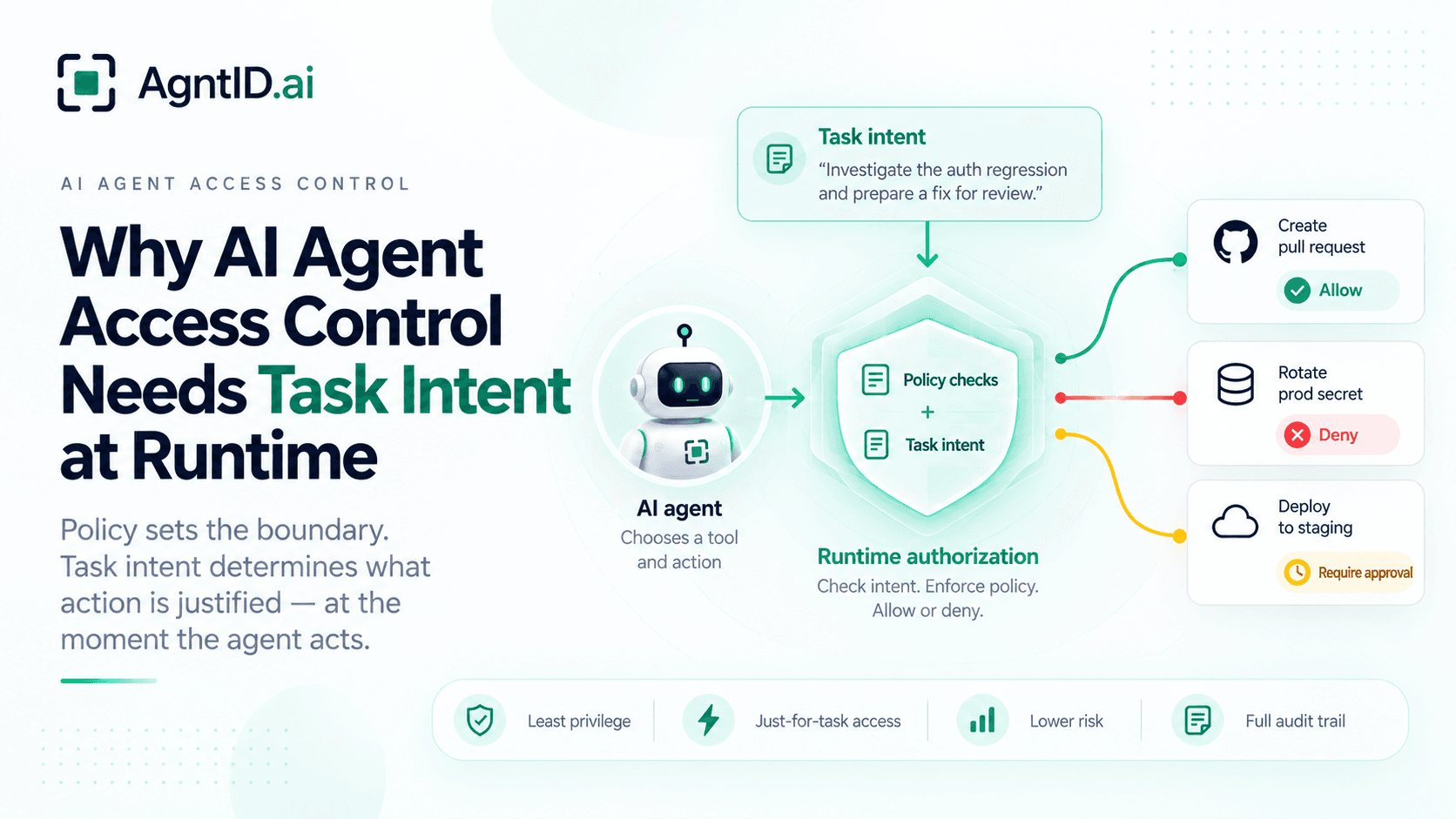
Why AI Agent Access Control Needs Task Intent at Runtime
Okta has moved access checks closer to the moment an AI agent acts. With Agent Gateway, an agent makes a tool request and Okta evaluates the identity and policies governing that request before allowing it to continue. That moves policy evaluation closer to the action itself rather than relying only on access established when the agent first authenticates or begins a session.
That solves an important part of the problem. But autonomous agents introduce another one: a request can satisfy configured policy and still be wrong for the task.
As agents receive open-ended instructions, reason about how to complete them, and choose actions dynamically, access control also needs context about what the agent is currently trying to accomplish. That is the problem AgntID is designed around.
Runtime policy checks solve one part of the problem
A runtime policy engine can evaluate whether an action satisfies rules and conditions that have already been defined. Security teams can specify which identities may reach which resources, which actions require approval, which environments are restricted, and which requests should always be denied.
That is useful because the decision happens when the request is made. The policy system can enforce the organization's defined boundaries at the point where the agent attempts the action.
The challenge is that autonomous agents do not always operate inside a small set of predefined workflows. They receive natural-language tasks, react to what they discover, select tools dynamically, and determine what action to attempt next. The system still depends on the organization defining the rules and conditions that should govern those possibilities.
The harder question is what the task justifies
Consider an engineering agent with access to GitHub, CI, application logs, a staging environment, and a secrets manager. Its task is:
Investigate the authentication regression introduced in yesterday's release and prepare a fix for review.
During the investigation, the agent identifies what it believes is the cause. It may now want to modify authentication code, run tests, deploy a candidate fix to staging, change an environment variable, rotate an application secret, or open a pull request.
Any of those capabilities may be legitimate under the broader access policy. The agent may be allowed to modify a particular repository. Staging deployment may be permitted. Production deployment may be denied. Secret rotation may require approval.
But another question remains: which of those actions does the current task justify? Opening a pull request may fit the purpose. Running tests may fit. Rotating a production secret may not.
Now change the task:
Rotate the compromised production authentication secret and validate the application after rotation.
The same agent may propose the same secret-rotation action. The secret manager is unchanged. The broader access policy can remain unchanged. What changed is the purpose for which the authority is being requested.
That change can justify a different access decision.
Task intent adds context inside the policy boundary
AgntID does not replace policy with intent. Policy establishes the hard security boundary. It can define which systems an agent may access, which environments are off limits, which actions always require approval, which capabilities an agent may never receive, and which identities may reach which resources.
Task intent answers a different question: within those boundaries, what authority does this task justify now?
At AgntID, the current task is an explicit input into the access decision. The runtime considers what the agent was asked to accomplish, what action the agent is attempting, and what policy permits.
Task intent therefore gives the runtime additional context for decisions that would otherwise require increasingly specific predefined conditions.
Why predefined rules become harder to scale
Security teams can encode task-specific conditions into policy. For known workflows, that can work well.
For example:
IF workflow = approved_secret_rotation
AND environment = production
AND approval = present
THEN allow secret rotation
The challenge appears as agents receive increasingly varied tasks and decide dynamically how to complete them. The relevant decision space can span combinations of task, agent, tool, action, resource, environment, and circumstance.
Not every combination needs a separate rule. But as agent workflows become more autonomous and open-ended, it becomes harder to anticipate every meaningful task-specific condition through predefined rules alone.
Policy remains the guardrail. Task intent adds context about the work happening inside it.
AgntID approaches least privilege from the task outward
Traditional least privilege usually starts with a question such as: what permissions should this identity have?
For an autonomous agent, there is another useful question: what permissions does this task require now?
An infrastructure agent might legitimately be capable of reading logs, inspecting Kubernetes resources, restarting workloads, modifying configuration, rotating credentials, and changing infrastructure. Different tasks require different subsets of that authority.
Giving the agent every permission it may need across all possible tasks creates standing privilege. AgntID approaches the problem from the task outward by asking what the agent is trying to accomplish, what action it is attempting, what authority that action requires, and what policy permits.
From available capability to just-for-task access
The AgntID model can be expressed simply:
Current task → proposed action → policy + task intent → access decision → narrowed privilege → execution
Policy defines the maximum permitted boundary. Task intent provides context about what the agent is trying to accomplish. The proposed action identifies the authority being requested.
AgntID brings those inputs together before execution. The resulting privilege can then be narrowed around the authority required for the approved action rather than remaining broadly available throughout the session.
This is what AgntID means by just-for-task access.
The access decision comes before credential narrowing
Short-lived credentials help reduce exposure. Scoped credentials help reduce privilege. But another decision comes first: what should the scope be?
Consider the same engineering agent across three tasks: finding the cause of a production incident, applying an approved remediation, and writing a post-incident summary. The investigation may require read access. The remediation may justify a specific write permission. The summary may require neither.
The identity and environment can remain the same. The required authority changes because the purpose changes. AgntID uses task intent as part of determining what access should be available. Credential narrowing then follows from that decision.
Intent has to affect access
Intent is not useful for authorization if it exists only as context in a trace or log. At AgntID, the current task contributes directly to the access decision.
Conceptually:
Current task:
"Investigate the authentication regression
and prepare a fix for review"

              ↓

Agent proposes:
rotate_production_secret()

              ↓

Policy:
Secret-system access is available within
approved engineering boundaries

              ↓

Task-intent evaluation:
Does this requested authority make sense
for what the agent was asked to accomplish?

              ↓

Access decision
The goal is not to determine whether an action is universally safe. The goal is to determine whether the requested authority makes sense within both the organization's policy boundary and the current task.
The agent should not authorize itself
The model can reason about how to complete the task, choose a tool, and propose an action. It should not have the final authority to decide whether it receives the permissions required to execute that action.
That decision belongs to infrastructure. With AgntID, the agent proposes the action. AgntID evaluates policy and task intent. Infrastructure determines what authority becomes available.
Enforcement and execution remain inside the customer's infrastructure. This keeps the authorization decision outside the agent's own reasoning loop.
Why this matters more as autonomy increases
Deterministic workflows are easier to constrain because the expected actions are known and the permitted path can be defined. Policies can be written around that path.
Autonomous agents are useful because the exact path does not always need to be known in advance. An agent can encounter unexpected conditions, select another tool, or reason toward an action that was not explicitly anticipated when the policy was written.
That flexibility also makes task context more important to access control. Policy sets the hard boundaries. Task intent helps determine what authority is justified inside those boundaries for the work happening now.
What security teams should ask
Security teams evaluating AI agent access control should start with the hard boundaries. Some actions should always be denied or always require approval regardless of task. Those belong in policy.
They should then look at the task itself. What is the agent currently trying to accomplish? What authority is it requesting now? Does that authority follow from the task, or is it simply available because the agent has broader permissions?
Another useful question is whether handling each new situation requires another task-specific policy condition. If that repeatedly becomes necessary, policy complexity can increase as agent workflows become more varied.
Finally, teams should ask whether access can be narrowed once the required authority has been determined and who makes the final decision. The agent can determine what it wants to attempt. Infrastructure should determine what it is allowed to execute.
Policy sets the boundary. Intent makes access task-specific.
Moving policy evaluation closer to the action is useful. It means a request can be checked when the agent makes the tool call rather than relying only on authority established earlier.
Autonomous agents still create another challenge. Their work can be dynamic enough that security teams cannot reasonably anticipate every meaningful task-and-action combination in advance.
AgntID is built around that gap. Policy defines the hard boundaries. Task intent explains what the agent is trying to accomplish. The proposed action identifies the authority being requested. AgntID combines those inputs before execution and can narrow access around the approved action.
A rule can determine whether an action is permitted. Intent helps determine whether that permitted action makes sense for the task happening now.
Frequently asked questions
What does Okta Agent Gateway do?
Okta Agent Gateway evaluates identity and configured access policy when an agent makes a tool request. The policy decision happens in the request path rather than relying only on access established earlier.
How is AgntID different from a runtime policy check?
A runtime policy check evaluates a request against configured rules and conditions. AgntID also uses the agent's current task as an explicit input into determining what authority should be available for the proposed action.
Why not encode the task entirely in policy?
For known workflows, task-specific policy can work well. The challenge grows as agents receive more varied natural-language tasks, select tools dynamically, and encounter conditions that were not anticipated when the policy was written.
What is task intent?
Task intent describes what the agent is currently trying to accomplish. AgntID uses that context together with policy when deciding what access should be available for a tool action.
Does intent replace policy?
No. Policy establishes the hard security boundaries. Intent adds task context inside those boundaries.
What is just-for-task access?
Just-for-task access means making available only the permissions required for the agent's current task, for the period in which those permissions are needed.
Does AgntID replace an identity provider?
No. AgntID is designed to work alongside existing IAM systems. Identity systems continue to establish and manage identities while AgntID adds policy-and-intent-driven access decisions when the agent acts.
Does AgntID replace existing MCP servers?
No. AgntID is designed to work with vendor-hosted, customer-hosted, and custom MCP servers, as well as existing tools and IAM infrastructure.
Further reading
- Runtime Access Control for AI Agents — How access decisions can be enforced at execution time when an AI agent attempts a tool action.
- Least Privilege for AI Agents — How to narrow an agent's authority around the systems, actions, resources, and permissions required for the current task.
- AI Agent Authorization — How to control what AI agents are allowed to do across tools, APIs, resources, and enterprise systems.