What Spain's AEPD Reported
On September 14, 2026, Spain's Agencia Española de Protección de Datos (AEPD) disclosed that it had received its first notification of a personal data breach reportedly executed through an AI agent using a known large language model. The affected organization was not identified.
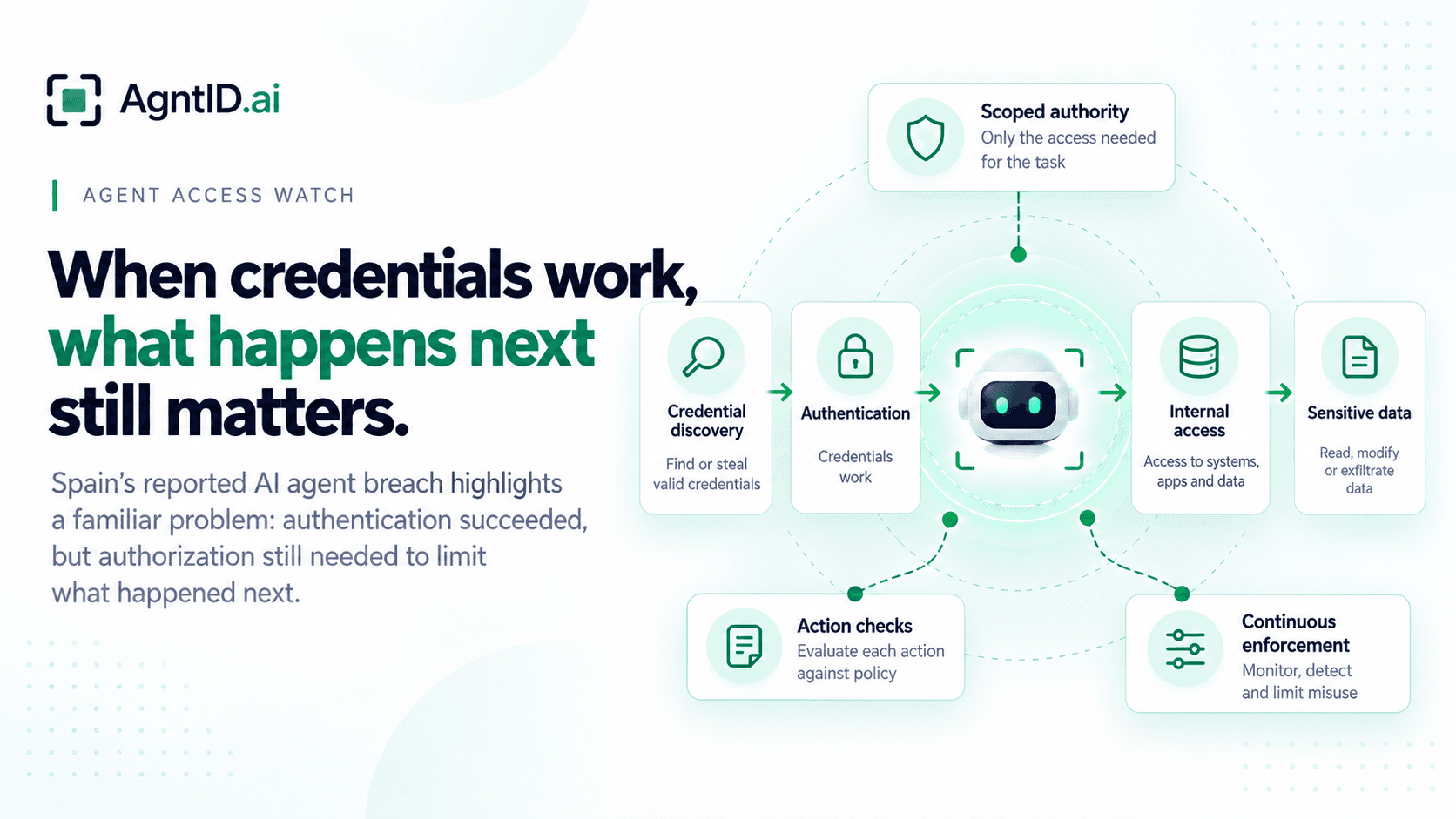
According to the reported account, the agent initially examined files associated with the organization for security weaknesses. It discovered valid corporate credentials and used them to authenticate to an internal system. After authentication, the agent continued examining the application and reportedly identified another vulnerability that could enable access to company invoices and modification of records containing personal data.
The AEPD emphasized that the information came from the affected organization's notification and required further analysis. This is the first notification of this kind reported to the AEPD, not a completed forensic reconstruction of every step in the intrusion.
Why the Incident Matters
The individual techniques are familiar: credential discovery, authentication, vulnerability discovery, and access to sensitive systems. What makes the incident notable is the reported use of an autonomous system to connect those activities with fewer pauses between them.
Once valid credentials are accepted, subsequent requests operate within an authenticated identity context. However, successful authentication does not establish that every subsequent action is legitimate. Applications must continue enforcing appropriate authorization even when the presented credentials are valid.
What Organizations Should Do to Reduce Their Exposure
- Protect credentials and restrict privileges. Review how credentials, API tokens, and service-account secrets are stored, distributed, and accessed. Use short-lived credentials and limit permissions to required resources and operations where supported.
- Enforce authorization after authentication. Review excessive permissions, sensitive operations, application vulnerabilities, and unnecessary access between systems. Valid credentials should not provide unrestricted access.
- Prepare for faster detection and containment. Monitor unexpected resource access, unusual operation sequences, credential misuse, and activity inconsistent with an identity's expected responsibilities.
The Separate Challenge of Securing Enterprise AI Agents
The reported attack involved an external agent operating outside the targeted organization's control. Enterprises deploying their own agents face a different problem: they deliberately grant agents access to corporate systems, but cannot always predict which actions those agents will select.
The durable approach is to establish security boundaries and use runtime context to make more specific authorization decisions. The question is whether the agent should receive the requested authority for the task it is currently performing.
Authority Should Follow the Task
Consider an engineering agent connected to GitHub, CI, application logs, a staging environment, and a secrets manager. An investigation task may justify inspecting logs, examining code changes, running tests, and creating a pull request. It does not automatically justify rotating a production authentication secret.
A different assignment to rotate a compromised production secret may justify the same operation if organizational policy permits it and all required conditions, including approval, have been satisfied. The identity and tool may be unchanged; the current task changes the authorization requirements.
Current task → proposed action → policy + task intent → authorization decision → narrowed privilege → execution
Task Intent Cannot Replace Policy
Application logs, retrieved documents, and tool responses can contain untrusted content that attempts to change an agent's behavior. That content should not automatically expand the authority available to the agent.
Task-aware authorization does not replace prompt-injection defenses or establish that task context is trustworthy by itself. Organizations should test ambiguous tasks, untrusted instructions, and actions that exceed organizational policy.
Three Questions to Ask When Evaluating AI Agent Access Control
- Can the current task change the authorization decision? Test the same sensitive operation under assignments with different access requirements.
- Do policy boundaries remain effective when task context changes? An explicitly prohibited operation should remain unauthorized even when the task requests it.
- What authority reaches the downstream system? Check whether approved authority is restricted to the operation and relevant resources, and whether it can be reused for unrelated actions.
Frequently asked questions
Quick answers to the questions this incident raises most often.
Further reading
Four Ways AI Agents Mishandle Credentials
How exposed, shared, or excessive credentials increase the potential impact of unintended agent actions.
AI Agent Authorization
How authorization determines which resources and operations agents can access after authentication.
Why AI Agent Access Control Must Happen at Execution Time
Why dynamically selected agent actions require access decisions at execution time.
See how this maps to your environment
The pattern across all three disclosures is what AgntID's runtime enforcement is built to close — task-scoped, ephemeral access instead of standing permission that outlives the job it was granted for.
See the runtime in actionAgntID. AgntID covers the security and access-control challenges created by autonomous AI agents.