AgntID vs Okta for AI agents
Okta is the identity foundation for AI agents. It defines agent identity and ownership while determining what resources an agent may access. AgntID complements Okta at the runtime layer. It evaluates the specific task, tool and arguments before an action runs. AgntID determines whether that action is authorized based on the task being performed.
Identity Foundation
Okta
Who is the actor?
Execution-time Layer
AgntID
What can the agent do right now?
Tool Execution
MCP Tools
Scoped, ephemeral access
The Alternative Options
Use A Service Account
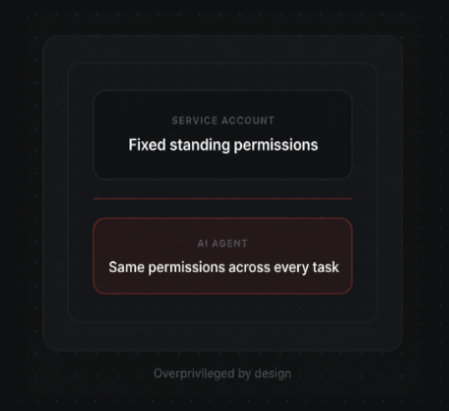
The agent runs under a service account and inherits its permissions. Access is broad, fixed at the account level, and applies across tasks regardless of what the agent is trying to do.
Act On Behalf Of The User
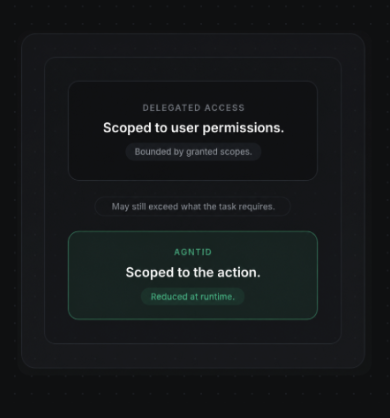
The agent acts with access delegated by the signed-in user. Its access is bounded by the user's permissions and granted scopes, but can still exceed what a specific task requires.
Give The Agent Its Own Identity
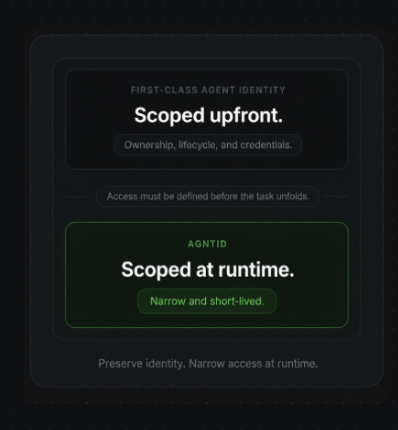
The agent gets a dedicated identity with its own credentials and scoped permissions. The challenge is defining the right access upfront when each task may require a different set of actions.
Our Difference
Where AgntID differs.
Okta defines the agent's identity and what resources it may access. AgntID complements Okta at the runtime layer by evaluating what the agent is trying to do, then authorizing the specific action before it runs.
Intent + policy enforcement
AgntID validates whether the action matches the intended task, then checks it against policy. Intent and policy are evaluated independently before access is granted.
Dynamic access narrowing.
Once the action is approved, access is narrowed to the permissions required for that action instead of carrying broader access forward.
MCP-native enforcement.
AgntID evaluates policy against the actual MCP tool and arguments used at runtime.
AgntID vs. The Alternatives
Where each option fits
Each path below is real and solves something worth solving. Here's where it holds up, and where AgntID picks up the rest.
AgntID vs SERVICE ACCOUNTS
Broad Permissions Across Every Task.
A service account gives the agent a persistent identity with a fixed set of permissions. It is simple to deploy and works well for predictable workloads. The tradeoff is that the same permissions follow the agent across every task, even when a specific task needs far less access. AgntID determines the tool and action required for the task, then narrows access to what that execution needs. Each action is evaluated at runtime, with intent validation, policy checks, and access scoped to the specific action before it executes.
AGNTID IS BEST FOR TEAMS THAT NEED TO
- Avoid carrying broad account permissions into every action.
- Apply least privilege to agents at runtime.
- Stop a compromised agent from acting outside its task.
AgntID vs. DELEGATED USER ACCESS
Scoped To User Permissions.
The agent acts with the signed-in user's permissions and granted scopes. This works well when the agent is closely tied to a user session. The limitation is that access is still defined around the user, so the agent may have more access than the task requires. AgntID narrows that delegated access to what the task needs. Before execution, intent is validated, policy is checked, and access is scoped to the action.
AGNTID IS BEST FOR TEAMS THAT NEED TO
- Narrow access below the user's broader permissions.
- Scope each execution to the task at hand.
- Avoid carrying session-wide access into every action.
AgntID vs. AGENT IDENTITY
First-Class Agent Identity
Giving an agent its own identity improves ownership, attribution, lifecycle management, and credential control. The challenge is defining the right access upfront when different tasks may require different tools and actions. AgntID narrows access at runtime once the task, tool, and action are known. Intent validation and policy checks remain part of the runtime decision before execution.
AGNTID IS BEST FOR TEAMS THAT NEED TO
- Preserve first-class identity without carrying broad access forward.
- Narrow access to the tool needed for the task.
- Keep access narrow and short-lived at runtime.
Capability comparison
Okta defines agent identity and what resources an agent may access. AgntID complements that foundation at runtime by evaluating the task, tool, and action before execution.
| Capability | AgntID | Okta |
|---|---|---|
Defines agent identity and ownership Okta defines the agent's identity and ownership. AgntID uses that identity to authorize what the agent can do at runtime. | Partial | Yes |
Provisions and deprovisions accounts Manages agent identities from provisioning through deprovisioning. | No | Yes |
Access reviews and certification Reviews whether agents should retain their assigned access over time. | No | Yes |
Authenticates agent identities Verifies agent identity before access is granted. AgntID relies on the existing identity provider for authentication. | No | Yes |
Maintains agent inventory Tracks known agent identities and keeps them under centralized identity management. | Partial | Yes |
Brokers scoped credentials Provides short-lived credentials scoped to what the agent needs at runtime. | Yes | Partial |
Discovers shadow agents Finds unmanaged agents outside identity management. | No | Yes |
Registers agents with a named owner Gives agents first-class identities tied to accountable owners. | No | Yes |
Per-action runtime enforcement Evaluates each tool call before execution and can block a specific action without stopping the agent. | Yes | Basic |
Validates intent before execution Checks whether the selected action still matches the task the agent was asked to perform. | Yes | No |
Customer-hosted enforcement Runs runtime enforcement inside the customer environment. | Yes | Partial |
Audit trail per tool call Records the runtime decision and outcome for each tool call. | Yes | Partial |
Frequently asked questions.
The Ask
Request design
partner access.
Tell us where your agents are today. We'll follow up to scope a pilot and walk through what changes in your stack.