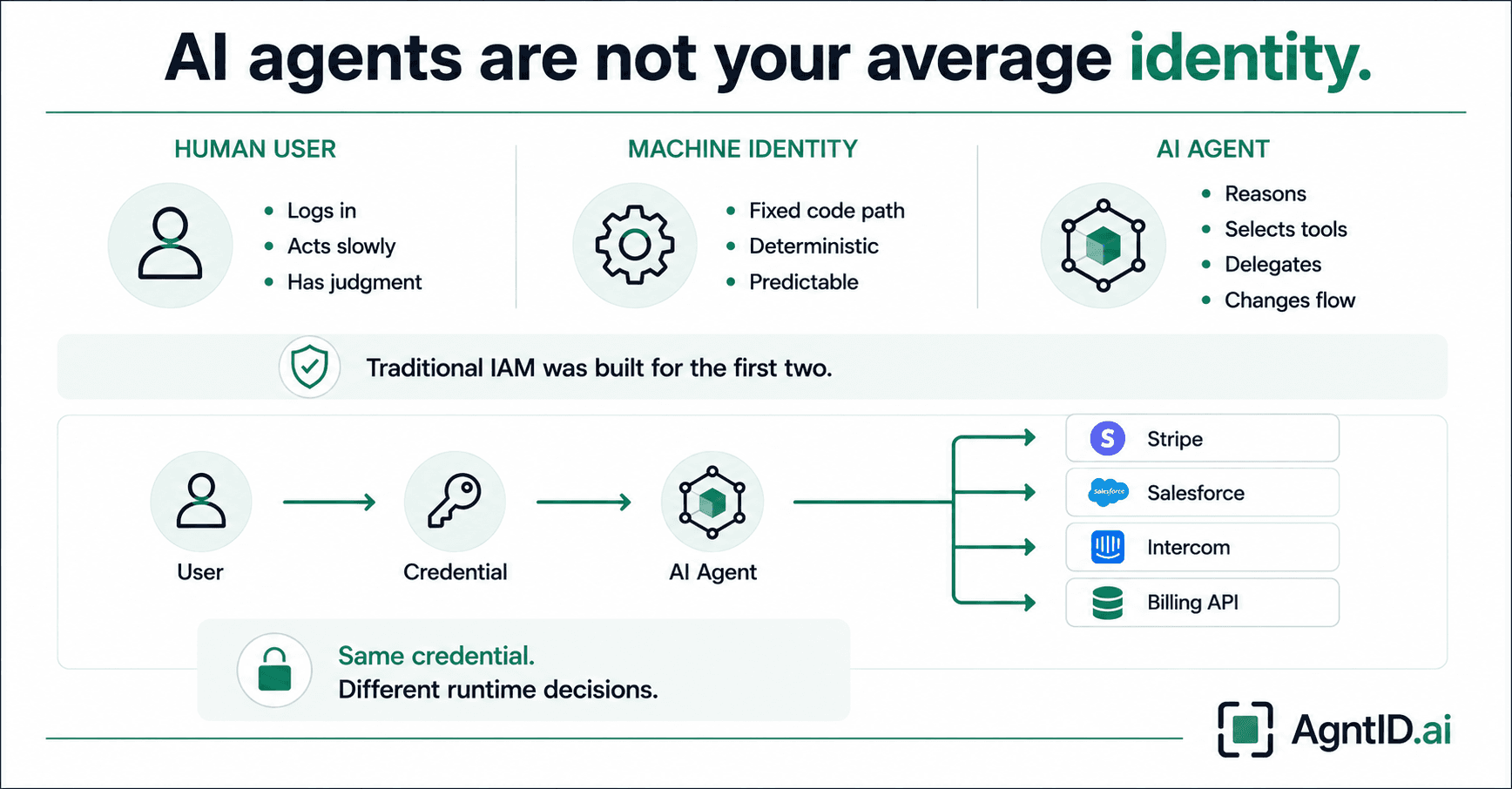
AI agents are not service accounts or bots. They are a third identity category — and most enterprise Identity and Access Management (IAM) systems were not built to handle them.
Imagine you have just connected your new AI customer support assistant to three tools: Intercom to read tickets, Stripe to look up billing history, and Salesforce to pull account details. Because traditional security systems are designed to recognize only humans, you provision the agent with a standard service account that has broad, static permissions across all three. The agent handles the first ticket correctly. Then, mid-conversation, it decides that one account's data isn't enough context and begins pulling billing records for every customer in your Stripe instance, passing them to Salesforce for cross-referencing. Your current security stack sees a valid credential and signals "Access Granted," because it only verifies who the actor is, not what the agent is trying to do at that moment. The identity is technically valid. The action itself is not.
The Identity Stack Was Built for Two Types of Actors
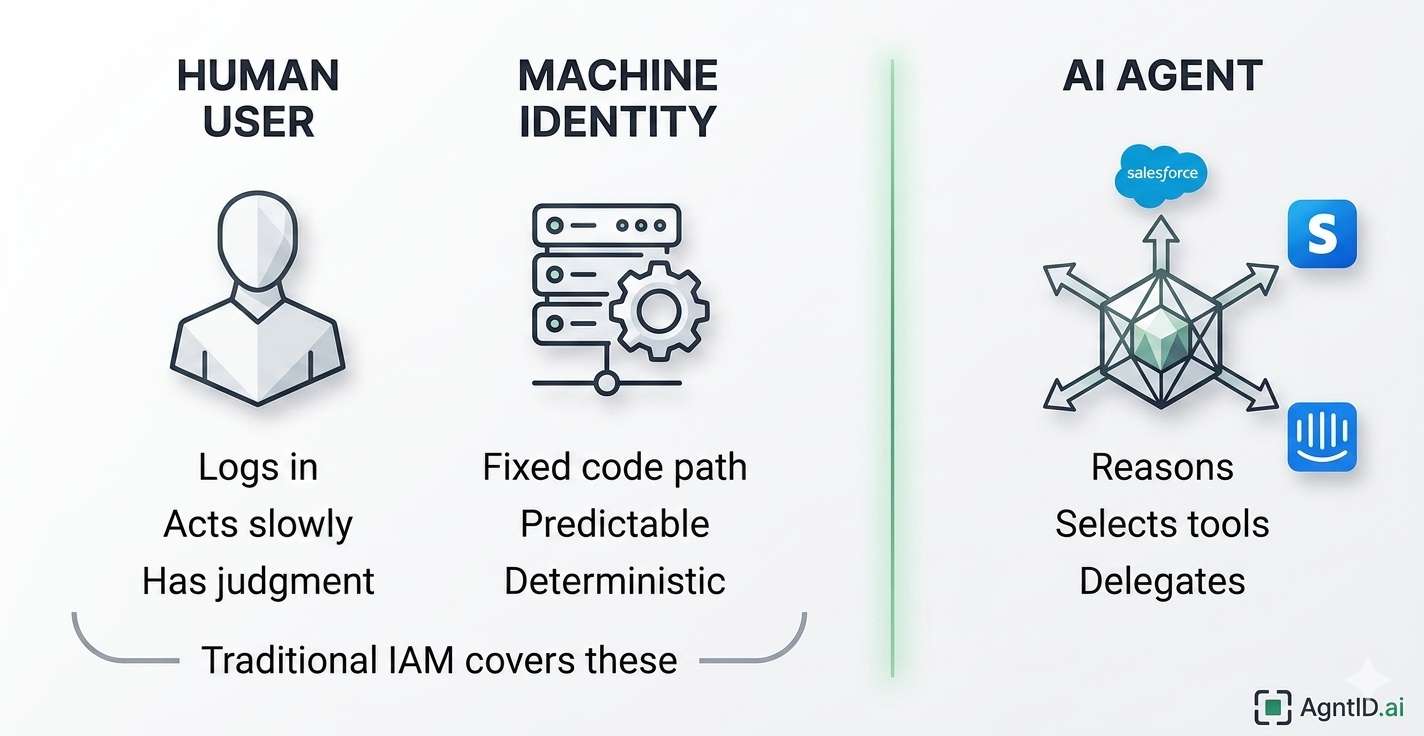
Most enterprise identity systems were built around two types of actors. The first is the human user. Humans log in, make decisions, approve actions, and move at human speed. They can be trained and can be challenged with Multi-Factor Authentication (MFA). They can be reviewed by managers. And also be held accountable when access is misused. The second is the machine identity. This includes applications, workloads, scripts, Application Programming Interfaces (APIs), containers, service accounts, and automation jobs. These identities are non-human but usually predictable. They follow fixed code paths and execute known functions.
AI agents do not fit cleanly into either model. An AI agent can receive a goal, interpret context, select tools, call APIs, delegate tasks, and continue execution without direct human control at every step. This makes the AI agent identity different from both human IAM and traditional workload identity. The mismatch is not cosmetic. It changes the security question.
Traditional IAM asks: "Who is this actor?" Agentic IAM must ask: "What is this agent trying to do right now, with which tool, on whose behalf, and under which policy boundary?" That question cannot be answered only at login.
Such an approach is moving from experiment to infrastructure. Gartner predicts that by 2028, 33% of enterprise software applications will include agentic AI, up from less than 1% in 2024. It also expects 15% of day-to-day work decisions to be made autonomously through agentic AI by 2028. But adoption does not equal ready. Gartner also estimates that more than 40% of agentic AI initiatives will be canceled by the end of 2027, in part because organizations are battling with cost, risk, and unclear value. For security teams, this shows the importance of building agent controls before they increase deployment.
Four Properties That Make AI Agents a Third Identity Category
AI agents deserve their own identity model because they combine autonomy, speed, and access in a way traditional IAM was not designed to manage. A human has judgment but acts slowly. A machine identity acts quickly but usually follows deterministic instructions. An AI agent can act quickly and dynamically change its execution path. That creates a third identity category, agentic identity, which has four defining properties.
First, AI agents are non-deterministic. The same prompt can lead to different steps depending on context, memory, model behavior, available tools, and intermediate results. This breaks access models that assume behavior is known at provisioning time. Second, agents compose tools dynamically. In Model Context Protocol (MCP)-based environments, agents can discover available tools and choose which ones to call during execution. The access footprint is not always known when the agent is configured. Third, agents delegate. A user may ask an agent to complete a task. That agent may call another agent, which then calls a tool or API. Without delegation-chain tracking, audit logs can show that something happened, but not why it happened or who originally authorized it. And fourth, agents operate at machine speed with human-level blast radius. A poorly scoped user account is risky. Also, a poorly scoped AI agent can repeat that risk across many systems before a human notices. This is why static IAM becomes fragile in agentic environments.
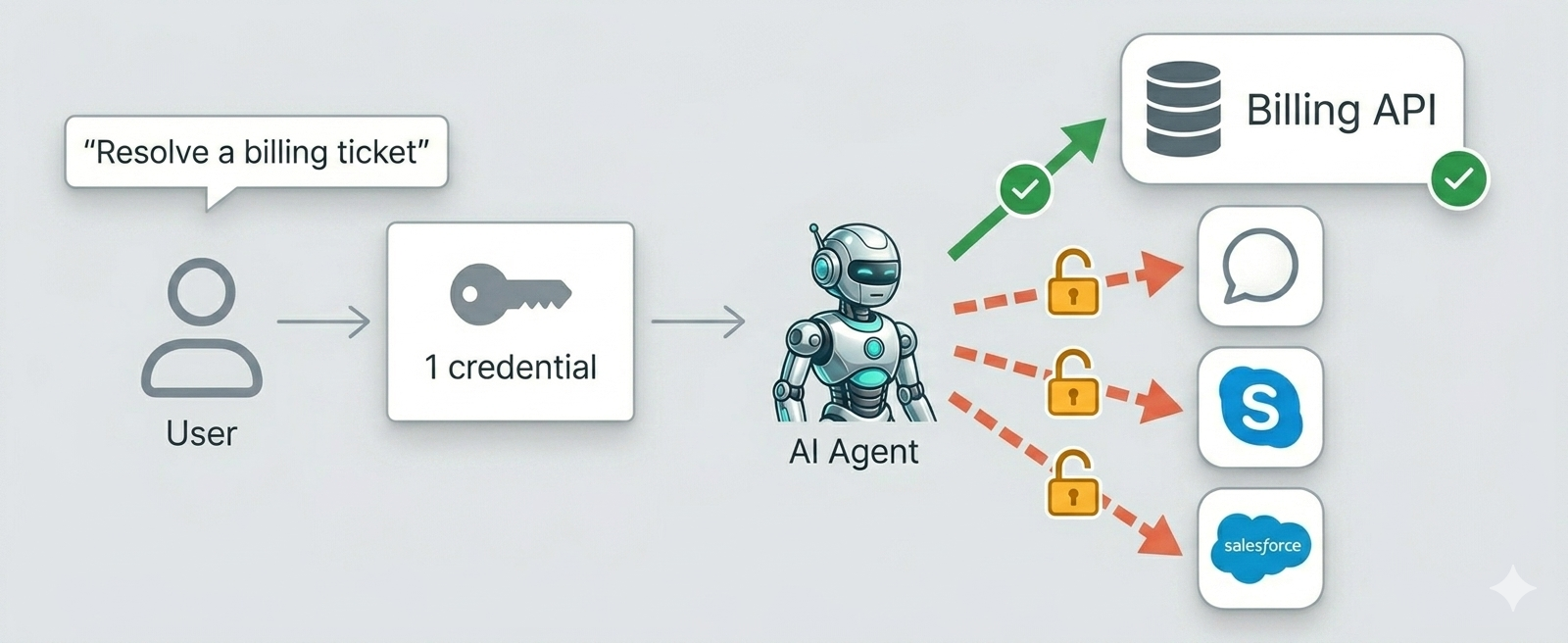
One task. One credential. Four systems reached — three of them unplanned.
What Breaks When You Use Existing Identity Models for Agents
The fastest way to connect an AI agent to enterprise systems is often the most dangerous: giving it a service account. That may work in a demo. It does not work as a long-term security model. Service accounts usually have broad, static permissions. They are often long-lived and may be shared across workflows. They rarely understand the intent behind an action and do not naturally support a user-to-agent-to-tool delegation chain. These limitations are well-documented in identity engineering. The OpenID Foundation's 2025 whitepaper on Identity Management for Agentic AI examines how existing identity protocols struggle with delegation, ephemerality, and fine-grained authorization for autonomous systems — exactly the conditions an AI agent introduces.
AI agents intensify each of these limitations in a specific way. Broad permissions stop being a static configuration problem and become an active runtime exposure: an agent can chain dozens of tool calls in seconds, all under one credential, before any human notices. Long-lived secrets compound the blast radius — a leaked token no longer grants access to one workflow but autonomous reach across multiple systems. Shared accounts erase per-agent attribution: when something goes wrong, audit logs show which credential was used but not which agent, which user request, or which step in a delegation chain triggered the action.
For example, an agent may be allowed to read customer data to summarize a support case. That does not mean it should be allowed to export all customer records, send them to another tool, or combine them with unrelated internal data.
This is not a theoretical risk. Verizon's 2025 Data Breach Investigations Report found that 39% of breaches involved hacking, often through stolen credentials or exploited vulnerabilities. If AI agents inherit long-lived service-account credentials, they expand the same risk pattern into autonomous workflows.
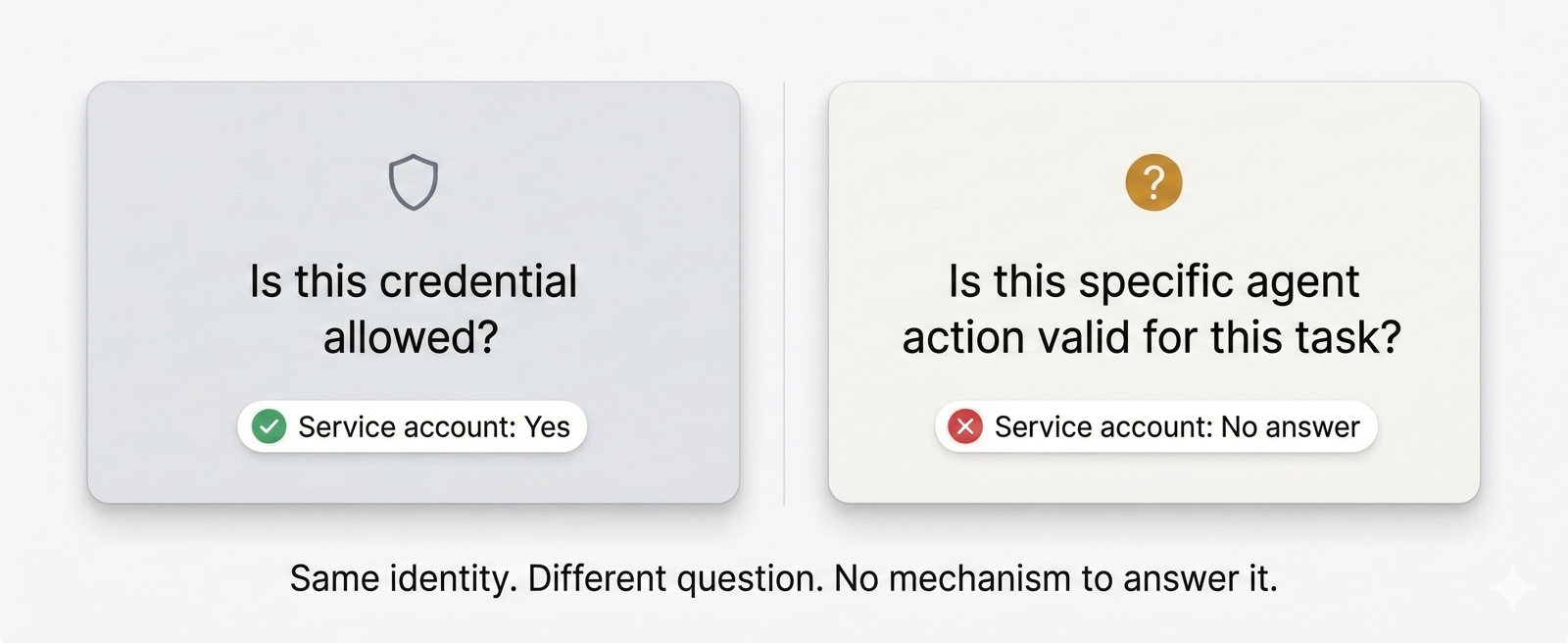
A service account can validate a credential. It cannot validate an action. That gap is where agent security breaks down.
Why the Industry Is Building New Systems, Not Extensions
Role-Based Access Control (RBAC) is useful when roles map to stable human responsibilities. A finance analyst has a role. A support engineer has a role. A developer has a role. These people still apply judgment when deciding how to use access. AI agents do not have that same judgment. They need technical boundaries that are enforced at runtime. OAuth also has limits in agentic workflows. OAuth is strong for delegated access in many human-centered applications, but autonomous agents may continue working after the original user interaction ends. They may call several tools, run multi-step workflows, or act later in a process.
That creates a gap between session-based authorization and autonomous execution. The Cloud Security Alliance's 2025 work on Agentic AI IAM argues that agentic systems need identity and access models that account for autonomy, ephemerality, and delegation in multi-agent environments. This does not mean existing IAM should be removed. It means existing IAM needs an execution-time control layer for agents.
That layer should evaluate every tool call, narrow credentials for the task, and produce audit records that security teams can actually investigate.
The change is already visible in standards and security discussions. In February 2026, the National Institute of Standards and Technology (NIST) announced its AI Agent Standards Initiative to support secure, interoperable AI agents that can function on behalf of users across digital systems. That is important because it shows that agent identity is no longer only an application design issue. It is becoming an issue of infrastructure and governance. NIST's National Cybersecurity Center of Excellence (NCCoE) also launched work on software and AI agent identity and authorization, focusing on practical guidance for applying identity standards and best practices to AI agents.
For IAM architects and security engineers, the direction is clear. AI agent IAM needs to answer questions that traditional identity models were not built to answer:
- Which agent is acting?
- Which user, workflow, or system initiated the task?
- What tool is being called?
- What parameters are being used?
- Is the action allowed under policy?
- Which credential is used for this exact call?
- Can the full execution path be audited later?
These are runtime questions. That is why runtime enforcement becomes central to AI agent identity.
What a Purpose-Built Agent Identity System Needs
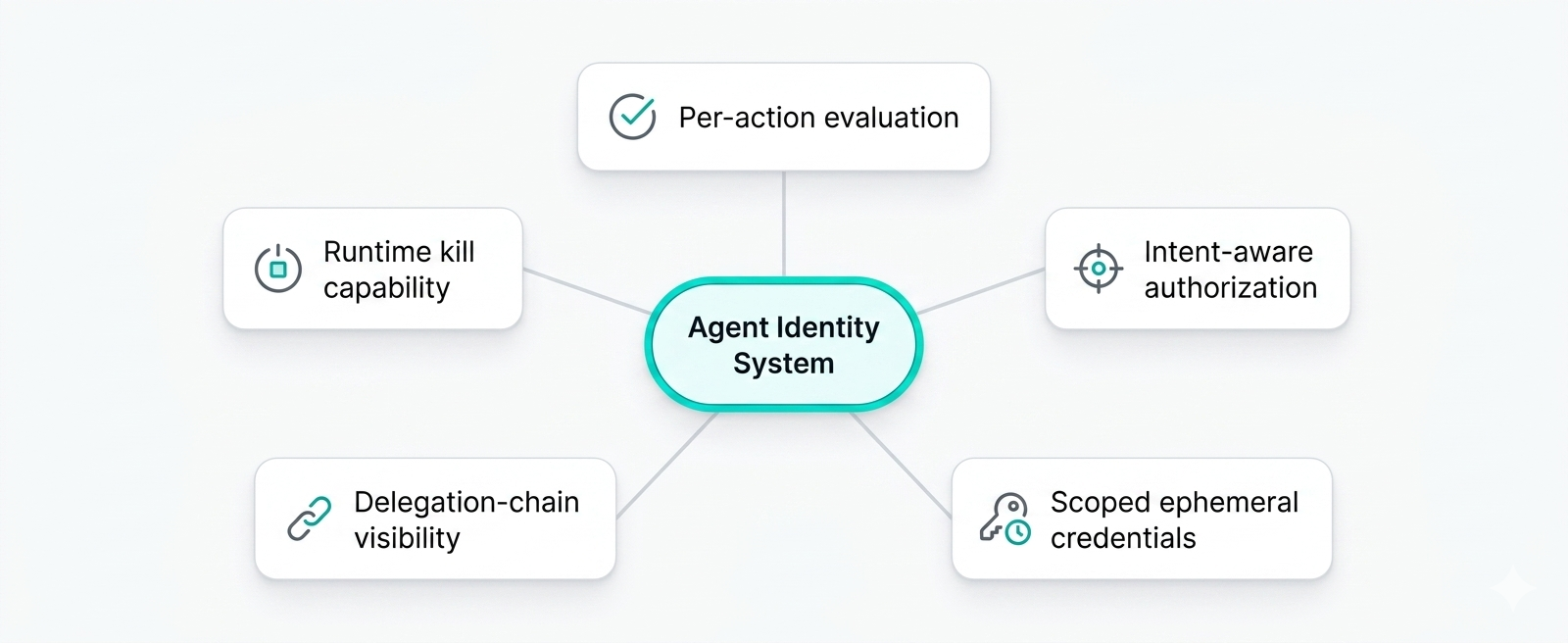
A secure AI agent identity system should not only assign an identity to the agent. It must control what the agent can do at the moment of execution. That requires five capabilities: per-action evaluation, where every agent-to-tool action is evaluated independently rather than relying on session-wide or role-level grants; intent-aware authorization, where the same tool can be safe or unsafe depending on the purpose behind the action; scoped ephemeral credentials, where agents do not hold standing privileges but instead receive credentials derived only for the approved tool action within the policy boundary; delegation-chain visibility, where security teams can see the full path from user to agent to tool with a complete audit record; and runtime kill capability, where infrastructure controls allow teams to quickly stop execution, block a tool path, or revoke access without a code rewrite.
A purpose-built agent identity system requires all five capabilities working together — not as isolated controls, but as a continuous enforcement layer at execution time.
How AgntID Addresses the Third Identity Category
AgntID is built around a clear idea: AI agent access should be enforced at execution time, not only configured in advance. AgntID enforces scoped, ephemeral access for AI agents without replacing existing tools, MCP servers, or identity platforms. It is built for infrastructure teams and designed to be developer-light.
This positioning matters. AgntID does not ask teams to redesign every agent. It adds a runtime control layer between agents and tools. Each tool invocation follows a controlled flow: apply policy-driven guardrails, evaluate task intent and parameters, derive scoped credentials, execute the tool with derived access only, and log full execution context.
Every tool call follows the same five-step enforcement flow — automatically, without requiring changes to agent code or existing infrastructure.
This flow runs for every tool call. AgntID's product page describes this as execution-time enforcement with no session-wide permissions, no standing privileges, and no blanket agent access. That is the practical difference between static IAM and runtime access control.
FAQ
If AI agents are a third identity category, do I need to rip out my existing IAM infrastructure?
No. The better approach is to extend existing IAM with runtime enforcement. AgntID is designed to work with existing identity platforms, tools, and MCP servers rather than replacing them.
How is an AI agent identity different from a bot or Robotic Process Automation identity?
A bot or RPA workflow usually follows a fixed process. An AI agent can reason, select tools, change execution paths, and act autonomously. That makes its access footprint dynamic.
At what point does an AI agent need its own identity? Only in production, or earlier in development?
As soon as it can access tools, APIs, data, or production systems. Waiting until production can create hidden service accounts, broad permissions, and weak audit trails.