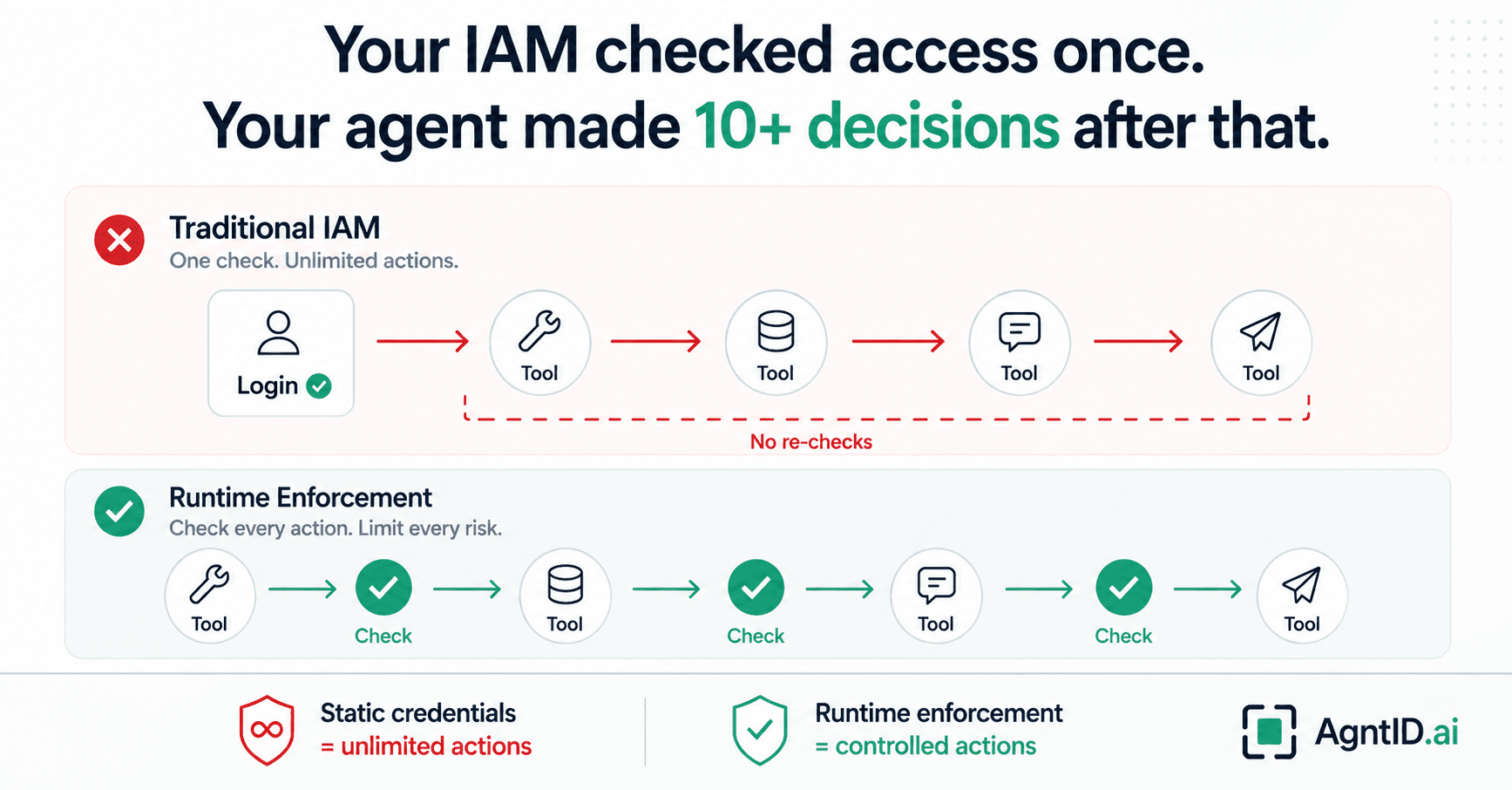
Configuration-time access control assumes permissions can be decided in advance. AI agents break that assumption every time they choose a tool at runtime.
The Configuration-Time Assumption That No Longer Holds
An agent updates a support case in Salesforce. Then it checks payment state in Stripe. Then it drafts a response in Intercom.
All with the same credential. No re-check.
Traditional IAM systems were designed for predictable contexts. During provisioning, permissions were granted, and systems operated within the set boundaries. That paradigm assumed behavior could be predicted in advance. Modern AI adoption trends show how quickly this assumption is becoming outdated. According to the World Economic Forum, over 80% of organizations are expected to adopt AI agents within the next three years, yet governance and control mechanisms remain in the early stages of maturity.
AI agents prove the configuration-time assumption wrong. They dynamically select tools, change behavior according to the situation, and execute actions autonomously. Consider a customer support agent asked to resolve a billing discrepancy. It queries the CRM to pull the account, calls the billing API to check the transaction, reads from a Stripe webhook log to trace the payment, and drafts a response in Intercom. These are four tool calls across four systems, all completed within seconds.
Each call uses the same credentials provisioned at session start. Nothing in that chain re-evaluates whether querying Stripe is appropriate for this specific task or whether the agent's reasoning remains aligned with the user's original request.
IAM checks access once. Agents act many times after that.
The World Economic Forum says that agentic AI systems are capable of reasoning and executing multi-step processes with minimal human oversight, which increases both their abilities and their risks. Empirical data reinforce this change. The 2025 AI Agent Index, analyzing 30 real-world agent systems, found that only 50% of agents referenced any formal safety framework, and fewer than 20% provided measurable evaluation results. This lack of transparency highlights how rapidly agent capabilities are evolving compared to the controls governing them.
Infrastructure, on the other hand, is not keeping up. The Teleport 2026 report says that 67% of companies still use static credentials for AI systems, meaning many agents have access at all times. The result is a structural mismatch where static authorization fails to account for dynamic execution. Access control at configuration time gives permissions only once — roles, API keys, and scopes — and assumes those permissions stay valid for all future operations. From a security perspective, assessments from the U.S. Cybersecurity and Infrastructure Security Agency (CISA) show that valid credentials are involved in 41% of successful attacks in real-world environments, making them one of the most consistently exploited attack vectors. When applied to AI agents, this risk increases because agents can continuously reuse those credentials across different automated actions.
Three Ways Configuration-Time Control Fails at the Tool Call
Conventional IAM approaches worked because workflows were predictable, actions were predefined, and humans acted as a control layer. AI agents break all three assumptions. The failures below occur during the tool call because the system lacks a mechanism to evaluate each action as a separate decision point in real time.
1. Least Privilege at Provisioning Is Mathematically Impossible for Non-Deterministic Systems
Least privilege assumes you can define required access in advance. For AI agents, that is rarely possible. To ensure agents can complete tasks, organizations grant permissions covering all potential actions. This creates a union of privileges that is always broader than necessary for any single operation. The result is that every action executes with excessive permissions, and there is no distinction between safe and risky operations.
From a systems perspective, this creates what can be described as "privilege inflation." Because agents must be able to handle unknown future paths, permissions are over-provisioned by design. NIST explicitly defines least privilege as access limited to what is required for a specific request, not a projected set of future actions, which makes static least privilege incompatible with non-deterministic execution.
2. Credentials Persist Long After Their Purpose Expires
Static credentials create long-term risk. API keys, service tokens, and service accounts do not expire when tasks end. They remain active, sometimes forever. Machine identities are a growing attack vector. Half of all businesses that have experienced breaches say the breaches were caused by compromised machine IDs. This creates systemic risk: by decoupling authorization from intent, configuration-time models allow access to outlast its original purpose, enabling valid credentials to be reused in unintended contexts.
For AI agents, a credential used for one action can later enable unintended or destructive actions. The blast radius expands across all accessible systems. Industry analyses show that machine credentials often remain active for months or years, far exceeding the lifespan of the task they were created for.
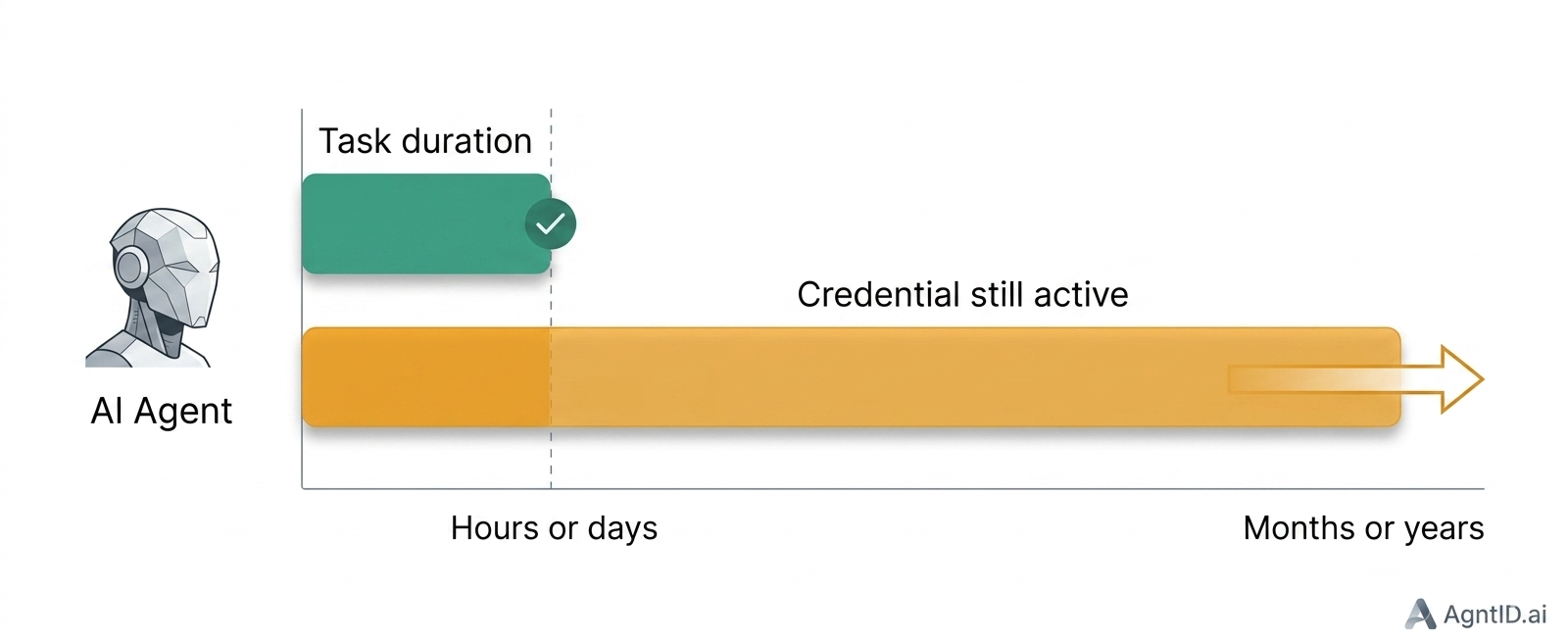
The task ends. The credential does not. That gap is the attack surface.
3. Intent Cannot Be Verified Without Execution-Time Context
Provisioning systems evaluate identity and scope, but not intent. This becomes an important gap in agent systems. Two actions can appear identical from an IAM perspective while having completely different implications. Without runtime context, tasks, parameters, and prior steps cannot be distinguished.
Research shows that AI agents often operate with broad, persistent access across systems, increasing the likelihood of unintended or harmful actions when misused or manipulated. The same gap is formally recognized in modern application security guidance. The OWASP Top 10 for Agentic Applications (2025) identifies "Tool Misuse" and "Excessive Agency" as major risks, highlighting the inability to validate intent at execution time as a primary cause of unsafe or unintended behavior.
Session-Level Scoping Is Not Fine-Grained Enough
Session-based access improves on static credentials but still falls short of the required granularity. A session token can limit duration, but not action-level scope. An agent with a valid session can still perform any operation within that session boundary. That is insufficient for systems where actions are dynamically composed.
Non-human identities often operate with static credentials, excessive privileges, and limited monitoring, making them one of the most exploited attack surfaces in modern infrastructure. While session-based models reduce exposure duration, they do not align with the granularity required by agent systems. Authorization must operate at the level of individual actions, not only at session boundaries.
From this point, the limitation becomes clear: session-based models reduce the access window, but they do not restrict what can be done inside that window. In environments where AI agents dynamically compose actions and interact with multiple systems, this level of control is still too coarse. Authorization must move to the execution level, where risk actually appears.
What Execution-Time Enforcement Actually Requires
Execution-time enforcement shifts authorization from provisioning to action. Instead of asking "What can this agent do?", the system asks "Is this action allowed right now?" This approach requires three real-time evaluations: policy compliance, alignment with intent, and minimum required privilege. It also introduces an important architectural principle: zero standing privileges. Credentials are generated per action, scoped to that action, and revoked immediately after execution.
Architecturally, this aligns with the policy decision point and policy enforcement point model defined by NIST. The policy engine evaluates the request, the policy administrator generates temporary credentials, and the enforcement point applies the decision at execution time. In AI systems, each tool call becomes a policy enforcement point, transforming access control into a real-time decision layer embedded directly in the execution flow.
In practice, implementing this model requires integration with existing identity providers, policy engines, and service meshes. Enforcement must occur inline without breaking latency expectations. This changes access control from an external IAM concern into a core component of application and infrastructure design.
The gap between theory and practice is significant. It is estimated that only 1% of organizations have fully implemented just-in-time privileged access, even as machine and AI identities rapidly increase. The data shows the same basic pattern: credentials last far longer than they should, privileges are consistently broader than necessary, intent is never evaluated at the time of action, and infrastructure remains anchored in static authorization models.
All of this comes from the same design flaw: authorization decisions are made at configuration time, while risk materializes at execution time.
How AgntID Enforces Access at Execution Time
The distinction between regular IAM and runtime enforcement is structural, not incremental.
Traditional IAM relies on static roles and set-once provisioning. Runtime enforcement enabled by AgntID shifts the trust model to continuous, context-aware verification for every individual tool call.
AgntID changes access control from configuration-time permissioning to execution-time enforcement. Instead of relying on pre-assigned permissions that stay the same for all actions, AgntID dynamically evaluates access at the moment each action occurs. Policy is applied in real time, authorization is based on context, and credentials are limited to the specific operation being performed. AgntID validates every action before it reaches downstream systems.
FAQ
Is this the same as just-in-time access for privileged users?
No. Just-in-time access applies at the session level. Runtime access control applies to each individual action.
Does execution-time enforcement add latency to every tool call?
Overhead is minimal, but modern architectures are optimized for real-time policy evaluation.
How does this apply to multi-agent systems where one agent calls another?
Each agent interaction becomes a new trust boundary, requiring independent runtime evaluation.