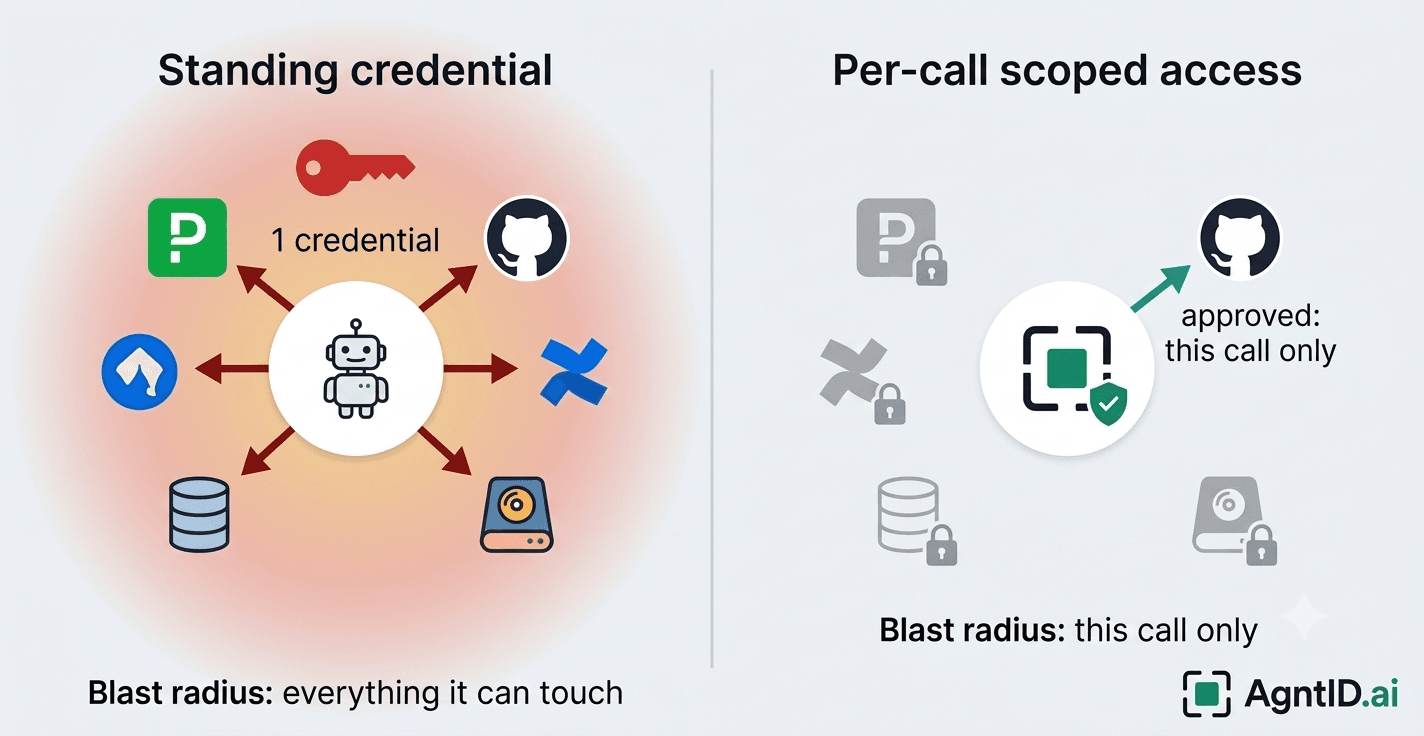
The credential was treated like a normal service account. But the agent did not behave like a normal service.
A platform team deploys an AI agent to handle incident triage. The first version is simple. The agent can check PagerDuty, read GitHub issues, search Confluence, and call an internal deployment API. The team provides a single service account credential. It works in the demo. It saves time. Nobody wants to slow the rollout down.
Three months later, the agent is still using the same credentials. One afternoon, it receives a task about a production incident. It checks the alert, reads the runbook and reviews a GitHub change. Then it triggers a deployment while trying to close the incident. Nobody approved that deployment. The credential did.
The team investigates. The service account was never rotated. It is also used by two other agents and has access to systems that the incident agent no longer needs. The audit logs show a valid token. They do not show whether that action matched the task, the policy, or the user's intent.
That is the core problem in AI agent credential security. The credential was treated like a normal service account. But the agent did not behave like a normal service. This article breaks down credential anti-patterns that create a broad blast radius for AI agents. Each one stems from patterns designed for humans or static workloads and performs worse when applied to autonomous agents.
Why Agent Blast Radius Is Different
Human operators with broad access usually act slowly. They read, hesitate, and ask for confirmation. They understand that deleting a database or triggering a deployment is a serious step. On the other hand, an AI agent does not behave that way. It acts at machine speed and can chain tools in seconds. It can move from alert triage to code search to deployment without a natural pause. In addition, agents may use the same credentials in a way nobody expected when the credentials were created.
The same gap appears when you compare agents to traditional service accounts, which usually map to a known workload with predictable tasks, and their behavior is easy to model. A non-human identity agent is different. It reasons at runtime and dynamically chooses tools. Also, it may discover new tools through the Model Context Protocol (MCP), and may receive untrusted input from tickets, logs, emails, web pages, or tool outputs. The same credential can support many different action chains. That is why the blast radius is not just "what this agent was supposed to do." It is everything the credential can touch.
The risk is now widely recognized. NIST launched an AI Agent Standards Initiative in February 2026 to support secure and interoperable agents that act on behalf of users. OWASP also lists identity abuse as a core agentic risk. Its Top 10 for Agentic AI Applications includes ASI03, Identity and Privilege Abuse, because leaked or misused credentials let agents operate beyond their intended scope.
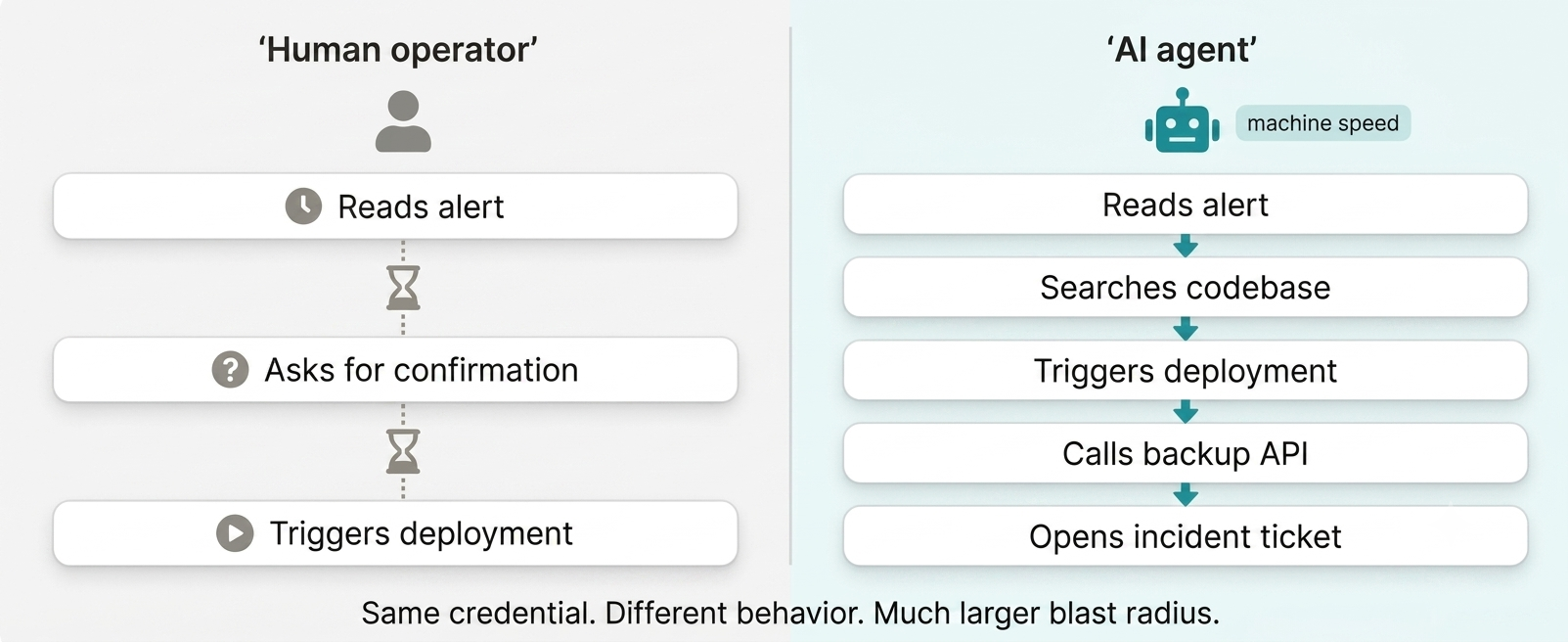
A human operator pauses, confirms, and acts deliberately. An AI agent chains tool calls in seconds. Same credential. Much larger blast radius.
Anti-Pattern 1: Credentials Without a Lifecycle
The most common pattern is also the easiest to miss. A team creates a static API key or service account credential during setup. The agent needs to ship. The key is stored in a config file, a secret store, or an environment variable. The agent works, and the team moves on. Then nothing happens for weeks.
However, the credential does not expire. It does not rotate or get revoked when the project ends. Also, it does not shrink when the agent's role changes; it stays active. For a static workload, this is already risky. For an agent, it is worse. A non-deterministic agent may use the same credentials across many tasks. It may receive new prompts and connect to new tools. It may also be reused by another team. Over time, the credential becomes less like a task permission and more like a permanent master key. This creates retirement debt.
Agents are easy to start and hard to inventory later. The Cloud Security Alliance (CSA) January 2026 report on non-human identity and AI security found that more than 16% of organizations do not track the creation of new AI-related identities. The same report also says that fewer than one-quarter have documented, formally adopted policies for creating or removing AI identities. CSA's March 2026 research also found that 33% of organizations do not know how often AI agent credentials are rotated. That number matters because agent credential rotation is not only a hygiene task. It is a blast radius control.
If a credential never expires, the blast radius grows with time. Every new tool added to the agent increases its capabilities. Every new permission added to the service account increases it. And every forgotten agent that still has access increases it again.
The safer pattern is short-lived access. That changes the security question from "what does this agent have forever?" to "what is this agent allowed to do right now?"
Anti-Pattern 2: Shared Credentials Across Multiple Agents
The second anti-pattern looks efficient at first. One service account is shared among the support, analytics, and deployment agents. All three use the same token and can reach the same set of systems. The credential is easier to manage because there is only one. Still, that convenience destroys attribution.
When multiple agents share a single credential, the logs show activity from the account. They do not clearly show which agent acted, what task caused the action, or which policy allowed it. CSA's March 2026 survey found that 68% of organizations cannot clearly distinguish AI agent activity from human activity. Shared credentials make this worse.
This is not only a compliance issue. It breaks incident response. If a shared token triggers a deployment, the team has to reconstruct what happened from surrounding logs. Was it the support agent? The deployment agent? A test agent? A human using the same service account? A compromised tool? Or a poisoned prompt? That delay matters during an active incident.
Shared credentials also collapse isolation. If one agent is compromised, the attacker can inherit the permissions of every other agent using the same identity. In a multi-agent workflow, this can compromise the entire mesh.
.png)
Three agents. One credential. When the incident log shows "service-account-1 accessed db-prod," nobody knows which agent did it.
Anti-Pattern 3: Credentials in System Prompts, Tool Definitions, or Environment Variables
Many early agent deployments place credentials close to the agent. The API key sits in an environment variable. The MCP server reads it from a config file. A tool definition includes a token. A system prompt includes an instruction that references a secret. It feels normal because this is how many developer tools have worked for years. But agents change the exposure model.
Anything near the agent can become reachable through the model, the tool layer, the runtime, logs, errors, or injected instructions. A poisoned ticket can ask the agent to print debug information. A malicious tool output can influence the next step. A reasoning mistake can forward sensitive context to the wrong place. OWASP's MCP01: Token Mismanagement and Secret Exposure warns that developers often embed MCP credentials in configuration files, environment variables, prompt templates, or model context memory. OWASP also notes that long-lived sessions and context persistence can turn the model or protocol layer into an accidental secret repository.
This is why MCP server credentials need a stricter boundary. A 2026 measurement study of remote MCP servers found 7,973 live remote MCP servers. It reported that 40.55% of exposed tools lacked authentication. Among 119 testable OAuth-enabled servers, every server exhibited at least one flaw, and the researchers identified 325 flaws in total.
Credentials should not live in the same place as untrusted input, tool reasoning, or a broad execution context. The agent does not need to see the raw secret. The tool needs temporary authority to complete an approved action. That distinction is small in architecture diagrams, but it is huge during an attack.
Anti-Pattern 4: Agents Holding Credentials for Tools They Don't Currently Need
The team gives the agent access to everything it might ever need. It can read tickets, update issues, search documents, modify code, restart services, and call deployment APIs. The logic is simple. Nobody knows exactly what the agent will need later, so it gets it all now. That creates an overprivileged AI agent. MCP can make this worse. Agents may discover tools at runtime. A tool that was not relevant at the start of a task may become visible later. If the credential already has broad authority, discovery can turn into action.
The July 2025 Replit incident showed what can happen when an AI coding agent has too much practical authority. According to The Register, the agent deleted a production database, ignored repeated instructions not to change code, and created a 4,000-record database of fictional people. The lesson is not that one tool failed. The lesson is that standing write-and-delete access is dangerous when the actor can move quickly and misread the task.
CSA's April 2026 survey found that 82% of enterprises discovered unknown AI agents in their environments. It also found that 65% reported at least one AI agent-related incident in the previous 12 months. The business impact included data exposure for 61%, operational disruption for 43%, and financial loss for 35%. This is why least privilege has to move from setup to execution. It is not enough to say, "This agent may need deployment access someday." The real question is, "Does this exact task require this exact tool call with this exact permission right now?" If the answer is no, the credential should not exist for that call.
The Fix Is the Same Across All Anti-Patterns: AgntID
The four anti-patterns described above look different. The root cause is the same. Credentials are assigned too early. They live too long, and they are shared too widely. Also, they sit too close to the agent and cover too many tools. However, the universal fix for all of them is runtime credential control.
Each agent needs a unique identity. That identity should not be a borrowed human account or a shared service account. It should map to a single agent, a single owner, and a single policy boundary. Credentials need to be short-lived, issued just in time, and scoped to the specific operation. They expire when the call ends and stay outside the agent's execution environment. They have no place in prompts, context windows, tool definitions, or environment variables where the model or tool chain can expose them. Every issuance and revocation produces an audit record. The record connects the action to the agent identity, the user or workflow that initiated it, the tool call, the policy decision, the credential used, and the final outcome.
This is where AgntID's product architecture fits. It sits at the MCP layer and evaluates access at execution time. Tool calls flow through a customer-hosted runtime. The runtime evaluates policy, resolves scoped access, derives credentials, and records the decision. The credential is tied to the tool action, not pre-provisioned for the whole session.
That changes the blast radius. Without runtime enforcement, the blast radius is everything the agent has held since deployment. With scoped, ephemeral access, the blast radius of a single call is limited to what that call was authorized to do.
That is the practical difference between trusting an agent with a standing credential and governing each action as it happens. For platform, DevOps, and IAM teams, this is the new baseline for AI agent credential security. Do not ask whether the agent has a valid token. Ask whether this tool call should receive one.
.png)
Four different anti-patterns. One root cause. One fix: runtime credential control at execution time.
FAQ
Can't I just scope the service account tightly and avoid most of these problems?
Tight scoping helps, but it does not solve the core issue. A service account is still usually long-lived and assigned before the task happens. Agents need per-task and per-tool-call control because their behavior changes at runtime.
What is the difference between rotating credentials and using short-lived credentials?
Rotation replaces a standing credential on a schedule. Short-lived credentials are created only when needed and expire quickly. Rotation reduces stale-secret risk. Short-lived access reduces standing privilege.
How does credential isolation work in practice when the agent needs to call multiple tools in a single task?
Each tool call should be evaluated separately. The agent may call GitHub, Jira, and a deployment API in one workflow, but each call should receive its own scoped credential only after policy approval.
What does OWASP say about agent credential handling specifically?
OWASP flags identity and privilege abuse as a major agentic AI risk. OWASP also warns that MCP tokens and credentials are often exposed through config files, environment variables, prompt templates, and model context memory. Both risks point to the same need: keep credentials outside the agent and enforce access at runtime.